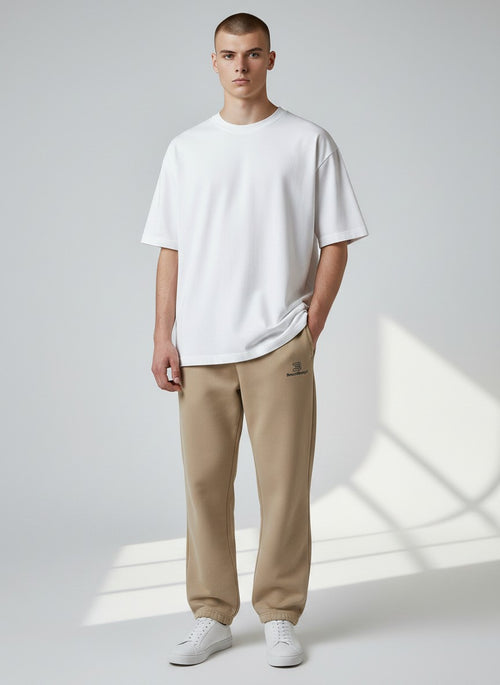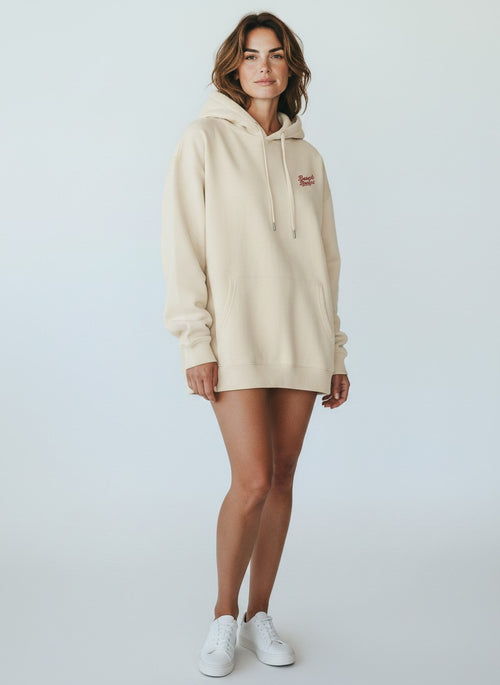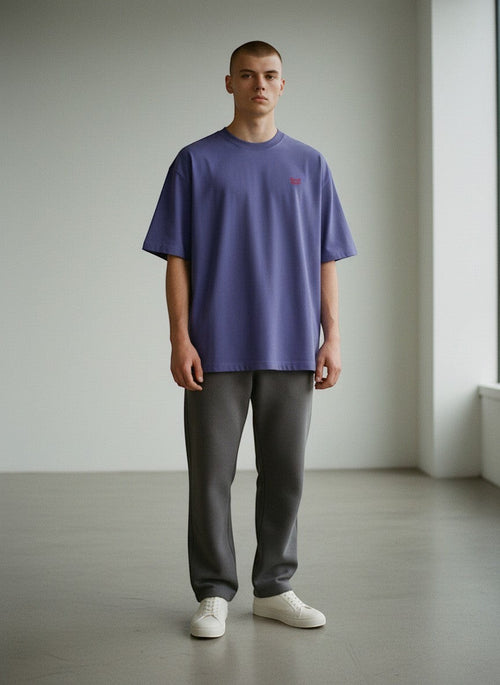
A sweatshirt rarely loses its shape due to a single mistake. Usually, several things come together: a wash cycle that is too hot or a spin cycle that is too fast, wet drying on a hanger, the weight of the fabric on a few points, and a garment that is too light for its cut. To prevent stretching, you should therefore take action in two places: in the care after each wear and in the fabric itself. Heavy, dense sweatshirt material with clean finishing maintains the shoulder line, hem, and cuffs over many washes. This is exactly what Beachbodyz focuses on with heavyweight sweatshirts made from organic cotton and embroidered in Germany. The following overview shows what matters when washing, drying, and storing, how to recognize form-stable garments, and how a stretched-out piece can often still be saved.
Key insights
- Water relaxes the yarns that were stretched during manufacturing. Heat, movement, and high spin speeds amplify this effect.
- Wet sweatshirts should be laid flat, not on a hanger or thin clothesline. Otherwise, the weight of the wet fabric pulls the shoulders and hem out of shape.
- Folding it in a shelf preserves its shape best. If you want to hang it, drape the garment over the hanger bar instead of hanging it by the shoulders.
- Dense, heavy sweatshirt fabric and well-finished ribbed cuffs are the most effective prevention, even before any care routine.
- A slightly stretched sweatshirt can often be gently pulled back into shape lengthwise and widthwise while it is still damp.
Table of contents
- Why sweatshirts lose their shape
- Shape retention starts with the fabric
- Washing sweatshirts gently
- Reading care symbols correctly
- Drying gently
- Storing correctly
- Saving a stretched sweatshirt
- Shape-retaining sweatshirts from Beachbodyz
- Frequently asked questions
- Sources
Why sweatshirts lose their shape
Sweatshirt fabric is a knit fabric. It is not made of cross-woven threads, but of interlocking loops. These loops react more strongly to water, movement, and drying than woven fabric does. That is exactly what makes sweatshirt fabric soft and stretchy, and that is exactly why it requires a little extra care. The difference from lighter jersey is described in more detail in the post Jersey and sweatshirt fabric compared.
The physical background: Almost all fabrics are created under tension. During washing, water acts as a lubricant, the yarns relax, and they shrink back. This is how textile scientist Rebecca van Amber from RMIT University explains the topic of shrunk clothing in the Guardian.
In knit fabrics, the loops shift. If they pull together, the garment becomes shorter or narrower. If wet fabric is dried under tension, however, it sets in the stretched shape.An overview of the most common causes:
| Cause | What happens in the fabric | Typical result |
|---|---|---|
| Fiber swelling | Cotton absorbs water, knit loops slip out of position | Garment becomes shorter or wider |
| Uneven yarn tension | Tension in the yarn releases on one side | Side seams twist to the front or back |
| High spin speed | Fibers and loops are pressed tightly together | Fabric appears smaller and stiffer |
| Wet hanging drying | The weight of the water pulls downward | Elongated hem, puckering at the shoulders |
| Continuous stretching at the cuffs | Ribbing is stretched by wearing and pulling up | Baggy sleeve and hem cuffs |
| Fabric that is too light | Low density does not support the weight well, such as that of a hood | Garment sags downward |
Not every garment that looks smaller after washing has actually shrunk. When worn, the shoulders, elbows, and hem stretch. In the wash, these stretches relax again, and the sweatshirt returns to its original shape. This is not damage, but the normal behavior of knit fabric. Real stretching is shown by seams that run crooked, an uneven hem, or puckering at the shoulders.
Shape retention starts with the fabric
The best care cannot compensate for fabric that is too thin for its cut. Shape retention depends primarily on three characteristics.
Fabric weight and density
Fabric weight is given in grams per square meter, or GSM. The higher the value, the denser and heavier the fabric. Dense knit fabric has less room for loops to shift. It therefore holds the shoulder line and hem better than thin fabric. This is especially important for oversized cuts with low shoulders, because a lot of fabric hangs on a few points. Guidelines and classification are provided in the post GSM in Hoodies: Significance and Guidelines.

Cuffs and seams
Ribbed cuffs on the sleeves and hem are the areas that are stretched the most. Dense, well-knitted ribbing snaps back after being stretched. Clean, evenly tensioned seams prevent side seams from twisting after washing. Similar rules to those for waistbands apply to cuffs and elastic bands, summarized in Preventing elastic waistbands from stretching out.
Brushed or smooth inside
Sweatshirt fabric is available with a brushed, fluffy inside and as smooth loopback fabric. Both variants have their own care requirements, for example regarding temperature and friction. The differences are shown in the comparison Brushed vs. Unbrushed.
What information about material and workmanship is common for a high-quality sweatshirt is also shown in the product description of a Premium Hoodie for Geocaching Fans. When buying, the material composition, fabric weight, and care instructions should be clearly stated.
Washing sweatshirts gently
Washing is the moment when yarns relax. The goal is to keep this process as gentle as possible. The following steps apply to sweatshirts made from cotton and cotton blends. The care label of the respective garment always takes precedence.
- Check the care label. Temperature, wash cycle, and dryer approval are stated there. What the symbols mean is explained in the next section.
- Turn inside out. This way, the outside rubs less against the drum and other parts. It protects the surface, prints, and embroidery and reduces pilling.
- Close zippers and buttons. Open zippers catch in the loops and pull threads.
- Do not overload the drum. A drum that is too full twists wet garments together. For heavy sweatshirt fabrics, a half-full to three-quarters-full drum helps.
- Wash similar garments together. Washing heavy jeans or towels with sweatshirts increases friction and tension.
- Choose a moderate temperature. A lower temperature than the maximum allowed is usually sufficient for normally worn sweatshirts and puts less stress on the fibers.
- Reduce the spin speed. High spin speeds press fibers and loops tightly together. A medium spin speed leaves the fabric wetter, but in better shape, when it comes out of the machine.
- Remove immediately after the program ends. Wet laundry that lies crumpled in the drum dries with creases and distortion.
The same applies after a workout. Sweaty garments should not lie damp in the laundry basket for long, but should be washed promptly or at least spread out to air out. Specific tips for training clothes are in the post Gym Hoodie Before and After Training. If you also want to protect the color and surface, you will find tips on Faded Hoodies and on Pilling on Hoodies.
Reading care symbols correctly
The label says exactly what a garment can withstand. For shape retention, the symbols for the wash cycle and drying are especially relevant.
| Symbol | Meaning | Relevance for shape |
|---|---|---|
| Tub without bar | Normal wash cycle | Suitable for sturdy garments |
| Tub with one bar | Gentle cycle with reduced spin speed | Less tension and pressing in the fabric |
| Tub with two bars | Extra gentle treatment | For delicate knit fabrics |
| Square with circle and dots | Dryer allowed, dots indicate the level | Fewer dots, lower temperature |
| Crossed-out square with circle | Do not dry in the dryer | Air dry, preferably flat |
| Square with horizontal line | Dry flat | Against stretching due to its own weight |
The meaning of the dots and the crossed-out dryer symbol is explained in the care symbol overview from the Verbraucherzentrale. That the bar under the tub stands for reduced spin speed and the horizontal line in the square for flat drying of textiles that can stretch due to their own weight is described in an explanation of care label symbols at oe24.
If there is no flat-drying symbol on the label, flat drying still remains the gentlest option. The label indicates the limit, not the only option.
Drying gently
Drying has a greater impact on the fit than washing itself. Wet sweatshirt fabric is heavy and stretchy. It retains the shape in which it dries.
Drying flat
The most reliable method:
- Carefully shake out the sweatshirt after spinning, do not wring it.
- Spread it out on a towel, a flat laundry net, or a drying rack.
- Straighten the shoulders, side seams, and hem. Lay the sleeves parallel to the body.
- While it is still slightly damp, gently pull it lengthwise and widthwise until the original dimensions are reached.
- After a few hours, turn it over so that the underside also dries.
The Woolmark Company describes for knitwear that hanging drying due to the weight of the moisture pulls garments out of shape lengthwise and leaves puckering at the shoulders, and recommends flat drying. The same principle applies to heavy cotton sweatshirts, because they also have several times their dry weight when wet.
Clothesline and hangers
The thin bars of a clothesline support the entire weight of a wet sweatshirt on a narrow line. Pressure edges are created, and the threads can stretch. If you do not have a drying rack, drape the sweatshirt across several bars so that the weight is distributed. Hanging a wet sweatshirt on a clothes hanger is the most common cause of puckering at the shoulders. Wire hangers are particularly unsuitable.

Clothes dryer
If the dryer is allowed according to the label, the lowest setting and removing it early, while the fabric is still slightly damp, are recommended. Then let it finish drying flat. This keeps the fabric supple and allows it to be pulled into shape.
Storing correctly
Gravity also works in the closet. A heavy sweatshirt that hangs by the shoulders for weeks will slowly stretch out of shape there.
Folding as standard
Folded in a shelf or drawer, a sweatshirt remains most stable. Here is how:
- Lay the sweatshirt flat with the front facing down.
- Lay the sleeves diagonally across the back.
- Fold both sides toward the center to create a rectangle.
- Fold up once or twice from the bottom.
Heavy garments go at the bottom of the stack, lighter ones on top. A stack that is too high presses permanent creases into the lower garments.
Hanging without puckering at the shoulders
If you want to hang sweatshirts, use the hanger-folding method:
- Fold the sweatshirt lengthwise in the middle, with the sleeves lying on top of each other.
- Place the hanger hook in the armpit so that the hanger is between the body and the sleeves.
- Drape the body over one side of the hanger.
- Drape the sleeves over the other side.
The weight thus rests on the hanger bar instead of on the shoulders. Wide, padded, or wooden hangers distribute the pressure even further. Thin wire hangers are unsuitable.
Protecting the cuffs
Ribbed cuffs stretch out especially when worn: by pulling the sleeves up over the elbows or pulling at the hem. It is better to roll the sleeves up loosely. In the closet, cuffs should not be squeezed or stretched out.
Saving a stretched sweatshirt
A slightly misshapen garment is often not lost. The method depends on the type of distortion.
| Problem | Action |
|---|---|
| Too short or too narrow after washing | Dampen slightly, gently stretch in length and width, dry flat |
| Hem or body too long | Wash lukewarm, do not iron, dry flat and compactly aligned |
| Bumps at the shoulders | Dampen or steam the shoulder area, press flat with hands, dry flat |
| Side seams twisted | Lay flat damp, pull seams straight to the sides, let dry this way |
| Stretched-out cuffs | Dampen briefly, push together, dry flat; with severe stretching usually only partially repairable |
A simple test shows whether the fit can be restored: lightly dampen the affected area with steam from the iron without placing the sole on the fabric. If the fabric can then be pushed into the desired shape, rewashing followed by shape-drying helps. This usually works better with tightly knitted heavyweight fabric than with very lightweight material, because the stitches have less room to move.
Shape-Retaining Sweatshirts by Beachbodyz
Care extends the lifespan, the fabric lays the foundation. Beachbodyz makes sweatshirts and hoodies from organic cotton, in a heavyweight style and with a focus on long-lasting quality. Embroidery is done in Germany, shipping within Germany is free. Many cuts are available in an oversized style.

- Sweatshirts: €71
- Hoodies: €66 to €78
- Joggers: €59
Matching combinations for wide cuts are shown in the post on Layering with Oversized Hoodies.
Frequently Asked Questions
Can a sweatshirt be ironed while damp?
Better not. Wet sweatshirt fabric is heavy, the weight pulls at the shoulders and stretches the body and hem lengthwise. Drying flat on a towel or drying rack holds the shape significantly better. Only dry garments can be hung up using the ironing-folding method.
Why do the side seams twist after washing?
Uneven tension in the yarn loosens during washing and pulls the seams diagonally. Laying the sweatshirt flat while damp and pulling the seams straight to the sides helps reduce the distortion. Tightly knitted fabric with even processing is less prone to this.
Is the dryer taboo for sweatshirts?
Only if the label shows a crossed-out dryer symbol. If the dryer is allowed, the lowest setting and taking it out while slightly damp are recommended. Then let it finish drying flat.
How do the cuffs stay elastic?
Do not push sleeves past the elbow, but loosely roll them up, and do not pull at the hem. After washing, push the cuffs into shape and dry flat. A dense, well-finished ribbing snaps back more reliably after stretching.
Does a heavy fabric really help prevent distortion?
Yes, dense sweatshirt fabric with a higher fabric weight gives the stitches less room to shift. The shoulder line and hem remain more stable as a result, especially with oversized cuts. Combined with gentle washing and flat drying, this is the most effective prevention.
Sources
- The Guardian: Back from the shrink, how to rescue clothes that have shrunk in the wash
- Verbraucherzentrale: Care symbols
- oe24: Meaning of the symbols on the care label
- Woolmark: How to dry a wool sweater