Ring spinning produces a softer but hairier yarn with high tensile strength. Open-end yarn is smoother, cheaper to produce, and generally has lower tear resistance. Choosing between ring-spun and open-end therefore means deciding between hand-feel quality and production costs. Compact spinning falls somewhere in between: less hairiness with a strength similar to that of ring-spun yarn.
In a nutshell:
- Ring-spun yarn is more tear-resistant and has a softer feel, while open-end yarns are cheaper and allow for higher production speeds.
- Compact yarn offers a good balance between hairiness, strength, and production costs, but contains fewer protruding fibers than traditional ring-spun yarn.
- Rotor yarns exhibit less hairiness, show less pilling, and are better suited for recycled fibers and high-volume production.
- Yarn quality can be objectively assessed and compared using metrics such as the CV% value, IPI, and hairiness index.
- The choice of yarn depends on the end product: ring-spun yarn is the better choice for softer, skin-friendly textiles, whereas open-end yarns are better for durable, cost-efficient products.
Table of Contents
- What is ring spinning? The technical foundation of the process
- What is open-end or rotor spinning?
- Ring spinning or open-end: A direct comparison
- CV%, IPI, and hairiness: How to read a yarn test report
- Which yarn is suitable for which garment?
- Recycled fibers and industry trends in spinning
- Why material selection at Beachbodyz is no coincidence
- Your next yarn choice: sustainable and durable with Beachbodyz
- Sources
- FAQ
What is ring spinning? The technical foundation of the process
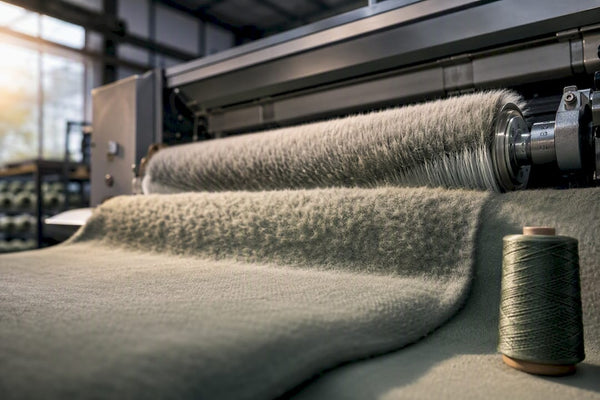
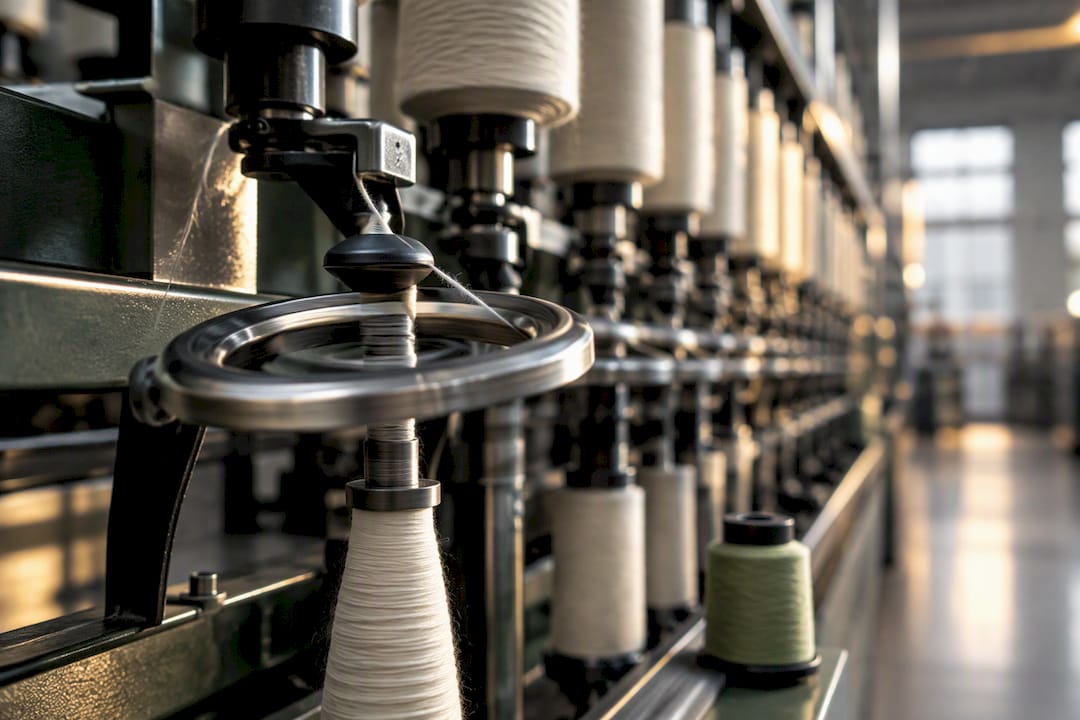
Ring spinning is the older and more elaborate of the two methods. The process runs in several steps: carding first creates a loose fiber sliver, which is then drawn into a roving. Only after this is the actual ring spinning machine used, in which a traveler rotates on a ring and gives the yarn its final twist.
It is precisely here that the so-called spinning triangle is formed, the point where the fibers from the roving converge and are twisted. Edge fibers are not fully integrated and stand out from the finished yarn as tiny hairs. This explains the higher hairiness of ring-spun yarn compared to rotor yarn.
However, these protruding fibers are also the reason for the soft, warm feel that many buyers appreciate in ring-spun yarn. Three metrics are decisive for evaluating yarn quality:
- Tensile strength: How much force the yarn can withstand before breaking.
- Hairiness index (H-value): Number and length of protruding fibers per unit of yarn length.
- CV% value: The uniformity of the yarn diameter along the fiber length.
According to comparative data from the European Scientific Journal, ring-spun yarns achieve a significantly higher tensile strength than comparable rotor yarns. The reason lies in the tighter, more uniform fiber bond produced by the ring spinning process. This additional strength, however, comes at a cost of time: ring spinning machines run at significantly lower delivery speeds than rotor spinning machines.
What is open-end or rotor spinning?
In rotor spinning, often called open-end spinning, the roving stage is omitted entirely. Individual fibers are opened and fed directly into a rotating drum, where they are joined into a new yarn. This elimination of an entire production stage is the main reason for the process's higher productivity.
Because the fibers are distributed more uniformly in the rotor and joined without the classic spinning triangle, a smoother yarn with less hairiness is created. Technical comparisons of surface characteristics confirm this: rotor yarns exhibit a significantly smoother, sometimes firmer feel, while ring-spun yarn remains softer but with a more uneven surface.
Rotor spinning machines also process raw material that would be unsuitable for ring spinning machines. Rieter describes its rotor spinning systems, such as the R 70, as being particularly robust when processing inexpensive or contaminated fibers. This makes the process interesting for:
- Yarns with a high proportion of recycled fibers or short fiber material.
- Products where production costs are more important than maximum softness.
- Applications with large quantities and tight timelines.
Another point: studies show that rotor yarn tends to have better uniformity than classic ring-spun yarn, which translates directly into the fabric's appearance. Where ring-spun yarn exhibits fine irregularities in yarn thickness, rotor yarn often runs more smoothly through the knitting machine.
Ring spinning or open-end: A direct comparison
The choice between ring-spun and open-end yarn depends on your priority: hand-feel quality, durability, or cost. A comparative study using Ne-22 yarns provides concrete indications across three spinning processes.
Core statistical finding: The study shows that compact yarn usually achieves the best combination of strength and uniformity. Rotor yarn often ranks ahead of ring-spun yarn in terms of uniformity, while ring-spun yarn consistently exhibits the highest hairiness.
The individual dimensions in detail:
- Softness/Haptics: Ring-spun yarn feels warmer and softer because protruding fibers create a fluffy layer. Rotor yarn appears cooler and smoother against the skin.
- Hairiness/Pilling: Ring-spun yarn is more prone to pilling because loose fiber ends tangle over time. Rotor yarn shows significantly less wear in this regard.
- Tensile strength/Durability: Ring-spun and especially compact yarn are more tear-resistant. Rotor yarn usually ranks lower with the same yarn count.
- Uniformity: Rotor yarn scores with lower CV% values, meaning fewer fluctuations in yarn thickness.
- Productivity/Costs: Rotor spinning runs at many times the delivery speed compared to ring spinning and requires fewer process steps, which lowers unit costs.
Compact spinning, an advancement of classic ring spinning, additionally densifies the fiber structure before twisting. This noticeably reduces hairiness without losing the high tensile strength of ring-spun yarn. For buyers who want both, it is often the compromise between ring-spun and open-end.
CV%, IPI, and hairiness: How to read a yarn test report
If you want to compare yarn quality objectively, there is no way around the measured values from the Uster tester. This testing system is the industry standard used by spinning mills worldwide to document and communicate their yarn quality.
Three key figures are central to this:
- CVm%: The coefficient of variation of the yarn mass. The lower the value, the more uniform the yarn thickness along its length.
- IPI (Imperfections per 1,000 m): Counts thin places, thick places, and neps per 1,000 meters of yarn.
- H-value (Hairiness): Measures the number and length of protruding fibers.
Concrete interpretation for practice: A high IPI value means more visible defects in the finished fabric, such as thin areas that absorb dye unevenly. A high H-value signals an increased risk of pilling and a rougher fabric feel after several washes.
Spinning mills use these three values to specify yarn batches exactly, rather than just stating "ring-spun" or "open-end." Two yarns of the same count (Ne) can yield completely different fabric appearances if they have different CVm% or H-values.
Pro tip: For larger orders, actively ask for the Uster test report of the respective yarn batch. Only compare values that were gathered using the same yarn count and the same test standard, otherwise the numbers will be distorted.
Which yarn is suitable for which garment?
The right choice depends on the end product, not on a blanket preference. Manufacturers like Cotonea select the spinning method specifically according to the intended fabric surface.
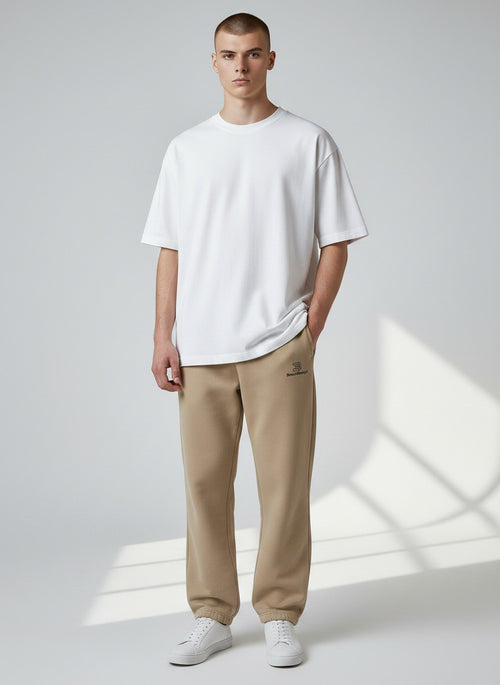
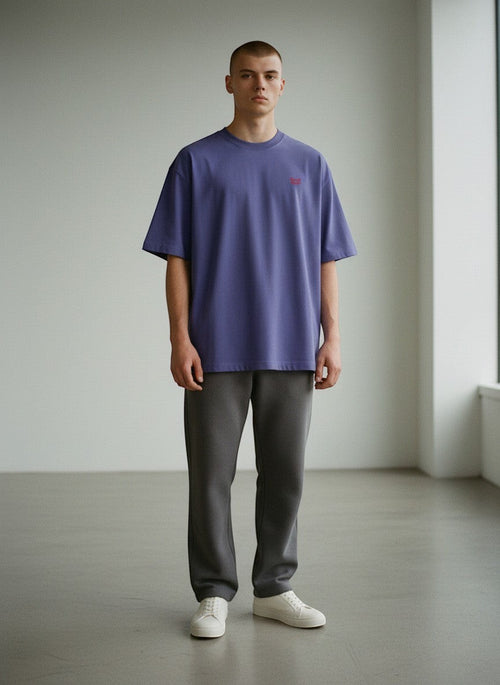
- Premium oversized shirts and sweatshirts: Ring-spun or compact yarn provides the soft, skin-friendly feel that buyers expect from high-quality streetwear.
- Bed linen and terry goods: Ring-spun yarn dominates here because softness remains the primary reason for purchase over the years.
- Workwear and robust basics: Open-end yarn is sufficiently durable and significantly cheaper in mass production.
- Embroidered textiles: A firmer surface, as provided by rotor yarn, often stands up better to stitch patterns than soft, loose ring-spun yarn.
- Wash-intensive sportswear: Compact yarn combines low pilling with high tear resistance, an advantage when washing frequently.
The simple rule of thumb: if feel is the priority, the path leads to ring-spun or compact yarn. If price and volume matter more, open-end is the more economical solution.
Recycled fibers and industry trends in spinning
Rotor spinning processes recycled fibers and short fiber lengths much less sensitively than classic ring spinning. Rieter describes its rotor spinning systems accordingly as being particularly productive when using less expensive or mixed raw materials.

Ring spinning and compact spinning react more sensitively to short, uneven recycled fibers. New technology is increasingly compensating for this: Compactdrum and Comber E90 systems allow for higher recycling shares while maintaining consistently good uniformity.
On the research side, the Institute for Textile Technology at RWTH Aachen is working on sensor- and AI-based solutions intended to bring rotor yarns made from recycled fibers qualitatively closer to virgin material.
For purchasing, it is worth looking at two values before ordering a batch:
- Fiber length profile of the recycled fibers used.
- Noil content, i.e., the share of short combed fibers in the mix.
How sustainable fabric choice specifically affects longevity and maintenance behavior depends heavily on these two factors.
Why material selection at Beachbodyz is no coincidence
Beachbodyz always makes the decision for yarn and processing to match the product category, not by a set formula. With GOTS-certified organic cotton, the feel against the body counts just as much as the durability over years. Anyone choosing between ring-spun and open-end should make this exact assessment: for which piece does softness count more, and for which does price and robustness? This question determines both the wearing experience and the longevity of a garment.
— Ahmed
Your next yarn choice: sustainable and durable with Beachbodyz
Beachbodyz consistently relies on GOTS-certified organic cotton and fair production in the EU for its sweatshirts and oversized shirts, a clear difference to fast-fashion goods, where yarn quality is rarely disclosed.

Instead of working your way through technical datasheets from various manufacturers, with Beachbodyz you get clothing whose material choice is already designed for longevity and skin compatibility. The oversized T-shirts are cut so that the soft feel of high-quality cotton is fully showcased, while the hoodies are made for robust everyday life. Anyone looking for an honest alternative to short-lived mass-produced goods will find the right starting point in the current collections and can select their desired piece directly in the shop.
Sources
- ESJ 2019 — Comparison of ring, rotor, compact (Uster/strength/hairiness data)
- Technical article: Hairiness and surface properties of ring vs. rotor yarns — 2025
- Institute for Textile Technology RWTH — Research project on recycling and process optimization
FAQ
What does ring-spun mean compared to open-end?
Ring-spun refers to yarn that is spun via a roving and a rotating ring-traveler mechanism, which increases softness and strength. Open-end yarn is created directly from individual fibers in a rotor drum, without a roving stage, and is therefore smoother and cheaper to produce.
Which yarn is more tear-resistant, ring-spun or open-end?
According to comparative data, ring-spun yarns show significantly higher tensile strength than rotor yarns of the same count. Compact yarn often achieves the most stable values overall.
Why is open-end yarn cheaper than ring-spun yarn?
Open-end yarn eliminates the entire roving stage and runs through the rotor spinning machine at significantly higher delivery speeds. This shortening of the process noticeably reduces production costs compared to the more complex ring spinning process.
Is open-end yarn suitable for recycled fibers?
Yes, rotor spinning machines process short and mixed recycled fibers more robustly than classic ring spinning machines, as Rieter describes. New technologies such as compact drum systems are now also increasing the possible recycled content in ring spinning.
Which yarn does Beachbodyz use for its collections?
For its products, Beachbodyz relies on GOTS-certified organic cotton, with the choice of yarn and processing adapted to the respective product category. You can find details on individual collections, such as hoodies or sweatshirts, directly on the respective product pages in the shop.