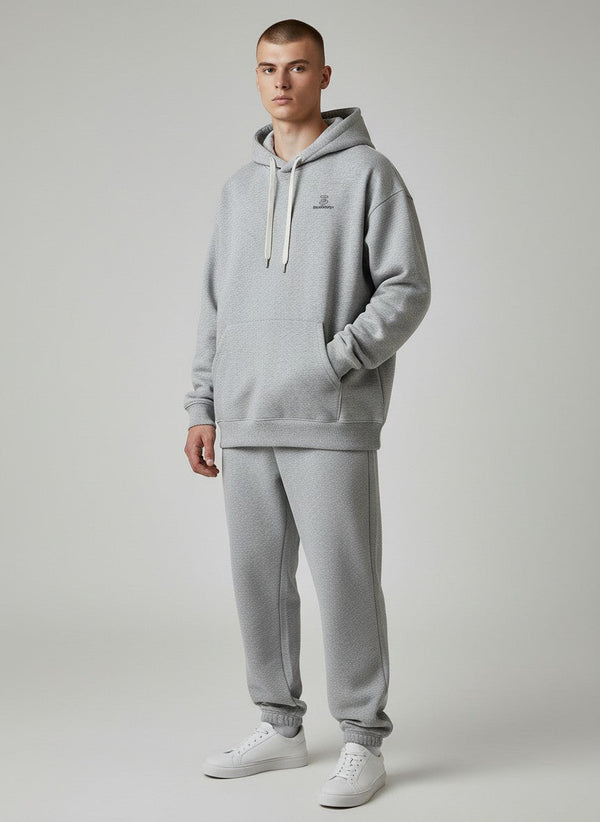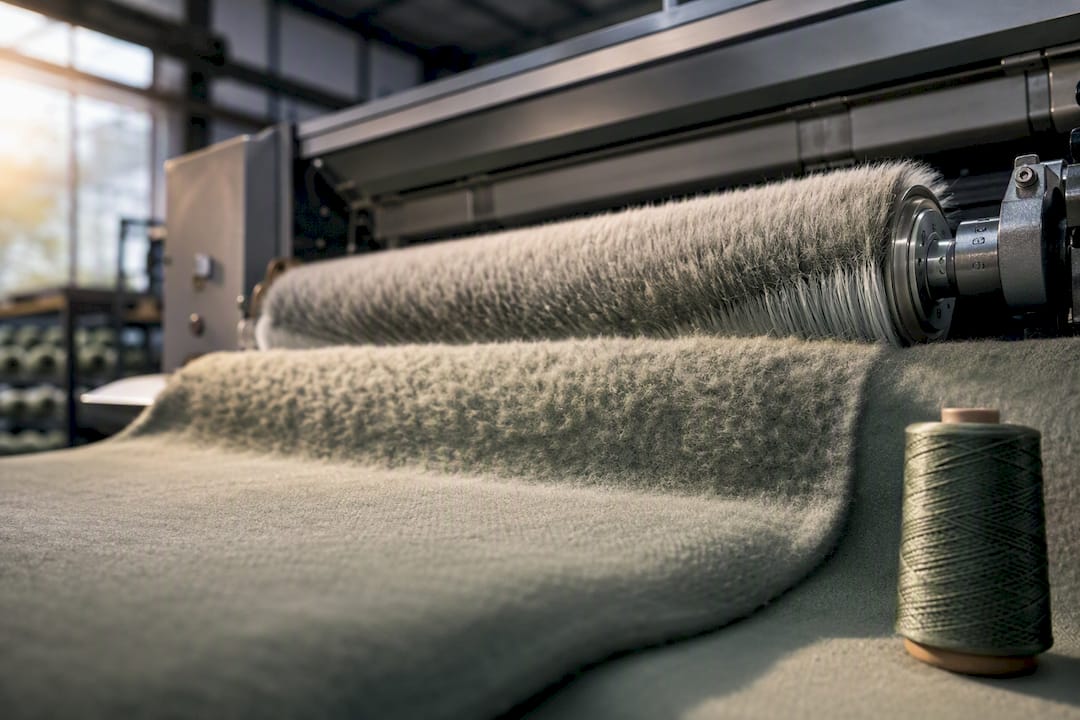
Brushed fleece has a mechanically roughened, napped inner side. French terry, by contrast, shows visible, un-napped loops. This is precisely what explains the difference in warmth and feel: the nap traps air and provides noticeably more warmth for the same weight. Warmth is determined not by GSM alone, but by nap height, density, and cut. When buying, it pays to look at photos of the reverse side, GSM specifications, fiber content, and the care label before committing to a material.
In short:
- Brushed fleece has a roughened inner side that traps significantly more air and is therefore warmer than French terry for the same weight.
- At the same GSM, the dense, flat nap of brushed fleece can feel warmer than lighter French terry with a higher face weight.
- Three-thread fabrics offer more volume and warmth thanks to an additional yarn, but are less stretchy and slightly stiffer than two-thread materials.
- French terry or microfleece is recommended for active users and high-sweat activities, while brushed fleece is better suited for cold, low-intensity activities.
- Care instructions such as washing inside out, using low temperatures, and air-drying extend the lifespan and reduce pilling in roughened fiber structures.
Table of Contents
- Brushed Fleece, French Terry and Microfleece: An Overview of the Terms
- GSM, Nap Height and Cut: How Warmth is Created
- Two-Thread or Three-Thread: Why the Number of Threads Determines Volume
- Which Material for Which Purpose?
- Care, Pilling and Fiber Shedding: What Really Matters When Washing
- Certificates and Testing Standards: How to Really Recognize Quality
- Who Brushed Fleece Is Really Worth It For
- Sustainable Hoodies and Jackets with Fleece Lining at BeachBodyz
- Sources
- FAQ
Brushed Fleece, French Terry and Microfleece: An Overview of the Terms
The term "brushed" describes a finishing process, not a fiber. During raising or brushing, a rotating brush roller pulls fine fibers from the base fabric to the surface and stands them up. The result is a soft, napped inner side that traps significantly more air than a smooth knit. According to the Blue Angel fact sheet, the main difference between brushed fleece and French terry lies primarily in the finishing, not necessarily in the material composition. Both can be made from cotton, polyester, or blended fabrics.
French terry, by contrast, remains un-napped. The characteristic loops (loopback) are visible and tactile on the inner side, making the fabric airier and more absorbent.
Here are the main differences between the types of fleece:
- Brushed fleece: roughened inner side, dense nap, high warmth.
- French terry: visible loops, no nap, lighter and more breathable.
- Microfleece/Polar fleece: made entirely from polyester, very fine fiber structure, lightweight and quick-drying, but usually less warm than heavier brushed fleece.
When buying online, these three terms should not be used interchangeably. A hoodie advertised as "fleece" can technically be French terry if the inner side remains un-napped.
GSM, Nap Height and Cut: How Warmth is Created
Grammage (GSM, grams per square meter) only indicates the face weight, not the actual warmth. Two fabrics with the same GSM can feel completely different because the nap determines how much still air the fabric traps.
Simply put: Roughened fibers form tiny air pockets that act as an insulating layer. This is precisely why brushed fleece feels warmer than French terry at a comparable weight, as French terry remains more open and breathable. According to Hohenstein, French terry usually ranges from approximately 150 to 350 g/m², while napped fleece varies between around 100 and 400 g/m². In practice, this means that a hoodie with a denser, higher nap can feel warmer than a fabric with a slightly higher face weight if the nap is flat and barely roughened. For guidance on specific weight classes, the BeachBodyz guide to winter hoodie materials provides an overview of which GSM ranges are suitable for which season. The cut also plays a role: oversized models trap more air between the fabric and the body than close-fitting styles, which further enhances the perception of warmth.

Two-Thread or Three-Thread: Why the Number of Threads Determines Volume
The knit construction determines how much nap can be created during raising, as clearly explained on the Fabric Info – SVBFLOR page. This is the technical core of the difference between French terry and brushed fleece.
- Two-thread (2-thread): A base yarn and a loop yarn form the typical loopback structure that remains visible in French terry.
- Three-thread (3-thread): An additional filling yarn is incorporated, which is only exposed during raising and creates a significantly more voluminous, fluffier lining.
According to KARCEM, this construction explains why three-thread fabric feels so much warmer than two-thread fabric with the same basic structure after finishing. However, the additional yarn also has side effects: three-thread fabrics usually stretch less than pure French terry, making them more stable but also slightly stiffer. For embroidery or prints, this means more support, while for highly active applications, it means slightly less flexibility.
Which Material for Which Purpose?
The choice depends less on the fabric's name than on three factors: activity level, moisture management, and temperature zone. Those who sweat a lot or move around a lot benefit from the more open structure of French terry. Those who prioritize warmth, for example during the cold transitional or winter months, are usually better off with brushed fleece.
- Light transitional hoodie: French terry or low-napped fleece at 250 to 300 g/m² for spring and autumn.
- Winter hoodie or sweatshirt: Three-thread brushed fleece from approximately 350 g/m² for maximum insulation during low-intensity activities.
- Sporty jogging bottoms: French terry or microfleece, as breathability is more important than pure warmth here.
- Statement jacket with lining: Brushed fleece as a lining fabric, combined with a more robust outer layer.
Pro tip: Before having an oversized model personalized, order a sample. A voluminous nap changes how embroidery sits and how the silhouette drapes on the body, especially with three-thread fabric that has a lot of fullness.
Care, Pilling and Fiber Shedding: What Really Matters When Washing
Napped surfaces are more prone to pilling than smooth knits because the raised fibers are more likely to become tangled through everyday friction. This generally affects brushed fleece more than French terry or microfleece.
A few firm rules significantly reduce the risk:
- Turn the garment inside out before washing.
- Choose a gentle cycle at a low temperature, and use cold instead of warm if in doubt.
- Avoid fabric softener, as it coats the nap and weakens the insulating effect.
- Never dry in a hot dryer; air-drying is better.
The same basic principles apply to general care: wash inside out, keep the temperature low, and prefer air-drying, as shown in the BeachBodyz guide to washing beanies. Washing also releases fine fibers that can enter the wastewater as microplastics, especially in fabrics with polyester content. Hohenstein tests precisely this fiber shedding using standardized testing methods to provide manufacturers with objective comparison values.
Certificates and Testing Standards: How to Really Recognize Quality
A label alone says little about the actual fabric quality. Testing standards and certificates provide a more reliable basis than marketing copy.
- GOTS requires minimum proportions of certified natural fibers and monitors chemical use and social working conditions throughout the supply chain. Importantly, "GOTS-certified" does not automatically mean that every component of a product consists of 100% organic fibers under the GOTS 7.0 standard.
- The Blue Angel evaluates textiles holistically: raw material origin, chemical use, manufacturing process, and suitability for use all contribute to the assessment, not just fiber quality alone.
- Hohenstein objectively measures thermal insulation, breathability, and fiber release using standardized methods such as the Performance Index, rather than relying on manufacturer specifications.
Such testing standards, for example according to DIN EN ISO 11092 or DIN SPEC 4872, are the reason why GSM values and care instructions are reliable in serious product descriptions in the first place. BeachBodyz uses these exact values in its own product descriptions to give buyers a realistic assessment of warmth and care requirements, including in the comparison of fabric weight and fit.
Who Brushed Fleece Is Really Worth It For
Brushed fleece plays to its strengths for comfort, meaning anywhere warmth and softness are more important than moisture wicking. For active sports with a lot of movement, I would recommend French terry or microfleece instead, as brushed fleece can quickly become uncomfortably damp. From a sustainability perspective, it is also worth looking at fiber origin and care requirements, because a fabric that wears out quickly and must be replaced frequently is rarely the better ecological choice. If you are unsure, you should request a photo of the reverse side before buying and read the care label carefully; it often says more than any product description.
— Ahmed
Sustainable Hoodies and Jackets with Fleece Lining at BeachBodyz
Those looking for a warm hoodie without fast-fashion compromises will find a concrete alternative to fabrics of unknown origin, made from organic cotton and recycled polyester and produced according to fair standards.
The hoodie collection features several oversized models with roughened inner linings, including the Identity Oversize Zipper Hoodie at 350 g/m², which is suitable for cooler months. For transitional weather, a lighter sweatshirt from the sweatshirt collection is a better fit, while the jacket collection offers models with fleece linings for wind and cold. Care instructions are provided directly in each product description, so you can check before buying whether the material and care requirements suit your everyday life. Look at the current models and find the piece that is right for your season and activity level.
Sources
For in-depth research, the Blue Angel provides criteria for textile assessment, Hohenstein provides testing methods for comfort and fiber release, and the Material Facts from the European Outdoor Group provide transparency tables on recycling content and origin.
- The Blue Angel – Textiles (Fact Sheet)
- Hohenstein – Wear Comfort / Performance
- KARCEM – French Terry vs. Fleece
FAQ
What Types of Fleece Are There?
The most common types are brushed fleece with a roughened inner side, French terry with visible loops, and microfleece made from fine polyester. There are also Sherpa and polar fleece variants, which differ primarily in nap height and fiber composition.
Which Fleece Is the Warmest?
In principle, denser, highly roughened brushed fleece provides more warmth than French terry or microfleece for a comparable weight because the nap traps more air. A three-thread fabric with a lot of filling yarn usually comes out on top here, as shown by the construction according to KARCEM.
What Is the Difference Between Fleece and Microfleece?
Fleece is the general term for roughened or napped knitwear, while microfleece is made specifically from very fine polyester fibers. Microfleece is usually lighter and dries faster, but for the same weight, it often provides less warmth than denser brushed fleece.
What Provides Better Warmth, Wool or Fleece?
Both work on a similar principle by trapping air in their fiber structure. Wool additionally absorbs moisture without feeling cold, while fleece is lighter and dries faster, which often makes it more practical for active use.
How Can I Recognize Brushed Fleece When Buying Online?
A photo of the reverse side shows the napped, roughened structure, while French terry clearly reveals loops. Also pay attention to the GSM specification, fiber composition, and care label, as these details significantly reduce confusion according to the Blue Angel.