GOTS and OEKO-TEX answer two different questions. GOTS asks: How was this product made? OEKO-TEX asks: Does the finished product contain harmful residues? If you want organic fibers and fair working conditions, you need GOTS. If you want to know if a garment is low in harmful substances, OEKO-TEX Standard 100 provides the answer.
For most purchasing decisions, this short rule applies:
- Skin contact, allergies, baby textiles: OEKO-TEX Standard 100 is sufficient as a safety check.
- Organic fibers + social standards: Only GOTS verifies both throughout the entire supply chain.
- Both seals combined: Possible and often the strongest statement, as they complement each other in content.
- No seal replaces the other: OEKO-TEX says nothing about cultivation or working conditions; GOTS says nothing about pollutant limits in the final product.
Key Takeaways
GOTS and OEKO-TEX answer different questions: GOTS verifies organic fibers and fair production throughout the supply chain, OEKO-TEX checks for harmful residues in the finished product.
| Topic | Details |
|---|---|
| GOTS: Scope and Focus | Raw fiber to finished product, organic fibers (min. 95% / 70%), social standards according to ILO |
| OEKO-TEX Standard 100 | Harmful substance testing of the end product, four product classes, strictest requirements for baby textiles |
| Combination makes sense | Both seals together offer the strongest evidence for organic quality and harmful substance safety |
| Verify labels | Check certificate number in the public GOTS register or OEKO-TEX database |
| Beachbodyz | Offers GOTS-certified streetwear made from organic cotton, fairly produced in the EU, climate-neutral shipping |
Table of Contents
- What do OEKO-TEX Standard 100 and MADE IN GREEN cover?
- What exactly does GOTS require, and how is the label structured?
- GOTS vs. OEKO-TEX: Direct comparison and typical purchasing situations
- Which seal should you buy? Concrete tips for everyday life
- What are the limits of both seals?
- How to check a label in a few steps
- How sustainable brands should display GOTS on product pages
- When does combining both seals make sense?
- Beachbodyz: GOTS-certified streetwear with verifiable origin
- Sources
- FAQ
What do OEKO-TEX Standard 100 and MADE IN GREEN cover?
OEKO-TEX Standard 100 checks the finished textile for defined limit values for a variety of harmful substances: pesticide residues, heavy metals, formaldehyde, allergenic dyes, and other parameters. The final product is tested in the laboratory, not the production process before it.

The system works with four product classes. Class I applies to articles with direct skin contact for infants and toddlers under three years. Here, the limit values are the strictest. Class II includes textiles with direct skin contact for adults, Class III those without direct skin contact, Class IV furnishing textiles. Whoever buys a Class I product receives the strictest harmful substance check of the system.
What OEKO-TEX Standard 100 does not cover:
- Cultivation conditions of raw fibers (conventional or organic)
- Social standards in production
- Chemical use during processing (only residues in the end product)
- Supply chain transparency
MADE IN GREEN is an additional label from OEKO-TEX. It confirms that the product has been tested according to OEKO-TEX Standard 100 and has been manufactured in audited production facilities. Buyers can trace the countries and companies where the product was made using an ID number printed on the label. This is a real transparency gain compared to Standard 100 alone, but not proof of organic fibers or ILO-compliant working conditions.
For buyers, this means: OEKO-TEX is a reliable safety check, not a comprehensive sustainability proof.
What exactly does GOTS require, and how is the label structured?
GOTS stands for Global Organic Textile Standard. The standard is supported by the non-profit Global Standard gGmbH, founded in 2002. The standard covers the entire chain: from raw fiber production to spinning, weaving, dyeing, and manufacturing to the finished product.
Minimum percentages of certified organic natural fibers:
The GOTS Manual defines two labeling levels:
At least 95% certified organic natural fibers for the "organic" label. At least 70% for the "made with organic" label.
The current version 8.0 (in force since March 2026) tightens due diligence obligations and circularity requirements compared to previous versions.
What GOTS checks along the supply chain:
- Approved and prohibited chemicals in processing (positive list of approved substances, prohibition of problematic substances)
- Wastewater requirements for processing facilities
- Social criteria according to ILO core standards: freedom of association, prohibition of child labor, safe working conditions
- Labeling requirements: Certifier, certificate number, percentage of organic fibers
GOTS completely prohibits certain problematic substances in production and works with positive lists of approved chemicals. OEKO-TEX, on the other hand, measures residue limit values on the finished product. This is a fundamental difference: GOTS intervenes earlier in the chain.
A GOTS label on a product is the visible result of a seamless certification chain. Every company in the supply chain must be individually certified. This makes GOTS more complex and expensive than OEKO-TEX, but also more meaningful for buyers who want to prove organic quality and social standards.

GOTS vs. OEKO-TEX: Direct comparison and typical purchasing situations
| Dimension | GOTS | OEKO-TEX Standard 100 |
|---|---|---|
| Scope | Raw fiber to finished product | Finished end product |
| Main focus | Organic fibers, production chemicals, social standards | Harmful substance residues in the end product |
| What is tested | Positive list chemicals, ILO social audit, wastewater | Limit values for pesticides, heavy metals, dyes, etc. |
| Minimum requirement | 95% organic fibers (organic) / 70% (made with organic) | Product class dependent, no fiber requirement |
| Audit/Inspector | Independent accredited certifiers, annually | Accredited laboratories, product testing |
| Consumer promise | Organic quality + fair production proven | Tested for low harmful substances |
| Verifiability | Public Certified-Suppliers Register | Label ID on product, OEKO-TEX database |
Typical purchasing situations:
- Baby bodysuit: OEKO-TEX Class I is mandatory as a minimum standard; GOTS is additionally recommended if organic cotton is desired.
- Bed linen: OEKO-TEX Standard 100 is sufficient for the harmful substance check; if you want to be sure that the cotton was organically grown, you need GOTS.
- Organic cotton streetwear T-shirt: GOTS is the relevant certification. OEKO-TEX alone does not prove that the cotton is organic.
- Cheap mass-produced goods: Often only OEKO-TEX or no seal at all. This does not automatically mean unsafe, but no proof of organic fibers or fair labor.
Both seals can be combined. A product with GOTS and OEKO-TEX Standard 100 offers the strongest proof: organic fibers, fair production, and tested harmful substance freedom in the end product.
Which seal should you buy? Concrete tips for everyday life
The simplest rule of thumb: If it's about harmful substance safety, OEKO-TEX is enough. If it's about organic fibers and fair labor, GOTS is necessary. Both together are possible and particularly useful for sensitive skin or baby products.
Checklist when shopping:
- Read material information: Which fibers, what percentage?
- Check percentage for GOTS: "organic" or "made with organic"?
- Note label ID or certificate number
- Identify certifier on the label
- Check care instructions for durability (quality signal)
Regarding price-benefit trade-off: GOTS certifications are more complex for manufacturers than OEKO-TEX tests. This is reflected in the price. Those who solely seek harmful substance safety pay less with OEKO-TEX. Those who want organic fibers and social standards must factor in the higher price for GOTS. This higher price is well justified for products with direct skin contact or for children.
Pro Tip: Ask the retailer for the full certificate number, not just the logo. A genuine GOTS certificate number can be checked in seconds in GOTS's public Certified-Suppliers Register. If the number is missing, the seal cannot be verified.
For sustainable streetwear made from organic cotton: GOTS is the relevant standard because it includes cultivation and processing, not just the end product.
What are the limits of both seals?
No certification system is flawless. Those who know both seals also recognize their weaknesses.
Limits of GOTS:
- Audit dependency: The quality of the inspection depends on the accredited certifier. Annual audits can leave gaps between inspection cycles.
- Supply chain transparency: GOTS certifies each company individually, but the chain can be complex. Not every stage is directly visible to consumers.
- Costs for producers: Certification is expensive. Small businesses in developing countries sometimes struggle to meet the requirements. This can limit supply.
Limits of OEKO-TEX:
- No proof of cultivation or raw material origin
- No statement about working conditions in production
- Residue limits on the end product say nothing about which chemicals were used during processing
Typical consumer traps:
- Logo without clear text: A seal sticker without a certificate number is not verifiable.
- Unclear percentages: "Organic cotton" without GOTS labeling and percentage is not a reliable statement.
- Missing certifier information: Without the certifier's name, authenticity cannot be checked.
Test seals do not replace complete material information. For critical purchasing decisions, such as for newborns or people with contact allergies, one should actively use certificate numbers and official registers, not just trust the logo.
How to check a label in a few steps
Step by step:
- Read the product label: Which seal is shown? Is a certificate number or label ID provided?
- Note the certificate number. For GOTS, it consists of a letter-number combination that uniquely identifies the certified company.
- Access the GOTS register: global-standard.org/certifiedsuppliers. There, you can search for the company by name, country, or certificate number.
- Check OEKO-TEX certificate: On oeko-tex.com there is a search function for test certificates. The label ID on the product leads directly to the certificate with product class and validity date.
- If unclear: Ask the retailer for a copy of the certificate. Reputable providers will provide this upon request.
What makes a GOTS certificate number recognizable:
- It is printed on the label, not just the logo
- It contains the name of the accredited certifier
- It can be looked up in the public register
What to do if information is missing:
- If the number is missing, the seal cannot be verified. This is a clear warning sign.
- For online shops: Check the product description for the certificate number, not just the logo graphics.
- When in doubt: Inquire directly with the manufacturer. If they are GOTS-certified, they can provide the number immediately.
The official primary sources are global-standard.org for GOTS and oeko-tex.com for OEKO-TEX.
How sustainable brands should display GOTS on product pages
Good product pages show more than just a logo. They state the GOTS certificate number, the material percentage (e.g.).
What should make you suspicious on product pages: missing percentage information, no certifier named, no link to a register, vague formulations like "sustainably produced" without evidence.
Pro Tip: Pay attention to detailed material breakdowns on product pages: fiber composition in percent, country of origin of the raw fiber, and country of processing. This information is standard for genuine GOTS products. If it's missing, it's worth asking the supplier. A look at Beachbodyz' GOTS-certified clothing shows what transparent product presentation can look like.
When does combining both seals make sense?
For most sustainably-minded consumers, GOTS is the first choice when both organic fibers and fair labor are important. OEKO-TEX remains a quick, reliable harmful substance check that also applies to conventionally produced textiles.
The combination of both seals is particularly useful for baby textiles, bed linen, and products with continuous skin contact. GOTS verifies the production chain, OEKO-TEX confirms the absence of harmful substances in the finished item. If you can only choose one, you should prioritize GOTS for organic claims. For pure safety concerns, OEKO-TEX is sufficient.
One point many buyers underestimate: GOTS can be stricter in production chemistry than OEKO-TEX because GOTS completely prohibits certain substances in processing, while OEKO-TEX measures residues on the end product. A product can be OEKO-TEX compliant and still have been processed with problematic chemicals, as long as the residues are below the limit values.
Beachbodyz: GOTS-Certified Streetwear with Traceable Origin
If you're looking for GOTS-certified streetwear, Beachbodyz offers products made from organic cotton, produced fairly in the EU. All items are shipped climate-neutrally. The certification can be verified upon request.
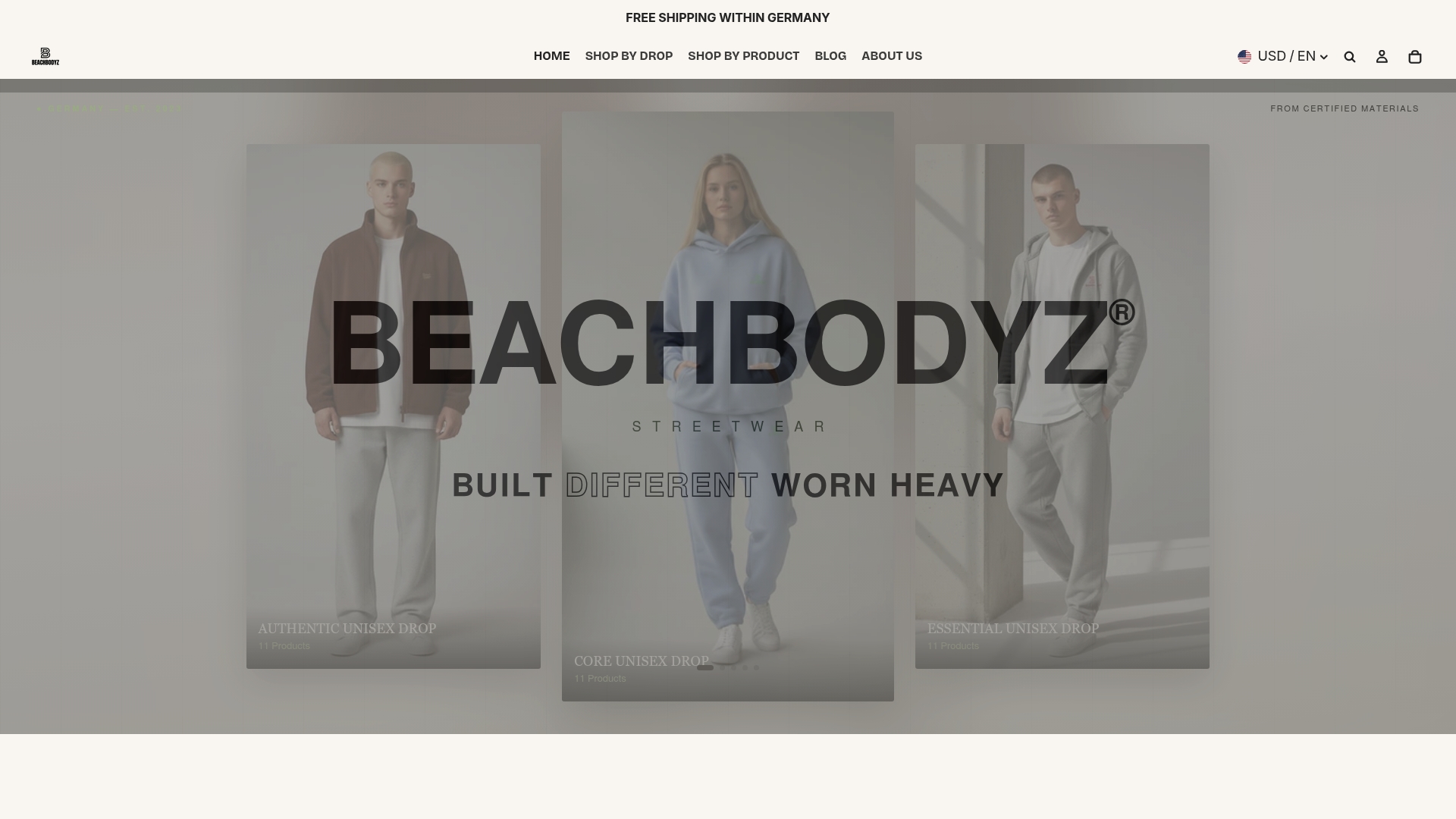
Beachbodyz combines GOTS-certified organic cotton with oversized cuts and durable materials that can be worn for years. This is the concrete difference from fast fashion: no greenwashing, but traceable production in the EU with verifiable standards. The certificate number can be checked in the public GOTS register.
Check out the Motion Oversize Top or browse directly in the Beachbodyz Shop for more GOTS-certified items.
Sources
For own research and verification:
- Global-standard
- Organic and certified materials (GOTS) — Lazi Akademie
- Textile labels for natural materials: Standards & Harmful substances
- Yarn certifications | OEKO-TEX & GOTS at a glance
FAQ
What is the main difference between OEKO-TEX and GOTS?
OEKO-TEX Standard 100 checks the finished product for harmful substance residues. GOTS certifies the entire supply chain from organic raw material to the final product and includes social criteria. Both seals complement each other but do not replace each other.
Who is behind GOTS?
GOTS is issued by the non-profit Global Standard gGmbH, founded in 2002. The organization develops and maintains the standard, operates the public certification register, and accredits independent certifiers worldwide.
Is a GOTS product always made from organic cotton?
Without this minimum proportion, the GOTS label may not be used.
What criticism is there of GOTS certifications?
GOTS is audit-dependent. The quality of the audit depends on the respective certifier, and gaps can arise between annual audits. In addition, certification costs are high for small producers, which can limit supply. Consumers should always check certificate numbers in the public register, not just trust the logo.
Can a product carry both GOTS and OEKO-TEX?
Yes. Both seals are not mutually exclusive. A product with both certifications offers the most comprehensive proof: organic fibers and fair production through GOTS, tested for harmful substances in the final product through OEKO-TEX Standard 100.