The carbon footprint of a garment indicates how many kilograms of CO2 equivalents (kg CO2e) are generated over its entire life cycle, from raw material extraction to disposal. A simple cotton T-shirt, depending on the production location and usage behavior, causes between approximately 2 and 10 kg CO2e. According to analyses, a pair of jeans lies between 5.14 and 24 kg CO2e. The biggest single lever for consumers is not the choice of material when buying new, but extending the useful life: if you wear a garment twice as often, you halve the CO2e value per wear unit. This is followed by avoiding tumble dryers and buying second-hand.
- A T-shirt: approx. 2–10 kg CO2e (life cycle, cradle-to-grave)
- A pair of jeans: approx. 5–24 kg CO2e
- Use phase (washing, drying): can account for 30% or more of total emissions
- Second-hand purchase, according to A-GAIN Guide studies, saves about 62% CO2e compared to buying new
- Sources: German Environment Agency (UBA), European Environment Agency (EEA), Systain Consulting, Bundestag Analysis
Immediate measure with the greatest effect: Buy less new and wear existing clothes longer.
Key Insights
The carbon footprint of clothing can be reduced most significantly by extending its use, buying second-hand, and avoiding tumble dryers.
| Topic | Details |
|---|---|
| CO2e range Jeans | 5–24 kg CO2e per item; average is between 13–20 kg CO2e depending on the study. |
| Largest consumer lever | Extend useful life: twice as many wear cycles halve the CO2e per use. |
| Second-hand savings | Studies show around 62% CO2e savings compared to buying a comparable new item. |
| Dryer effect | Avoiding dryers and using green electricity can reduce care emissions by up to 66%. |
| Beachbodyz | GOTS organic cotton, EU production, and durable designs directly implement the recommended levers. |
Table of Contents
- What exactly does the carbon footprint of a garment measure?
- Which life cycle phases cause the largest share of CO2?
- How high is the CO2e value of typical garments?
- How to calculate the CO2e value per wear unit yourself?
- 10 effective measures to reduce the carbon footprint of fashion
- How to recognize credible climate signals in clothing?
- Can toxins be washed out of clothes?
- How many wear cycles does a garment need for its production to become CO2-neutral in economic terms?
- How Beachbodyz reduces the footprint of its streetwear
- What research really says and what many misunderstand
- Sustainable streetwear that lasts longer than one season
- Sources
- FAQ
What exactly does the carbon footprint of a garment measure?
CO2 equivalents (CO2e) combine various greenhouse gases, including CO2, methane, and nitrous oxide, into a single metric. This is based on the global warming potential of each gas over a 100-year time horizon. For clothing, this means all emissions along the supply chain are expressed in kg CO2e.
Life Cycle Assessment (LCA, life cycle assessment according to ISO 14040/14044) is the recognized method for systematically recording these emissions. It defines which processes are included in the calculation and where the system boundaries lie.
Two system boundaries are common in practice:
- Cradle-to-Gate: Records emissions from raw material extraction to the factory gate. Transport to retail and the use phase are excluded.
- Cradle-to-Grave: Includes all phases, i.e., production, transport, use (washing, drying), and disposal. This value is more informative for consumers.
Why do LCA figures vary so widely? This is due to different assumptions about useful life, washing temperature, and the energy mix in the country of production.
The German Environment Agency (UBA) and the European Environment Agency (EEA) provide the institutional framework for such analyses in Germany and the EU. Organizations like Fashion Changers and Grüne Erde translate this data into consumer-friendly recommendations.
Which life cycle phases cause the largest share of CO2?
The emissions of a garment are unevenly distributed across the individual phases. According to Systain Consulting, production and material manufacturing dominate in many life cycle analyses.
- Material manufacturing and production: Spinning, weaving, and dyeing are the most emission-intensive steps. The energy mix in the country of production is a decisive factor: a factory in a country with a high proportion of coal-fired electricity generates significantly more CO2e than one in a country with renewable energies. Some analyses attribute around 71% of total emissions to the production phase.
- Use phase (washing, drying): For a long-sleeved shirt, the use phase can account for around 31% of CO2e. Using a tumble dryer can significantly increase this proportion. Green electricity and avoiding the dryer reduce care emissions by up to 66% according to an analysis by Polarstern Energie.
- Transport: Sea freight has a comparatively small share of the total footprint. Air freight, however, significantly increases transport emissions. The Bundestag analysis on ultra-fast fashion shows that even small proportions of air freight in the logistics mix noticeably increase the footprint.
- End-of-Life: Landfilling and incineration release stored emissions. Recycling and reuse reduce this proportion.
Pro Tip: Those who buy clothes from ultra-fast fashion sources often pay a hidden CO2 surcharge due to air freight. Sea freight-based supply chains are significantly more climate-friendly.
How high is the CO2e value of typical garments?
The following ranges are based on published LCA studies. Wide ranges arise from different materials, production locations, and assumptions about the use phase.
| Garment | Typical Range (kg CO2e) | Main Driver |
|---|---|---|
| T-Shirt (cotton) | 2–10 kg CO2e | Production, dyeing, washing |
| Jeans (cotton) | 5–24 kg CO2e | Raw material, wet processing, use |
| Sweater (wool/synthetic) | 5–15 kg CO2e | Fiber type, factory energy |
| Jacket (synthetic/blended fabric) | 10–30 kg CO2e | Material input, filling, transport |
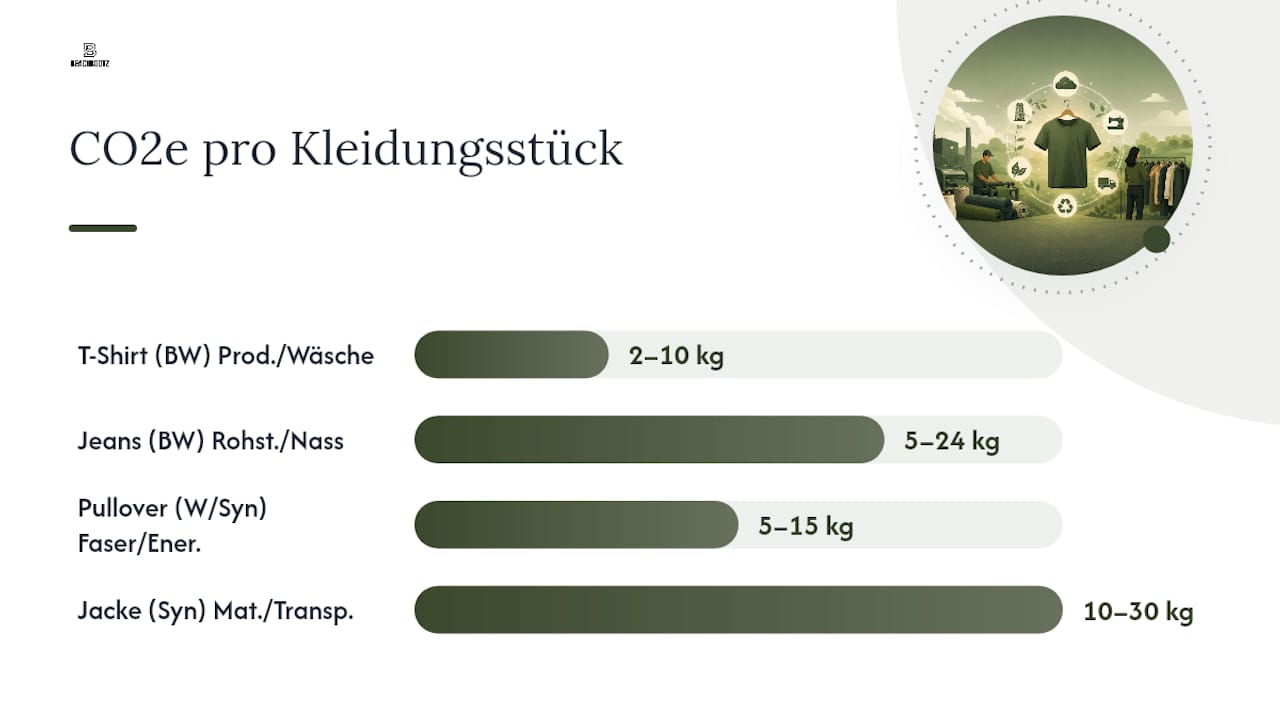
For jeans, the Bayreuth analysis states a maximum value of 24 kg CO2e, while other methods show values from 5.14 kg CO2e. The average, depending on the study, is between 13.65 and 20 kg CO2e.
Synthetic fibers like polyester often have higher climate impacts due to their origin from fossil resources, according to the EEA. Cotton is more climate-friendly but has a high water consumption.
Pro Tip: Jackets and jeans particularly benefit from longer use, as their high production CO2e can be distributed over many wears. A sweater worn for ten years has a fraction of the footprint per use compared to an item discarded after two years.
How to calculate the CO2e value per wear unit yourself?
The formula is simple:
CO2e per wear unit = Total CO2e ÷ expected wear cycles
If you want to include care emissions, add them to the total CO2e:
CO2e per wear unit = (Production CO2e + Total care CO2e) ÷ Wear cycles
Example calculation: Jeans
- Total CO2e of jeans: 15 kg CO2e (conservative average from study range)
- Assumed wear cycles: 150 (approx. 3 days per week over 1 year)
- CO2e per wear unit: 15 ÷ 150 = 0.10 kg CO2e per use
- For 300 wear cycles (2 years): 15 ÷ 300 = 0.05 kg CO2e per use
This shows: Double the useful life halves the value per wear unit exactly.
The A-GAIN Impact Calculator provides a transparent basis for your own calculations with plausible assumptions.
10 effective measures to reduce the carbon footprint of fashion
1. Buy less new
The most effective lever. Before every purchase: Do I really need this, or is an existing item sufficient?
2. Buy second-hand
Studies show savings of about 62% CO2e compared to buying new. Platforms for used clothing are readily available in Germany. Check quality, look for damage, and realistically estimate useful life.
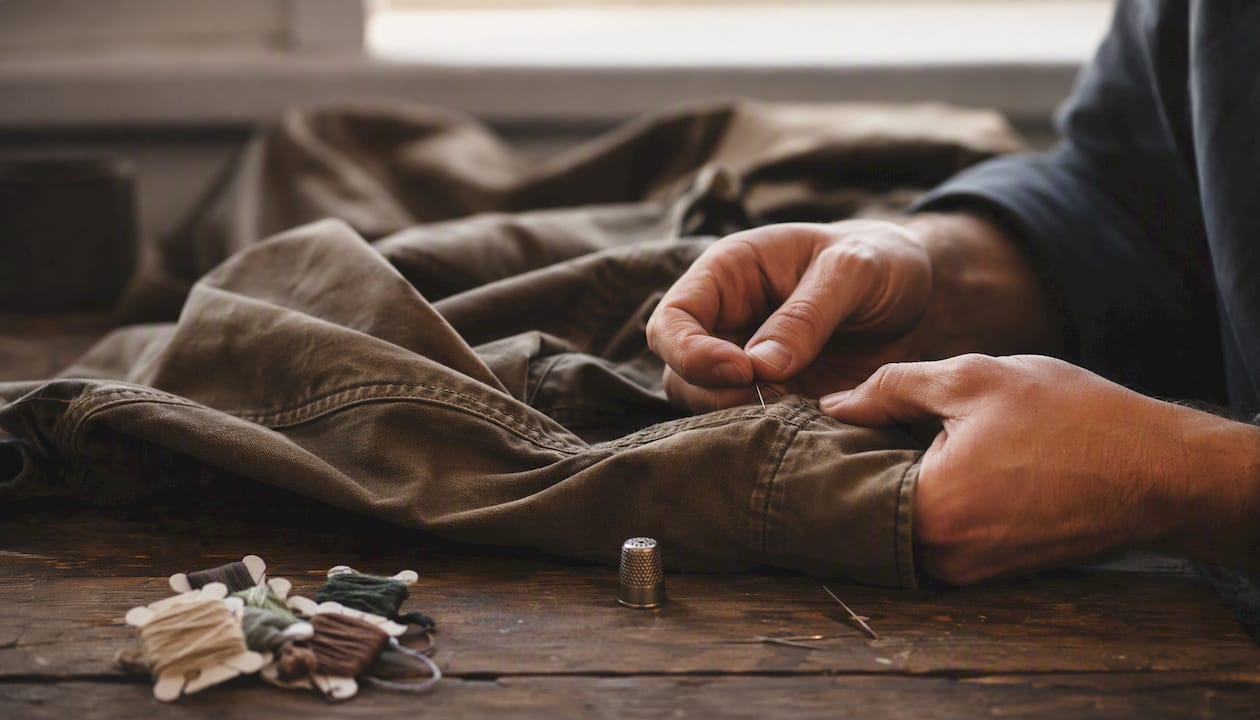
3. Extend lifespan
Wear more, care for carefully, repair when necessary. An guide to repairing streetwear shows how seams, zippers, and fabric can be easily maintained.
4. Avoid tumble dryers
The tumble dryer is the largest CO2 emitter in the use phase. Air-drying saves significant amounts of CO2e over the lifespan of a garment, depending on the frequency of use.
5. Wash cold and choose short programs
30 °C instead of 60 °C significantly reduces energy consumption per wash cycle. Short programs for lightly soiled laundry are sufficient in most cases.
6. Use green electricity
Switching household electricity to green electricity reduces the care emissions of all laundry.
7. Material choice when buying new
Sustainable fabrics like organic cotton and recycled fibers generally have a lower production CO2e than conventional synthetics. GOTS-certified organic cotton and GRS-certified recycled polyester are reliable indicators.
8. Repair instead of discard
A torn hem or a broken button is no reason to dispose of an item.
9. Use microplastic filters when washing
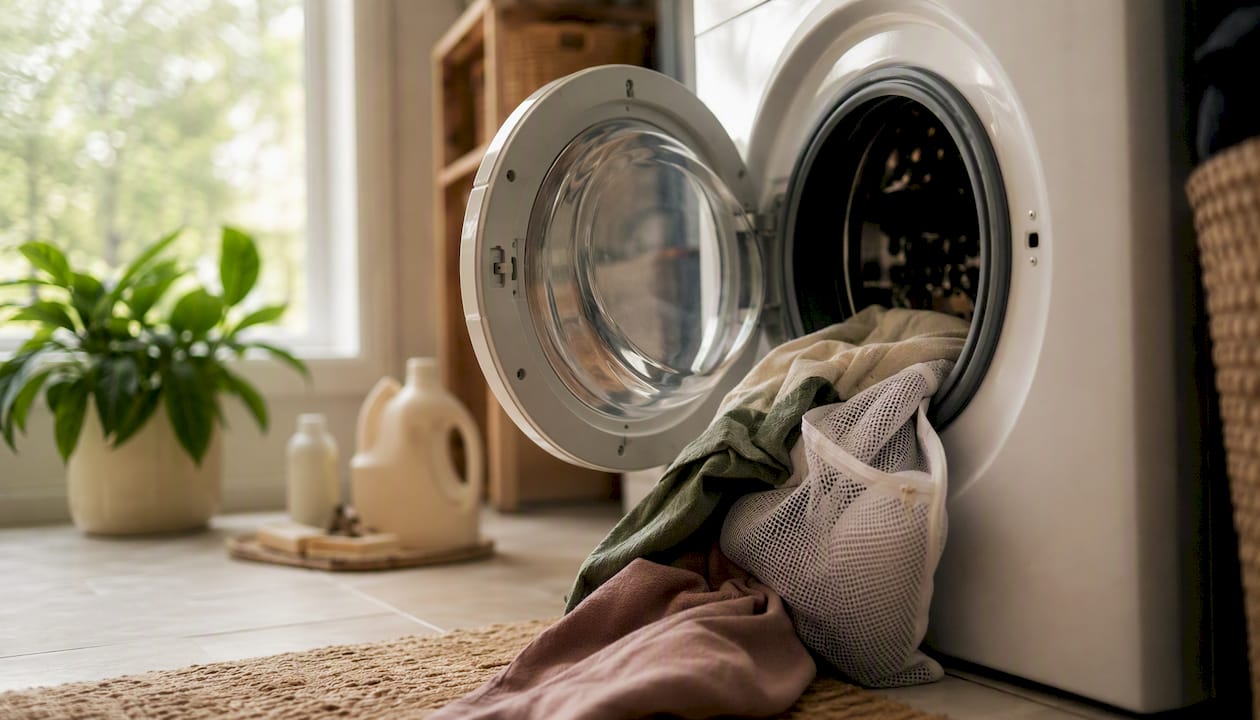
Synthetic fibers release microfibers when washed. Wash bags like the Guppyfriend or filter attachments for washing machines measurably reduce the entry of microplastics into wastewater.
10. Avoid ultra-fast fashion
Models with air freight logistics have a significantly higher CO2 footprint than brands with sea freight or EU production, according to the Bundestag analysis. The comparison Slow Fashion vs. Fast Fashion shows the differences concretely.
Pro Tip: The combination of measure 1 (buy less) and measure 4 (no dryer) covers the largest part of personal savings potential for most households.
How to recognize credible climate signals in clothing?
Not every green symbol on a label indicates the actual carbon footprint. Four seals are particularly relevant in Germany and the EU:
- GOTS (Global Organic Textile Standard): Checks ecological and social criteria along the entire supply chain, from fiber to finished product. Considered one of the strictest textile seals. Verification number can be checked on the GOTS website. More about this is explained in the Beachbodyz GOTS guide.
- GRS (Global Recycled Standard): Certifies recycled materials and their traceability. Relevant for products made from recycled polyester or other secondary raw materials.
- OEKO-TEX Standard 100: Tests for harmful substances in the finished product but makes no statement about CO2 emissions or social standards in production.
- EU Ecolabel: Considers environmental criteria across the life cycle, including energy and water consumption. The EU Textiles Strategy establishes the EU Ecolabel as a central reference point for credible environmental communication.
Verification Checklist
- Is the certificate number searchable on the seal's website?
- Does the seal cover the entire supply chain or just the end product?
- Is the certification carried out by an independent third party?
- Does the company provide specific information on production locations?
Warning signs for greenwashing
- Vague terms such as "environmentally friendly" or "green" without certification or proof
- Symbols that do not represent recognized standards
- CO2 neutrality promises without specifying the method (avoidance vs. compensation)
- Missing information about the country of production or the supply chain
Pro Tip: OEKO-TEX Standard 100 alone says nothing about the carbon footprint. If you want to buy climate-consciously, you need GOTS or GRS as an additional signal.
Can toxins be washed out of clothes?
Partially, yes. Water-soluble residues from finishing, such as certain sizing agents, can be reduced by repeated washing. Persistent harmful substances like PFAS (per- and polyfluoroalkyl substances) or certain heavy metals from dyeing processes, however, are difficult or impossible to wash out. OEKO-TEX Standard 100 certified clothing has already checked these limits in the product, which reduces the risk from the outset.
Washing synthetic fibers creates another problem: microfibers. Each wash cycle releases thousands of plastic particles that enter water bodies via wastewater.
- Laundry bags (e.g., Guppyfriend): Catch microfibers in the bag before they enter the wastewater.
- Filter attachments for washing machines (e.g., Filtrol or PlanetCare): Measurably reduce microplastic discharge.
- Full load: Less friction between fibers means less fiber breakage.
- Low temperatures and short programs: Protect fibers and simultaneously reduce energy consumption.
Recommendations from the UBA and EEA suggest washing synthetic clothing less frequently and at lower temperatures. A detailed guide to sustainable washing summarizes the most important care steps.
Pro-Tip: Wash new clothes once before wearing them for the first time to reduce processing residues. After that: wash as rarely as possible, as cold as necessary.
How many wear cycles does a garment need to amortize its CO2 footprint?
"Amortization" here means: At what point does the CO2e value per wear unit become low enough for the garment to be climatically justifiable? There is no fixed limit, but the calculation shows clear trends.
| Garment | Total CO2e | Wear Cycles for 0.10 kg/use | Wear Cycles for 0.05 kg/use |
|---|---|---|---|
| T-shirt | 5 kg | 50 | 100 |
| Jeans | 15 kg | 150 | 300 |
| Sweater | 10 kg | 100 | 150 |
| Jacket | 20 kg | 150 | 300 |
Decision Rule: Buy, Repair, or Second-hand?
- New purchase: Only if the item is worn regularly for at least 2–3 years and a seal (GOTS, GRS) confirms production quality.
- Repair: Almost always worthwhile, as long as repair costs are below the new price and the item still has many wear cycles left.
- Second-hand: Best CO2e balance per wear unit, because production emissions are spread over more total uses.
Material blends make recycling difficult at the end of their life cycle.
Beachbodyz communicates the longevity of its products as a concrete climate advantage: GOTS-certified organic cotton and robust cuts are designed to withstand many wear cycles, thus keeping the CO2e value per use low.
How Beachbodyz Reduces the Footprint of its Streetwear
Beachbodyz is a German streetwear brand focusing on sustainable production in the EU. The brand's measures can be directly attributed to the levers described in this article.
- Material selection: GOTS-certified organic cotton and GRS-certified recycled polyester. Organic cotton avoids synthetic pesticides and generally has lower production CO2e than conventional cotton.
- Production in the EU: Shorter transport routes, stricter environmental and social standards, no air freight risk due to intercontinental logistics.
- Durable cuts: Oversize fits made from robust materials are designed for many wear cycles. This directly reduces CO2e per use.
- Climate-neutral shipping: Compensation for shipping emissions for direct delivery to customers in Germany and Central Europe.
Longevity is not a marketing promise, but a measurable CO2e factor: a garment worn 300 times instead of 150 times halves its footprint per use.
The Essential Oversize Sweatshirt made from GOTS organic cotton and the Identity Jogger Shorts are examples of products where material selection, production, and cut are designed for maximum lifespan. All information is based on company data from Beachbodyz.
Pro-Tip: When buying sustainable streetwear: Check the GOTS number on the product page and look for information about the country of production. "Made in EU" with GOTS is a more reliable signal than an unspecified "eco" label without proof.
What Research Really Says and What Many Misunderstand
Most guides on the CO2 footprint of clothing focus on purchasing: organic cotton instead of polyester, labels instead of no labels. This is not wrong, but it falls short.
If someone buys a GOTS-certified T-shirt but washes it at 60°C and then puts it in the dryer, the advantage of cleaner production is quickly negated. Material choice at purchase is a one-time effect. Washing behavior is repeated a hundred times.
Even more underestimated is the second-hand effect. And yet, second-hand is often just a marginal point in many sustainability guides.
What really matters is the combination: buy less, wear longer, wash cold, no dryer. Anyone who implements these four points has done more than someone who exclusively relies on expensive certified new goods and discards them after one season. Certificates are important for production quality. But they do not replace post-purchase behavior.
Sustainable Streetwear that Lasts Longer Than One Season
If you want to reduce the CO2 footprint of your clothes, you need pieces that withstand many wear cycles. Beachbodyz produces streetwear from GOTS-certified organic cotton and GRS-certified recycled polyester, ethically manufactured in the EU, and shipped climate-neutrally. The cuts are designed for longevity: no pilling after three washes, no fit issues after a year.

The Essential Oversize Sweatshirt and the Identity Jogger Shorts are concrete examples: GOTS cotton, EU production, cuts that work for years. If you buy a piece now and wear it 300 times, the CO2e per use is far below the average of a fast-fashion item with 50 wear cycles. The Oversize Hoodie made from recycled materials is also available in the shop. All products directly at Beachbodyz.
Sources
- A pair of jeans causes 24 kilos of CO2
- Carbon Footprint of Clothing (Systain Consulting, Whitepaper)
- A‑GAIN Guide – CO2e‑Impact Calculator (PDF)
- Circularity Of The EU Textiles Value Chain In Numbers (EEA)
These sources are EU institutions, independent expert studies, or parliamentary analyses. They serve as a basis for own calculations and as a reference for evaluating company statements.
FAQ
How much CO2 does a T-shirt cause?
A cotton T-shirt causes about 2–10 kg CO2e over its entire life cycle (cradle-to-grave), depending on the production location and usage behavior. Cradle-to-gate values are sometimes around 1.37 kg CO2e, but do not include usage and disposal.
What is the CO2 footprint of a pair of jeans?
Analyses cite ranges from approximately 5.14 to 24 kg CO2e per pair of jeans; average values vary between 13 and 20 kg CO2e depending on the study. The actual value strongly depends on the production location, wet finishing, and washing behavior.
Can you wash toxins out of clothes?
Water-soluble processing residues can be partially reduced by multiple washes. Persistent pollutants such as PFAS or heavy metals from dyeing processes, however, are hardly washable; OEKO-TEX Standard 100 certified clothing has already had these limits checked in the product.
How high is the total CO2 consumption in clothing production?
The exact share varies depending on system boundaries and product type.
What are the real climate benefits of buying second-hand?
Second-hand is thus one of the most effective individual levers for consumers, because production emissions are spread over more total uses.
Recommendation
- Eco-Friendly Fabric Choices: Sustainable Fabrics for a Better Future – BEACHBODYZ®
- GOTS-certified Clothing: Check, Understand, Buy Safely – BEACHBODYZ®
- Carhartt Alternatives: Sustainable Streetwear Made from Organic Cotton – BEACHBODYZ®
- How to correctly read and understand care labels on clothes – BEACHBODYZ®