In short:
- The water consumption for cotton production averages 1,200 liters of blue water per kilogram of fiber. Approximately 55 percent of cotton grows without artificial irrigation, which reduces the ecological footprint. Sustainable initiatives and certifications such as GOTS help reduce water consumption in cotton cultivation.
How much water does cotton really consume?
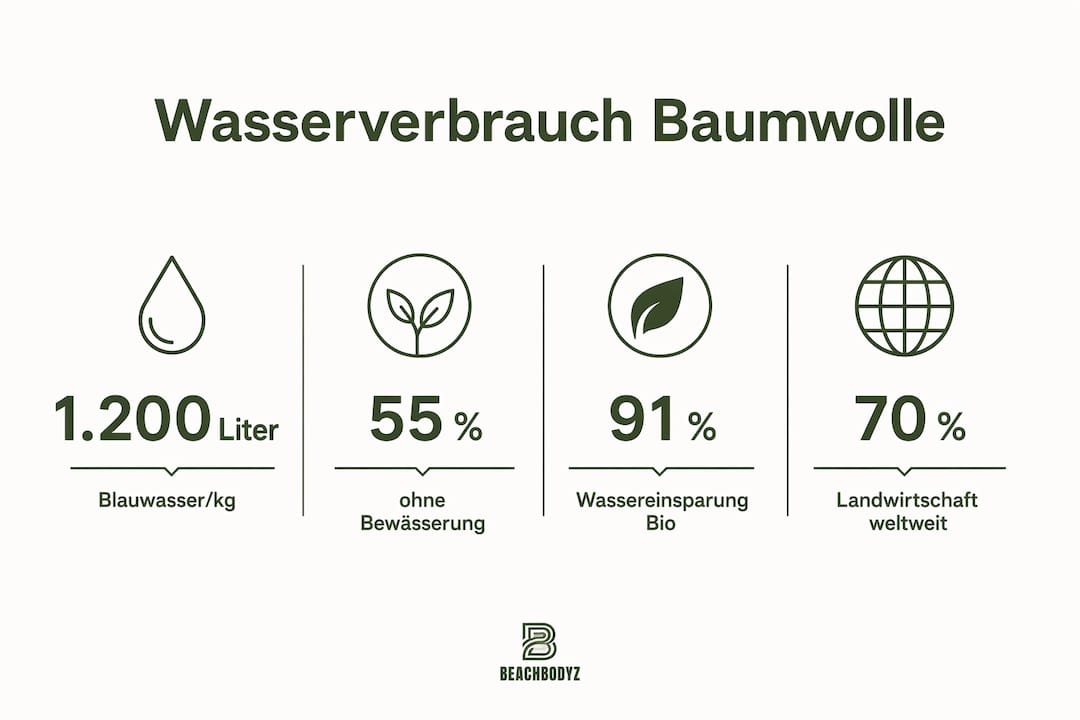
Globally, the production of one kilogram of cotton fiber requires an average of about 1,200 liters of artificial irrigation. This value refers to so-called blue water and comes from current calculations by the International Cotton Advisory Committee (ICAC). The often-cited figure of up to 20,000 liters per kilogram is scientifically outdated and dates back to a 1999 white paper that was based on crop yields under extreme pest conditions.
Cotton accounts for around 3% of global agricultural water consumption. Agriculture as a whole is responsible for about 70–73% of global water consumption.
Key facts at a glance:
- Blue water consumption per kg fiber: approx. 1,200 liters (ICAC estimate)
- One cotton T-shirt: around 2,700 liters total water consumption
- One pair of jeans: up to 11,000 liters of water from raw material extraction to production
- 55% of global cultivated land is irrigated exclusively by rainwater
- Water consumption varies greatly depending on the region, cultivation method, and yield level, without providing a specific figure
Blue water, green water, grey water: Which types of water count in cotton cultivation
The total water requirement for cotton consists of three different types of water. This distinction is crucial for a realistic assessment of ecological water consumption.
- Blue water: Surface and groundwater that is actively extracted for irrigation. This share is ecologically the most critical, as it directly strains water reserves.
- Green water: Rainwater stored in the soil, which plants absorb directly. It accounts for the largest part of total consumption in rain-fed cultivation.
- Grey water: The volume of water required to dilute pollutants from pesticides and fertilizers to a harmless level.
| Water type | Source | Ecological relevance |
|---|---|---|
| Blue water | Ground and surface water | High, direct extraction from water reserves |
| Green water | Rainwater in the soil | Low, no interference with water reserves |
| Grey water | Dilution water for pollutants | Medium, depending on pesticide use |
The water footprint varies considerably depending on the cultivation region, climatic conditions, and yield level. Newer life cycle assessments, for example by the IFEU Institute, additionally weight water consumption with water scarcity factors according to the AWARE method. One liter of water in a dry region thus causes significantly greater ecological damage than the same liter in a humid region.
Global context: Where does Germany's cotton come from?
Germany does not grow its own cotton. Almost 100% of the water needed to produce clothing consumed in Germany comes from abroad. The main supplier countries for cotton are India, China, the USA, Brazil, and Pakistan.
| Country | Cultivation method | Water source |
|---|---|---|
| India | Mixed (irrigated and rain-fed) | Blue and green water |
| China | Predominantly irrigated | Blue water dominant |
| USA | Regionally varied | Blue and green water |
| Brazil | Increasingly rain-fed | Green water dominant |
| Pakistan | Heavily irrigated | Blue water dominant |
Approximately 55% of the world's cotton is produced without artificial irrigation. Rain-fed cotton has a significantly lower ecological water footprint than irrigated conventional cotton. For Germany, this means: the origin of the cotton and the cultivation methods used there largely determine how water-intensive a piece of clothing actually is.
Which initiatives reduce water consumption in cotton cultivation
The Better Cotton Initiative (BCI) is the world's largest sustainability initiative for cotton. It trains farmers in environmentally friendly water management, promotes the development of healthy soils, and sets standards for the use of pesticides and fertilizers.
- BCI Standards: Focus on reducing blue water consumption, improving soil quality, and strengthening the resilience of farms
- International Association of the Natural Textile Industry (IVN): Promotes the use of certified organic cotton in Germany and sets standards for ecological textile production
- GOTS Certification: The Global Organic Textile Standard prescribes ecological cultivation conditions and social criteria for the entire supply chain
- Cotton made in Africa (CmiA): Promotes rain-fed cultivation in Africa and has demonstrably saved billions of liters of water
Sustainability programs like the Better Cotton Initiative focus on where ecological pressure is greatest: on blue water consumption in dry cultivation regions. Training in drip irrigation and soil building measurably reduces water demand per kilogram of fiber.
Pro Tip: When buying clothes, it's worth looking for certifications like GOTS or the BCI label. These seals indicate that cotton cultivation has been carried out according to audited environmental standards.
Sustainable cotton fashion from Germany: Beachbodyz as an example
Beachbodyz is a German streetwear brand that exclusively uses GOTS-certified organic cotton and recycled polyester. All products are ethically produced in the EU and shipped carbon-neutral.
GOTS-certified organic cotton combines ecological cultivation standards with social criteria along the entire supply chain. For consumers, this means transparency from the field to the finished garment.
Organic cotton is often grown in rainier regions, which reduces the need for artificial irrigation. Studies show that organic cotton in certain growing regions requires up to 91% less irrigation water than conventionally irrigated cotton. This difference is primarily due to the choice of location and the higher humus content of the soils, not a physiological property of the plant.
If you want to buy sustainable cotton clothing, you should pay attention to the following features:
- GOTS or OCS certification on the label
- Production in the EU or in countries with proven social standards
- Durable designs instead of seasonal fast fashion
- Manufacturer transparency regarding the supply chain
Pro Tip: Durable organic cotton clothing significantly reduces water consumption per wear time. A garment that lasts five years distributes its water footprint over significantly more usage cycles than fast fashion items.
The Authentic Sport Jogginghose from Beachbodyz is an example of durable streetwear made from GOTS-certified organic cotton, ethically produced in the EU.
How does cotton compare to other fibers?
Cotton consumes less water than commonly assumed when compared to other natural fibers and crops.
| Fiber / Plant | Water consumption per kg |
|---|---|
| Cotton (conventional, irrigated) | approx. 1,200 liters blue water |
| Rice (unmilled) | approx. 2,300 liters |
| Wheat | approx. 1,400 liters |
| Linen / Hemp | significantly lower, often without irrigation |
| Polyester | low water consumption during cultivation, but microplastic pollution |
Linen and hemp manage without artificial irrigation in many growing regions and are therefore considered low-water alternatives. Synthetic fibers like polyester require little water during cultivation but cause microplastic emissions when washed. Cotton is in the middle range, with the cultivation method being decisive. More on sustainable fabrics and their environmental properties is available in a more in-depth overview.
How can water demand in cotton cultivation be reduced?
Several methods have proven effective in practice:
- Drip irrigation: Water is directed directly to the roots, minimizing evaporation losses. Israel uses this method even in the Negev Desert, achieving comparatively low consumption figures.
- Soil building and humus enrichment: More organic matter in the soil increases water storage capacity. In sandy soils, a 2% increase in organic matter can double water storage capacity.
- Cover cropping: Cover crops reduce water runoff and increase organic soil matter.
- Rain-fed agriculture: Where climatically possible, artificial irrigation is completely eliminated.
- Efficient pumping technology: Modern irrigation systems reduce energy consumption and water loss due to leaks.
Climate change exacerbates water scarcity in many agricultural regions. Rising temperatures increase evaporation and shift precipitation patterns. Cultivating countries in Central Asia and parts of India are particularly affected. Efficient water management is not an option there, but a necessity.
Key findings
Cotton's blue water consumption averages about 1,200 liters per kilogram of fiber, not the often-cited 20,000 liters.
| Topic | Details |
|---|---|
| Blue water consumption per kg | Approx. 1,200 liters of artificial irrigation according to ICAC, not 20,000 liters |
| Share of rain-fed cultivation worldwide | 55% of cultivated area without artificial irrigation |
| Cotton's share of total consumption | Around 3% of global agricultural water consumption |
| Organic cotton and irrigation | Up to 91% less blue water, primarily due to site selection in rainy regions |
| Most effective saving measure | Drip irrigation and humus building measurably reduce water demand per kg fiber |
FAQ
How much water does cotton consume per kilogram?
According to ICAC, an average of approximately 1,200 liters of blue water (artificial irrigation) are needed for one kilogram of cotton fiber. The total water footprint varies significantly depending on the region and cultivation method and includes not only irrigation water but also the share of rainwater.
Is it true that cotton needs 20,000 liters of water per kilogram?
No. This figure comes from an outdated white paper from 1999 and does not reflect current crop yields. Newer ICAC studies correct this value to around 1,200 liters of blue water per kilogram of fiber.
Does organic cotton consume less water?
Organic cotton, in certain studies, requires up to 91% less irrigation water than conventional cotton. This difference primarily results from the choice of location in rainier regions and a higher humus content of the soils, not from a physiological property of the plant.
Who is the largest water consumer in Germany?
Agriculture is responsible for about 70–73% of water consumption worldwide. Water consumption varies significantly depending on the type of consumption and assessment.
What certificates prove sustainable cotton cultivation?
GOTS (Global Organic Textile Standard), the BCI label of the Better Cotton Initiative, and OCS (Organic Content Standard) are the best-known certificates. They verify ecological cultivation conditions, water management, and social standards along the supply chain.
Recommendation
- Eco-Friendly Fabric Choices: Sustainable Fabrics for a Better Future – BEACHBODYZ®
- Organic Cotton Clothing Benefits: Sustainable Streetwear Explained – BEACHBODYZ®
- Sustainable Streetwear 2026 | BeachBodyz®
- Premium Cotton Basics: The Ultimate Guide for Sustainable and High-Quality Everyday Wear – BEACHBODYZ®