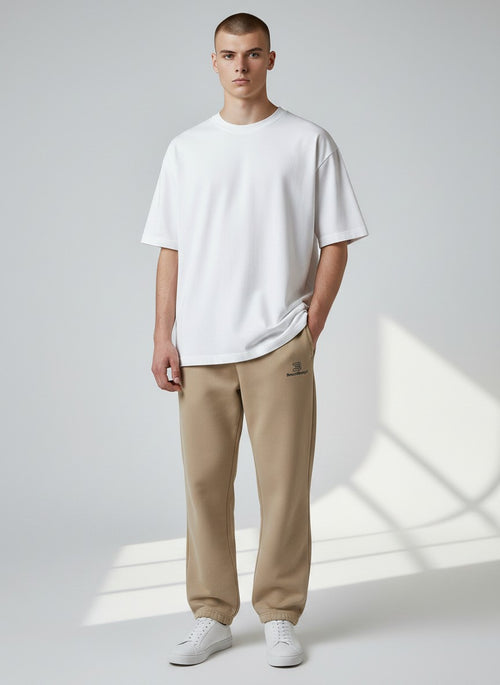
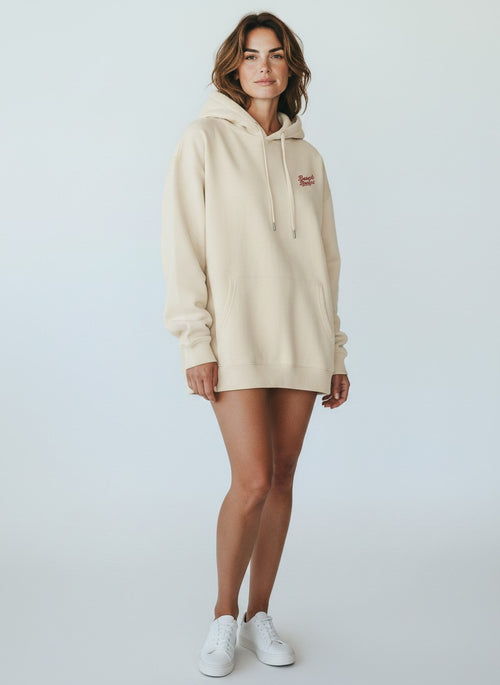
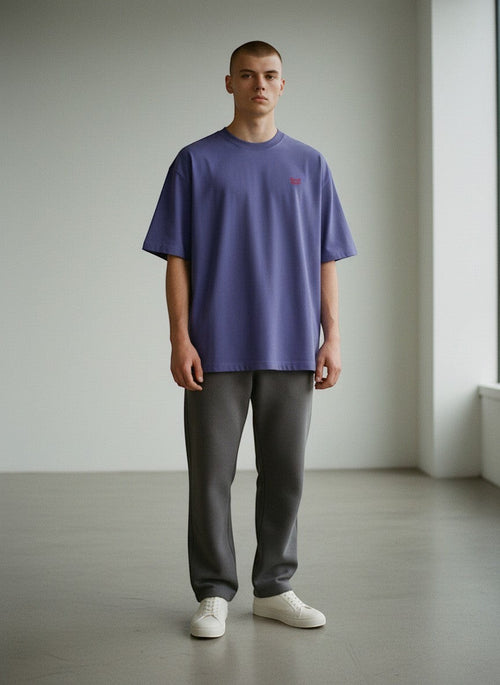
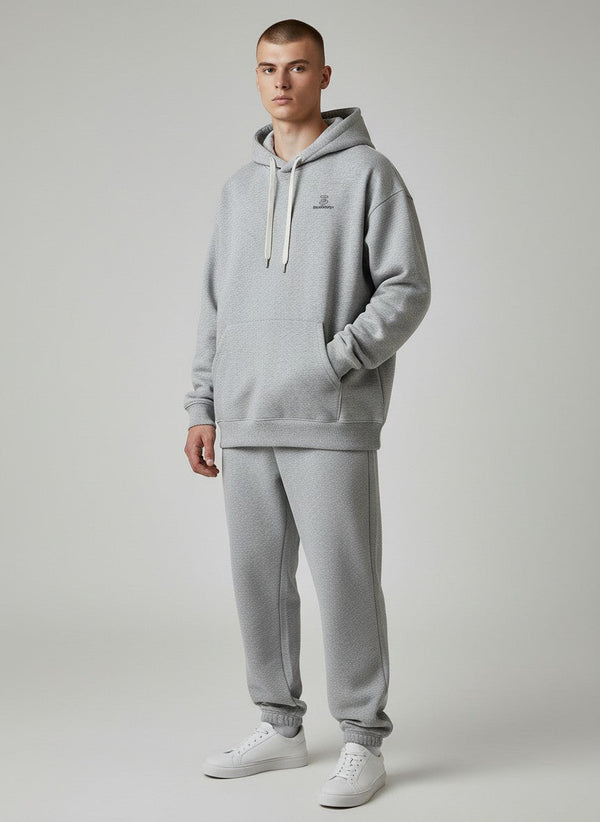
Unisex cuts are garments designed for all genders. For women, this usually means: loose, body-skimming silhouettes, broader shoulders, longer sleeves, and little to no waist shaping, because many unisex styles are based on men's ready-to-wear sizing. Those who know the differences from classic women's cuts, take their own measurements, and pay close attention to the shoulder seam, sleeve length, and hem will find unisex pieces that look intentionally casual rather than simply too big. This overview covers definition, size selection, fit check, styling, material, and care.
The essentials in brief
- Unisex fashion is often based on men's standards: little to no waist shaping, broad shoulders, long sleeves.
- For tops, the chest circumference is the deciding factor; for pants, the hip circumference. For unisex tops, women usually choose one size smaller than usual.
- Oversize is the typical feature of unisex fashion. The looseness is intentional, not a mistake.
- T-shirts, hoodies, sweatshirts, and sweatpants work most reliably in a unisex cut.
- Certifications such as GOTS provide information about the organic content and social standards, not necessarily about longevity.
Table of Contents
- What defines a unisex cut
- Unisex cut vs. women's cut
- Typical garments in a unisex cut
- The right size for unisex clothing
- Fit check: shoulder, sleeve, length, width
- Unisex cuts in larger sizes
- Typical mistakes when buying unisex clothing
- Combining unisex pieces: everyday wear and streetwear
- Material and workmanship: how to recognize durable unisex clothing
- Care for a long lifespan
- Unisex streetwear from Beachbodyz
- Frequently asked questions
- Sources
What defines a unisex cut
Unisex fashion includes clothing that men and women can wear equally. In practice, this is rarely neutral: According to an analysis in Spiegel, many unisex cuts are based on men's ready-to-wear standards. The result: little to no waist shaping, few curves, sleeves that can end up too long, and shoulders that sit too wide. The title of the post summarizes the situation: gender-neutral clothing usually consists of shirts and hoodies, i.e., pieces that are most likely to compensate for differences in body shape.
As typical features, n-tv cites loose silhouettes and oversized cuts. They are worn primarily for their casual, comfortable fit.
Overview of the characteristics of a unisex cut:
- Body-skimming basic shape: The fabric does not fit tightly but hangs straight.
- Little or no darts: Chest and waist shaping are largely absent.
- Straight side seams: No cut at the waist, no flaring at the hips.
- Shoulder and sleeve according to men's measurements: The shoulder seam and sleeve length are designed for broader shoulders and longer arms.
- Longer torso length: Tops often reach past the hips.
- Neutral size designation: Usually only letter sizes (XS to XXL) without a women's or men's designation.
For women, this does not result in a disadvantage as long as the fit is chosen consciously. A unisex hoodie bought one size smaller fits differently than the same hoodie in the usual women's size. It is precisely these differences that determine whether the look appears casual or shapeless.
Unisex cut vs. women's cut
Classic cuts take different body shapes into account. According to Deutschlandfunk Nova, women benefit from darts, while unisex fashion, according to designer Sarah Effenberger, must be designed very body-skimming and rather sack-like. The reason: women often need more room at the hips and chest, while classic men's cuts are based on broader shoulders and a V-shape that narrows towards the bottom. A cut that is intended to cover both must plan for width at all points.
| Criterion | Classic women's cut | Typical unisex cut |
|---|---|---|
| Basic shape | Body-skimming, adapted to curves | Body-skimming, straight |
| Shoulders | Narrower, seam on the shoulder edge | Broader, seam often beyond the shoulder |
| Chest | With darts or shaping | Without darts, uniform width |
| Waist | Waisted | Little to no waist shaping |
| Hips | More width in the hip area | Straight hang, width distributed over chest and stomach |
| Sleeves | Shorter, narrower | Longer, wider |
| Torso length | Shorter to hip length | Hip length to past the hips |
| Size system | Women's sizes (e.g., 36, 38, 40) | Letter sizes, often based on men's measurements |
Fashion expert Ulrike Nägele sees oversized silhouettes in her conversation with detektor.fm as a means to blur gender-specific contours. However, she considers a completely gender-neutral fashion industry unrealistic due to different body shapes. In practice, this means: unisex cuts work best where width is already desired, i.e., for tops and loose pants. For figure-hugging pieces such as blazers or dresses, the principle reaches its limits.
Typical garments in a unisex cut
According to n-tv, unisex fashion includes basic sweaters, wide jeans, T-shirts, and hoodies, but also floral shirts and more elegant garments. How well a piece works for women depends heavily on the type of garment.
| Garment | Typical unisex fit | Check point for women |
|---|---|---|
| T-shirt | Straight, wide, often oversized with dropped shoulders | Sleeve length and hem height |
| Hoodie | Wide torso, kangaroo pocket, cuffs on sleeves and hem | Torso length, hood size |
| Sweatshirt | Straight cut, ribbed cuffs | Cuffs should sit at hip height, not below |
| Sweatpants | Straight or slightly tapered leg, elastic waistband | Hip width and leg length |
| Jacket | Straight cut, room for layers underneath | Shoulder width, sleeve length |
| Shorts | Wide leg, elastic waistband | Hip circumference, leg opening |
| Shirt | Straight, without darts | Button placket over the chest must not gape |
| Wide jeans | Straight or wide leg | Ratio of waistband to hip width |
Tops with stretchy cuffs and pants with elastic waistbands are the easiest entry pieces. Cuffs absorb excess width, while elastic waistbands compensate for differences between the waist and hips. Shirts and jeans with fixed waistbands are more demanding because the difference between men's and women's proportions becomes directly visible.
The right size for unisex clothing
For unisex and men's tops, a simple rule of thumb applies: Women usually choose one size smaller. For tops, the chest circumference is the deciding factor; for pants, the hip circumference. Product-specific manufacturer notes take precedence over any general rule.
German men's sizes usually follow a fixed formula: The ready-to-wear size corresponds to the chest circumference in centimeters divided by two. Women's sizes are calculated differently. Therefore, the usual women's size cannot be transferred one-to-one to a unisex label.
Calculation examples according to the men's formula:
| Chest circumference | Calculation | Men's ready-to-wear size |
|---|---|---|
| 88 cm | 88 ÷ 2 | 44 |
| 92 cm | 92 ÷ 2 | 46 |
| 96 cm | 96 ÷ 2 | 48 |
| 100 cm | 100 ÷ 2 | 50 |
| 104 cm | 104 ÷ 2 | 52 |
Which letter size corresponds to which number is determined by each brand. The size chart of the respective product is therefore the most reliable basis.
Procedure in five steps:
- Measure chest circumference: Run the measuring tape horizontally across the fullest part of the chest, not too tightly.
- Measure hip circumference: At the widest part of the hips, relevant for pants and shorts.
- Measure your favorite piece: Lay a well-fitting shirt or hoodie flat, measure the width from armpit to armpit, and double it. Also note the length from the shoulder to the hem.
- Compare with the size chart: Many shops provide product measurements as half chest width. Compare your own measurement with these values, not just with the label.
- Determine the desired look: For a subtly loose fit, choose one size smaller. For a conscious oversized look, take the size that exceeds the product measurement by a significant width.
A special case is pieces that are already cut as an oversized model. Here, the width is planned. If you order one size larger in addition, you will quickly end up with a garment that no longer fits properly at the shoulder and sleeve.
Fit check: shoulder, sleeve, length, width
According to Spiegel, men-oriented unisex cuts repeatedly present the same problems: sleeves that are too long, shoulders that are too wide, little to no waist shaping. Four check points help during the fitting.
Shoulder seam
In classic cuts, the seam sits on the shoulder edge. In oversized models, it is often deliberately placed lower, the so-called dropped shoulder. This is intentional and looks casual. It becomes problematic when a classically cut piece is so large that the seam ends up on the upper arm. Then the piece does not look oversized, but simply too big.

Sleeve length
The sleeves are often the first weak point in unisex pieces. For T-shirts, the sleeve should not reach past the elbow, unless a conscious long-sleeve look is desired. For hoodies and sweatshirts, ribbed cuffs absorb additional length: The fabric slightly bunches at the wrist, which fits the streetwear look. Without cuffs, only rolling up or altering remains.
Torso length
A unisex top that reaches the middle of the thighs strongly changes the proportions. As a guideline: The hem should end at hip height or just below. Longer pieces work best with narrow pants, cycling shorts, or shorts.
Width at chest and hips
Because unisex cuts distribute the width evenly, women often experience tension at the chest, while fabric is left over at the waist and back. A quick test: stretch your arms forward. If the fabric pulls across the back or pulls up at the chest, the size is too small. The same applies to the hips for pants: The waistband fits if the pants do not dig in when sitting down.
Unisex cuts in larger sizes
Unisex collections often range up to XXL or beyond. For women with larger ready-to-wear sizes, this can be an advantage because loose cuts offer more freedom of movement and do not fit tightly at every point. At the same time, the differences between men's and women's proportions become more clearly visible in larger sizes, especially at the shoulder, chest, and hips.
What to pay attention to in larger sizes:
- Check chest and hip measurements separately: Even if the top fits at the chest, it can still be tight at the hips if the hem ends there.
- Length before width: A top with sufficient torso length sits more calmly than one that is only generous in width.
- Pay attention to cuffs: Tight hem cuffs can constrict at the stomach or hips. An open hem hangs straighter.
- Pants with elastic waistband and drawstring: Sweatpants and shorts flexibly compensate for differences between the waist and hips.
- Choose heavy fabrics: Dense qualities show less and hang more evenly.
Typical mistakes when buying unisex clothing
- Assuming women's size: A women's M is rarely equal to a unisex M. Without looking at the size chart, the piece usually turns out too wide.
- Double oversized: Ordering an already loosely cut model one size larger shifts the shoulder seam and sleeve too far.
- Read only the label: Product measurements in centimeters are more informative than the letter size.
- Don't underestimate thin fabric: Lightweight jersey falls limply in wide cuts and highlights exactly the areas that are meant to be concealed.
- Buy trousers by waist width: For unisex trousers, the hip circumference is the deciding factor.
Combining Unisex Pieces: Everyday Wear and Streetwear
For everyday wear, n-tv recommends tucking wide shirts into the waistband or combining oversized shirts with jeans and sneakers. Baggy jeans and a hoodie are mentioned for a casual look, with color used to create targeted accents.
The basic principle behind almost all successful unisex outfits: balance volume and structure. A wide top looks more defined when the bottom is slightly narrower or the waist remains visible at one point.
| Occasion | Combination | Effect |
|---|---|---|
| Everyday | Oversized shirt, front tucked into the waistband of straight jeans, sneakers | Waist is emphasized, volume is maintained |
| Streetwear | Hoodie with baggy jeans or sweatpants, cap, chunky sneakers | Consistently casual silhouette |
| Transition | Sweatshirt over a shirt, collar visible, straight trousers | Layered look with structure |
| Training | Oversized shirt with shorts or cycling shorts | Freedom of movement, clear proportions |
| Evening | Wide shirt, half-tucked, with slim trousers and ankle boots | Casual but polished |
| Cold days | Jacket over a hoodie, sweatpants with cuffs | Warmth through layers, cuffs hold the shape |
Further adjustments:
- Proportion: Wide at the top, narrow at the bottom, or vice versa. Wide combined with wide works best in a pure streetwear look.
- Tone-on-tone: A hoodie and sweatpants in the same color elongate the silhouette.
- Color accent: A colored piece with neutral basics draws the eye.
- Push up sleeves: Pushed-up sleeves show the wrist and make wide tops look lighter.
- Accessories: A belt over a long shirt, a cap, or a bag adds structure to a wide silhouette.
Material and Workmanship: How to Recognize Long-Lasting Unisex Clothing
A good cut means little if the garment loses its shape after a few washes. The Verbraucherzentrale recommends buying high-quality clothing, caring for it gently according to the washing instructions, and carrying out minor repairs yourself. Seals provide information about environmental and social standards. According to the Verbraucherzentrale, the GOTS seal (Global Organic Textile Standard) only certifies textiles that contain at least 70 percent fibers from certified organic farming.
The GOTS system distinguishes between two labels. According to the GOTS organization, products with the seal must consist of at least 95 or 70 percent organically produced natural fibers. The label "Organic" or "Made with XX% Organic" indicates which level applies.
Important for classification: According to the Umweltbundesamt, environmental and social seals do not allow for automatic conclusions about the longevity of a garment. A seal therefore does not replace a close look at the workmanship.
Checkpoints for workmanship:
- Fabric weight: Heavier cotton qualities (heavyweight) hang more smoothly in wide cuts and retain their shape better than thin jersey fabrics.
- Seams: Even, dense stitching without loose threads. Double seams on the hem and sleeves last longer.
- Cuffs: Ribbed cuffs with an elastane content snap back after being stretched.
- Collar: A firm ribbed collar loses its shape less quickly.
- Material mix: The fiber specification shows whether pure cotton or a blend, for example with recycled polyester, has been used.
- Label: The fiber composition and care symbols should be fully specified.
Especially with oversized cuts, the fabric weight is crucial. A thin, wide shirt hangs limply and quickly looks like an oversized mistake. A heavy fabric gives the volume structure and makes the difference between an intentional unisex look and an unsuitable size visible.
Care for a Long Service Life
The Umweltbundesamt recommends wearing clothing for as long as possible and having it repaired or altered when it shows wear or damage. This also applies to unisex pieces: Sleeves that are too long or a hem that is too long can be adjusted by an alterations tailor, which can significantly improve the fit for women.
For laundry, the Verbraucherzentrale says a limited range of products is sufficient. Ecological detergents, low temperatures, and airing out instead of washing protect the fibers.
Care routine for unisex streetwear:
- Turn pieces inside out to protect prints and embroidery.
- Wash at a low temperature, unless the care label states otherwise.
- Wash similar colors together.
- Air out hoodies and sweatshirts after wearing them instead of washing them immediately.
- Dry flat or on a wide hanger to prevent wide cuts from stretching out.
- Repair minor damage, such as open seams, early on.
Unisex Streetwear by Beachbodyz
Beachbodyz is a streetwear brand from Bremen with a focus on sustainable fashion. The collections consist of GOTS-certified organic cotton and recycled polyester, are produced fairly in the EU, and shipped climate neutrally. The cuts are often oversized, a typical feature of unisex fashion, and combine streetwear with gymwear. Heavy, high-quality materials give the volume structure. Many pieces are suitable for personalization, such as embroidery.
| Product Line | Price |
|---|---|
| Oversized Shirts | 45 € |
| Hoodies | 66–78 € |
| Sweatshirts | 71 € |
| Sweatpants | 59 € |
| Jackets | 58–68 € |
| Shorts | 50 € |
| Shoes | 65 € |
The complete range is available in the Beachbodyz online shop.
Frequently Asked Questions
What is unisex fashion?
Unisex fashion is clothing that men and women can wear equally. Typical features are loose, body-skimming silhouettes and oversized cuts. Many styles are based on men's sizing, are barely tailored, and have broader shoulders.
What size should you choose for unisex?
Women generally choose one size smaller than usual for unisex tops. For tops, the chest circumference counts; for trousers, the hip circumference. For already oversized pieces and for deviating manufacturer specifications, the product's size chart applies.
Do unisex cuts also suit women over 50?
Unisex cuts are not tied to any age. What matters is the fit and combination: A high-quality sweatshirt or a wide shirt with straight trousers looks harmonious at any age. Heavy fabrics and muted colors support a clear, mature look.
Why do unisex pieces often look too big on women?
Many unisex cuts are based on men's measurements with broader shoulders, longer sleeves, and no tailoring. Those who order their usual women's size therefore often get more volume than planned. One size smaller, a close look at the shoulder seam and sleeve length, or tucking it into the waistband usually solves this.
Sources
- Spiegel: Unisex fashion, why gender-neutral clothing usually only consists of shirts and hoodies
- n-tv: Unisex fashion, 3 factors for a stylish look
- Deutschlandfunk Nova: The problem with unisex fashion
- detektor.fm: Unisex fashion at Berlin Fashion Week
- pro-dress: Size chart
- Wikipedia: Clothing size
- Verbraucherzentrale: Fair clothing, what the seals mean
- GOTS: Fiber flyer for the Global Organic Textile Standard
- Umweltbundesamt: The role of longevity and the service life of clothing
- Verbraucherzentrale: Washing laundry, proven detergents and unnecessary products