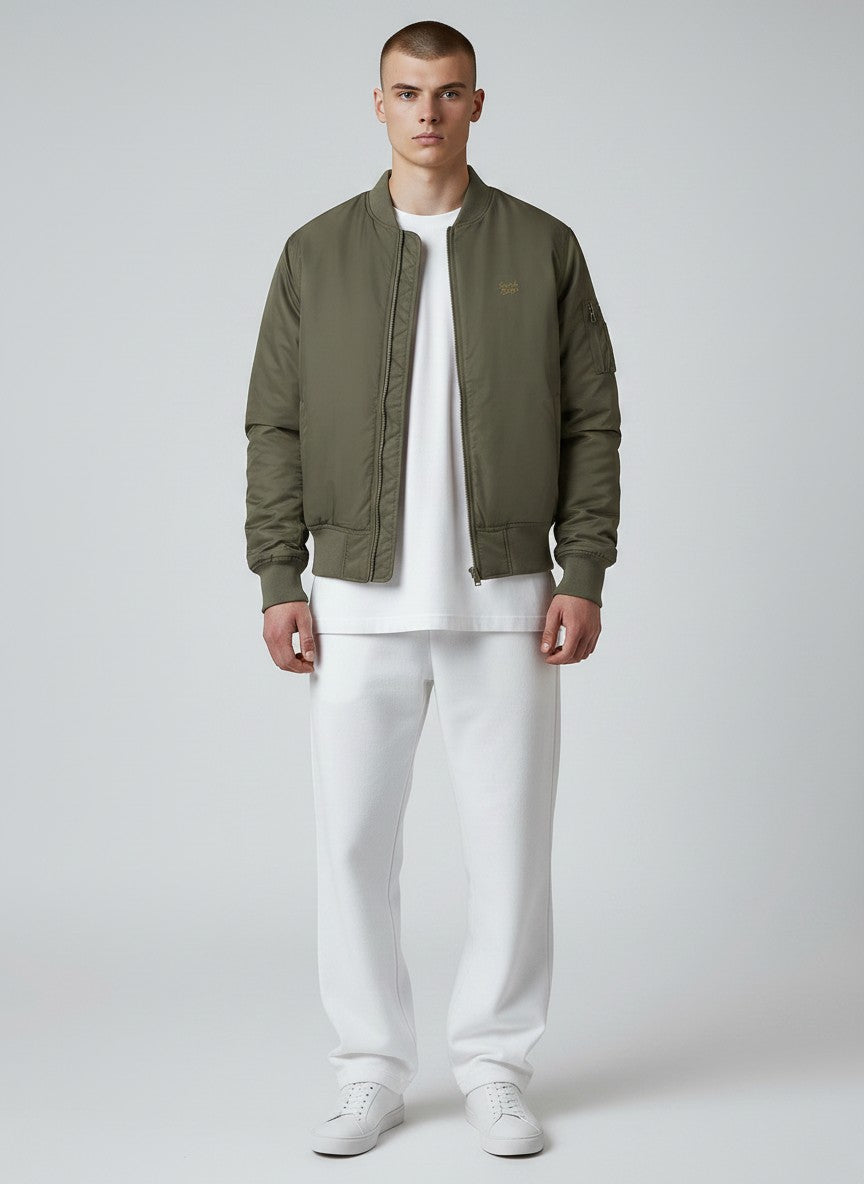
Recycled materials can be sensible in streetwear – but the word "recycled" does not yet explain how a garment was made, how long it will last, or whether an environmental claim is sound. Anyone wanting to realistically evaluate materials needs three things: accurate fiber disclosure, a verifiable standard, and a product-specific context.
This guide therefore explains what recycled polyester actually signifies, how it and OEKO-TEX differ, and which material classification applies to BeachBodyz. The focus is on verifiable information rather than sweeping sustainability promises.
In short: Recycled content is a relevant product feature, but not a free pass for terms like "environmentally friendly" or "sustainable." The decisive factors are the specific proportion, the certification, the scope, the manufacturing, the care, and the actual service life.
What recycled material means – and what it doesn't
With recycled polyester, existing plastic material is reused as a raw material. The Recycled Claim Standard (RCS) and the Global Recycled Standard (GRS) define requirements for verifying recycled content and for traceability along the supply chain. The GRS includes additional requirements for processing, chemicals, as well as social and environmental criteria.[1]
Such certification helps in verifying a material claim. However, it does not automatically mean that a product is climate-neutral, fully recyclable, or the better choice in every respect. Fit, workmanship, repairability, care, and service life also influence how useful a garment is in everyday life.
The European Environment Agency points out that 60 to 70 percent of textiles consist of plastic, primarily polyester. At the same time, less than one percent of all textiles worldwide are currently recycled back into new textile products. The agency therefore cites durable design and longer use, alongside the use of recycled materials, as central components of a more circular textile economy.[2]
Correctly categorizing BeachBodyz materials
At BeachBodyz, materials are distinguished by product group. This separation is important: and OEKO-TEX do not verify the same things and must not be used as interchangeable terms. The information on the respective product page and the care label always remains authoritative.
| Product group | Basic editorial classification | What should be checked before purchase |
|---|---|---|
| T-shirts, hoodies, sweatpants and shorts | GOTS organic cotton | Exact fiber composition, GOTS details of the specific item, grammage, and care label |
| Fleece jackets | Recycled polyester; GRS-certified for models specifically designated as such | Recycled content, GRS details, material weight, and product-specific care |
| Softshell and other jackets | Model-specific information regarding recycled polyester and/or OEKO-TEX STANDARD 100 | Specific material composition, certificate attribution, stated function, and care label |
A concrete example shows why this differentiation is necessary: the Authentic Fleece Jacket is stated on its product page as having 100 percent recycled polyester and GRS certification. In contrast, the Core Softshell Jacket is listed as softshell made from recycled polyester with OEKO-TEX STANDARD 100. For the Authentic Oversize T-Shirt, the product page specifies 100 percent GOTS-certified organic cotton. These details apply to the specific model in each case and do not replace the need to check other items.
GOTS, GRS and OEKO-TEX: the differences
GOTS: Organic fibers and textile processing
The Global Organic Textile Standard applies to textiles made from certified organic fibers and includes downstream processing. GOTS distinguishes between two label grades: "organic" with at least 95 percent certified organic fibers and "made with organic materials" with at least 70 percent. Compliance is verified by independent certification bodies; the statement regarding a specific product must be covered by the actual scope of the certificate.[3]
GRS and RCS: recycled content and traceability
RCS and GRS serve to verify recycled materials and their supply chain. The GRS has a higher minimum percentage for consumer labeling and includes additional requirements. The phrasing remains important: a GRS claim confirms the certified recycled content and the verified process framework – not automatically every conceivable environmental impact of a finished product.[1]
OEKO-TEX STANDARD 100: tested for harmful substances
OEKO-TEX STANDARD 100 is a label for textiles that have been tested for harmful substances. According to OEKO-TEX, all components of a certified item – from yarn to buttons and accessories – are tested against more than 1,000 substances. The more intensive the skin contact, the stricter the requirements.[4]
Important: OEKO-TEX STANDARD 100 does not mean that a material is recycled. Conversely, the statement "recycled polyester" does not prove OEKO-TEX testing. Both statements must be verified separately and on a product-specific basis.
How to check material information before purchasing
- Look for the exact composition. "Recycled" or "organic" alone is too imprecise. The fiber type, percentage, and, if applicable, material weight are decisive.
- Check the standard and scope. Is it GOTS, GRS, RCS, or OEKO-TEX STANDARD 100? Does the information refer to the finished item, a material, or just one component?
- Separate material from function. Recycled polyester does not yet tell you whether a jacket is windproof, water-repellent, or particularly warm. Such properties must be stated on the specific product page.
- Treat origin as a separate piece of information. The note 📍MADE IN EU🇪🇺 describes the production location. By itself, it is not proof of specific wages, transport emissions, or higher product quality.
- Read the care label. The binding instructions for the specific item take precedence over general washing tips.
Vague terms, missing percentages, and certificate names without traceable product links are warning signs. Equally critical are absolute claims like "completely sustainable," "free of harmful substances," or "climate-neutral" when no appropriate basis is explained.
Wearing longer: selection, care and repair
A material guide should not end at the product page. The EEA cites extending product life cycles as a building block for circular textiles.[2] For everyday life, this primarily means: choosing a garment for a real purpose, checking the fit before purchasing, and observing the care instructions.
Washing temperature, drying, and ironing depend on the specific material, workmanship, and finishing. Therefore, use the label and the product-specific instructions first. The BeachBodyz guide "Reading care labels correctly" explains the symbols. For minor damage, the guide "Repairing clothing" can provide initial orientation; for functional parts, linings, or zippers, a tailor is often the safer solution.
Which material group suits which use?
For T-shirts, hoodies, sweatpants, and shorts, organic cotton is the focus at BeachBodyz. These product groups are suitable as a base for everyday wear, gym travel, and layering. For jackets, however, model-specific function counts: a fleece jacket is used differently than a softshell or windbreaker. Therefore, the selection should not be based solely on the seal, but on temperature, weather, movement requirements, and maintenance effort.
Those who wish to compare certificates in more detail will find an in-depth analysis in the BeachBodyz guide " vs. OEKO-TEX". For product selection, the simple rule applies: first determine the intended use, then check the material and proof, and only then choose the color or drop.
BUILT DIFFERENT in this context does not mean advertising with as many sustainability terms as possible. It means formulating product information clearly so that you can make an informed decision.
FAQ on recycled materials in streetwear
Is recycled polyester automatically more sustainable?
No. Recycled content is a relevant feature, but the overall assessment depends on factors including proportion, production, processing, use, and service life. A sound statement requires a clear comparison and appropriate verification.
Does OEKO-TEX STANDARD 100 mean that a product is recycled?
No. STANDARD 100 describes a test for harmful substances. Whether a product contains recycled fibers must be proven separately via the material composition and, if applicable, a standard such as GRS or RCS.
What does GOTS state for a garment?
GOTS refers to certified organic fibers and textile processing within the certified scope. For a specific product, the corresponding GOTS information should be traceable on the product page or in the associated documentation.
How do I care for streetwear made of recycled polyester?
First, follow the care label and the product-specific instructions. Sweeping rules are unsuitable because fleece, softshell, and other jackets can have different constructions and finishes.
Conclusion
Recycled materials are a sensible part of modern streetwear if their origin and content are transparently verified. However, they do not replace a precise product description or a realistic assessment of use, care, and service life. GOTS, GRS, and OEKO-TEX perform different tasks; good communication separates these standards cleanly and relates every statement to the specific product.
For your selection at BeachBodyz, this means: do not mix cotton-based product groups and jackets, read certificates according to their actual meaning, and take the care label seriously. This turns a buzzword into a traceable purchase decision.
Sources and Verification
- Textile Exchange: Recycled Claim Standard and Global Recycled Standard, accessed on September 20, 2026.
- European Environment Agency: Textiles, updated on April 10, 2026, accessed on September 20, 2026.
- Global Standard: Key Features of GOTS, accessed on September 20, 2026.
- OEKO-TEX: STANDARD 100, accessed on September 20, 2026.
Product information in the BeachBodyz section was checked against the respective linked product pages on September 20, 2026. In the event of subsequent changes to material, certification, or care, the information must be reconciled again. Author: Ahmed Shehata.