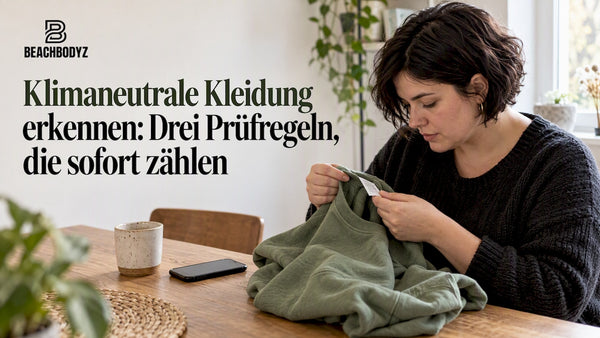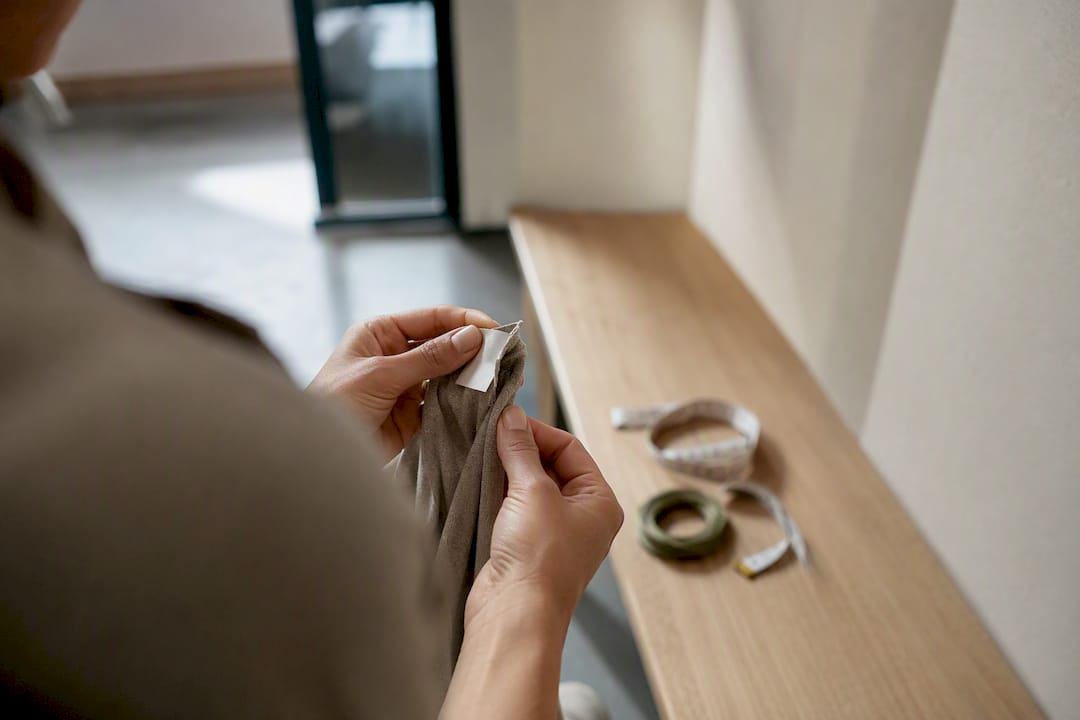
You can find plastic-free clothing by looking for genuine natural fibers such as GOTS-certified organic cotton, linen, or wool and by verifying certifications instead of trusting advertising claims. Secondhand platforms and specialized slow fashion shops usually provide more reliable results than large fashion retailers. The key is to check the label: no synthetic lining, no hidden percentages in blended fabrics, and a certificate that can actually be verified.
In short:
- Plastic-free clothing should consist of genuine natural fibers like organic cotton, linen, or wool and feature verification certificates.
- Secondhand and clothing swap platforms often offer higher-quality, natural fiber-based pieces than conventional fashion retailers.
- Recycled polyester is not a plastic-free substitute, as it remains a plastic and can release microplastics.
- Labels like GOTS, IVN Best, Green Button (Grüner Knopf), and Fair Wear check social and ecological standards but do not certify complete plastic-free status.
- When purchasing, it is important to carefully check material information, labels, and certificate numbers to avoid hidden sources of plastic.
Table of Contents
- Where can you actually find plastic-free clothing?
- Which materials are truly considered plastic-free?
- What do GOTS, IVN Best, Green Button, and Fair Wear actually guarantee?
- How do I check if a product is truly plastic-free before buying?
- How do you properly care for and repair plastic-free clothing?
- Where does plastic-free clothing reach its limits?
- How does BeachBodyz put plastic-free, fair streetwear into practice?
- Why plastic-free clothing is a realistic goal, but shouldn't be a dogma
- Sustainable streetwear without compromises on materials
- Where can you find further reliable information?
- Sources
- FAQ
Where can you actually find plastic-free clothing?
The honest answer: not on the next fast fashion rack you see. Anyone truly looking for plastic-free fashion has to search more selectively than during ordinary online shopping, but will receive much more reliable results in return.
Online marketplaces with filter functions are a good starting point if you use them correctly. Many larger platforms allow filtering by material composition, but these filters are often inaccurately maintained. Do not rely solely on the filter; open each product individually and check the full material details in the text, not just the title.
Specialized slow fashion shops differ from regular fashion retailers by something that is easily overlooked: supply chain transparency. Reputable providers name their production facilities, often even the name of the factory, and frequently offer repair services or at least repair instructions. If this information is missing entirely, it is a warning sign, not a coincidence.
Secondhand and clothing swaps are often the most pragmatic solution for plastic-free fashion. A piece of clothing from the 1990s made of pure cotton was produced at a time when synthetic blended fabrics were rarer. At clothing swap events, in free-shops, or via local swap boards, you can often find high-quality natural fiber pieces that would hardly be affordable new. The advantage: you extend the lifespan of an already produced garment, which, according to the German Environment Agency (UBA), is one of the most effective levers against overproduction in the fashion industry.
Local shops and manufactures offer an advantage no online shop can replace: you can touch the fabric. Natural fibers feel different from synthetics; they are usually less smooth, wrinkle differently, and smell charred rather than melting when a fiber sample is burned (if the seller allows it).
Before you buy, regardless of the channel, you should check the following points:
- Look at product images of the inside, not just the outside, to identify hidden lining fabrics.
- Read the material information in full, including sewing thread and fasteners, if stated.
- Request the certificate number if a label is advertised but not shown with a number.
- Check the return policy so that a bad buy due to incorrect material information can be easily reversed.
- For secondhand: have the label photographed before you buy, as older labels can sometimes be hard to read.
A look at alternatives to well-known outdoor brands also shows that true sustainability is often measured more by smaller, transparent labels than by market leaders.
Which materials are truly considered plastic-free?
Strictly speaking, the term "plastic-free" refers to the absence of synthetic, petroleum-based fibers such as polyester, nylon, polyamide, or elastane. However, not every fiber that sounds plant-based meets this criterion entirely.
Genuine natural fibers form the most reliable category. Organic cotton is breathable, robust, and very durable with proper care, though it requires a lot of water for cultivation. Linen is even more durable, though it wrinkles more and has a cooling effect, making it ideal for warm months. Hemp is considered particularly resource-efficient as the plant requires little water and no pesticides, but it feels rather coarse if not softened. Wool provides reliable warmth, is naturally dirt-repellent and antibacterial, but requires gentle care. Silk is the most delicate of them, shiny and lightweight, but not very practical for everyday streetwear.
Regenerated cellulose fibers such as lyocell, modal, and viscose originate from wood but go through intensive chemical processing steps before becoming fibers. They start out plant-based, but are not automatically equivalent to unprocessed natural fibers. Regarding the question of "plastic-free," they are generally unproblematic as they contain no petroleum, but they are not ecologically equivalent to an untreated natural fiber.
Recycled polyester is not a plastic-free substitute, even if it is sold as progress in many "sustainable" collections. It remains plastic and releases microplastics when washed, just like new polyester. The ecological advantage lies solely in lower primary resource consumption during production, not in the material property itself.
Hidden sources of plastic that almost everyone overlooks at first glance:
- Linings made of polyester, even in organic cotton jackets.
- Sewing thread, which is frequently made of polyester, even in completely natural fabrics.
- Buttons and zippers made of plastic instead of horn, wood, or metal.
- Impregnations with fluorinated chemicals, which, while not microplastics, act in a similarly problematic way.
- Embroidery threads on personalized pieces, where natural alternatives are rarely the standard, as seen in sustainable embroidery thread.
Pro tip: Never rely solely on the product name. A "100% organic cotton shirt" often refers only to the main fabric; the sewing thread and neck tape can still be synthetic. When in doubt, specifically ask about the composition of every single component.
What do GOTS, IVN Best, Green Button, and Fair Wear actually guarantee?
Labels are not an end in themselves; they are verification tools, but only if you know what they actually cover.
- GOTS (Global Organic Textile Standard) requires that a product contains between 70 and 100 percent organic natural fibers, combined with minimum ecological and social standards along the supply chain. It is therefore the most widely used label in the natural fiber textile sector.
- IVN Best is stricter: it requires 100 percent organic natural fibers and higher environmental standards than GOTS, but is harder to find because fewer manufacturers meet this hurdle.
- Green Button (Grüner Knopf) is a German government-backed label that recognizes existing certificates like GOTS as a prerequisite and additionally checks company-wide due diligence, for instance regarding wages and occupational safety beyond the individual product.
- Fair Wear focuses not on the material, but on working conditions. It offers a monitoring system for production sites and is therefore a useful supplementary signal if you want to know how fairly something was sewn, not just what it is made of.
This is how you verify a label in practice: Look closely at the logo; reputable providers display it in the correct resolution, not pixelated or copied. Demand the certificate number if stated, and compare it with the public GOTS database, which exists exactly for this purpose and helps effectively against greenwashing. Ask the manufacturer if information is missing; a transparent provider usually replies concretely within a few days.
Important to know: None of these labels certify synthetic fibers as "plastic-free." A GOTS label on a blended fabric with 30 percent polyester only confirms that the organic fiber content was declared and produced correctly within the allowed range, not that the product is completely plastic-free. Therefore, always read the material information in addition to the label.
How do I check if a product is truly plastic-free before buying?
A structured check rarely takes longer than two minutes, but saves you from unnecessary returns and disappointments.
For online purchases, step by step:
- Read the material information in full, including footnotes on lining, fasteners, and embellishments.
- Look for photos of the inside or request them from the provider if none are available.
- Demand proof of certification if a label is mentioned but no number is visible.
- Ask the customer service directly: Where does the raw material come from, where was it produced, what sewing thread was used?
- Note the return policy before you buy; especially with material discrepancies, a free return should be possible.
Asking the seller questions is not an act of distrust, but good practice. Formulate them concretely: "Is the sewing thread synthetic or natural?" is more effective than "Is this sustainable?" A provider that gives evasive answers to precise questions usually lacks full transparency about its own supply chain.
Secondhand has its own rules. Traceability is naturally weaker here; a twenty-year-old label rarely reveals the sewing thread used. Therefore, focus on what is actually verifiable:
- Read the label for material composition, even if faded or partially cut off.
- Feel the lining by hand; smooth and cool usually points to synthetics, while natural fibers feel warmer and have more grip.
- Evaluate the overall condition: seams, buttons, potential moth damage in wool.
- When in doubt, it is better to choose a cheaper piece and invest the rest of the budget in a reliably certified new piece.
Price and quality have a more realistic relationship with natural fibers than with synthetic mass-produced goods. A high-quality organic cotton shirt usually costs more than a polyester equivalent, but lasts significantly longer with good care and can be repaired instead of having to be thrown away.
How do you properly care for and repair plastic-free clothing?
The best plastic-free clothing is of little use if it loses its shape after three washes. Care is not a side issue here, but the actual lever for longevity.
Wash by fiber, not by habit: Organic cotton usually tolerates 30 to 40 degrees, wool and silk belong in the delicate cycle at 30 degrees or hand wash, and you should omit fabric softener for both entirely, as it coats the natural fiber structure and reduces breathability. Linen becomes softer with every wash, thus tolerating slightly more robust cycles than wool.
Drying and impregnating without compromising on material: Letting natural fibers air dry is significantly gentler on the shape and fibers than using a dryer. Anyone needing impregnation, for instance for a light jacket, should rely on products without fluorinated chemicals, as these can cause similar environmental problems as microplastics, even if they are not technically synthetic fibers.
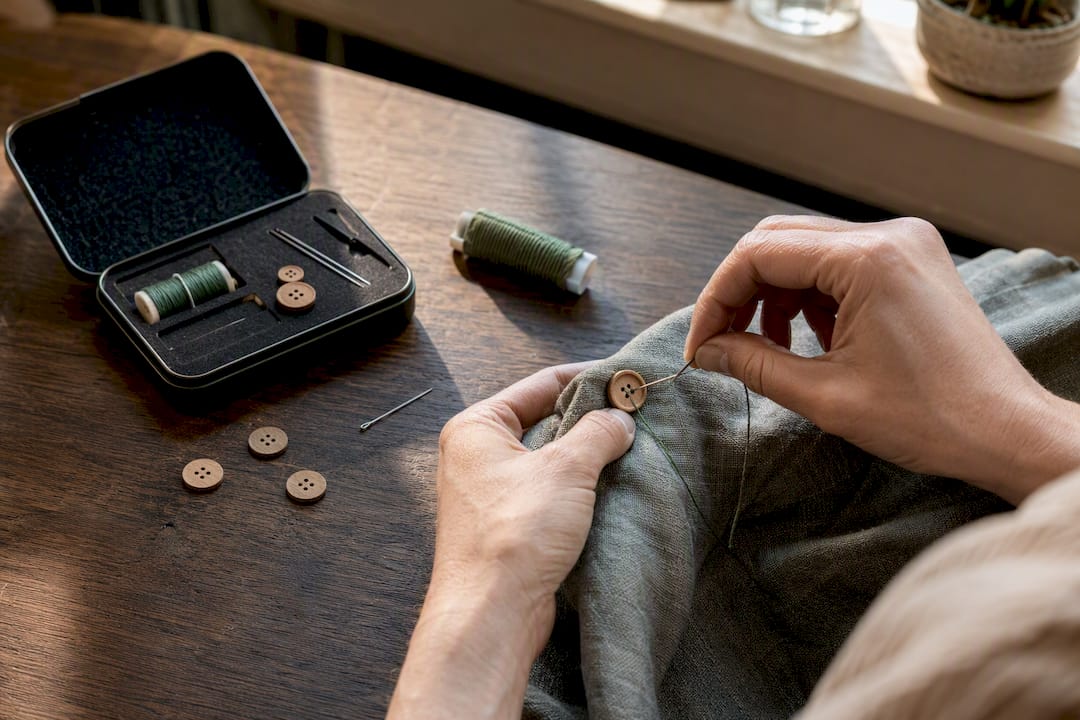
Repairing instead of throwing away is the underestimated building block of plastic-free fashion. A simple sewing kit is enough for loose buttons or small tears. For larger damage, a local tailor is worth it, often cheaper than buying new. Plastic buttons can easily be replaced with horn or wooden buttons, a small intervention with a major impact on the plastic-free status of the overall piece. You can find more detailed instructions on this in our guide on repairing clothing.
Pro tip: Microplastic filters for the washing machine are useful if you still own synthetic leftovers, but they do not replace plastic-free material choices. View them as a transitional solution, not a permanent one.
Those who consistently focus on material quality and repair reduce overall resource consumption more than buying a single "perfect" fiber ever could, according to estimates by the German Environment Agency.
Where does plastic-free clothing reach its limits?
Honestly: for certain areas of use, there is currently no completely convincing plastic-free solution, and admitting that openly is more honest than greenwashing.
For waterproof and heavy-duty outdoor clothing, natural fibers reach their physical limits. Waterproof membranes, as used in rain jackets, are almost always based on synthetic materials because comparable natural fiber alternatives do not provide the necessary impermeability to date. There are only a few completely plastic-free, truly functional alternatives for this specific purpose.
Possible compromises: impregnated wool or cotton for light rain, multi-layer systems where only the outermost protective layer is synthetic, or deliberately choosing recycled instead of newly produced polyester for the functional part. An honest life cycle assessment sometimes even shows that recycled polyester in a rarely worn, but extremely durable functional piece is ecologically more advantageous than a natural fiber that cannot withstand the load and must be replaced quickly.
Before you buy, it is therefore worth clarifying a few things for yourself:
- What is the garment really needed for: everyday wear or actual extreme conditions?
- How often is it actually used?
- Is a compromise between natural fiber main material and synthetic functional components acceptable?
- Would a secondhand functional piece serve the same purpose and thereby avoid new production?
For streetwear and everyday clothing, the area where most purchasing decisions are actually made, this dilemma hardly arises anyway. Here, completely plastic-free options have long been a reality.
How does BeachBodyz put plastic-free, fair streetwear into practice?
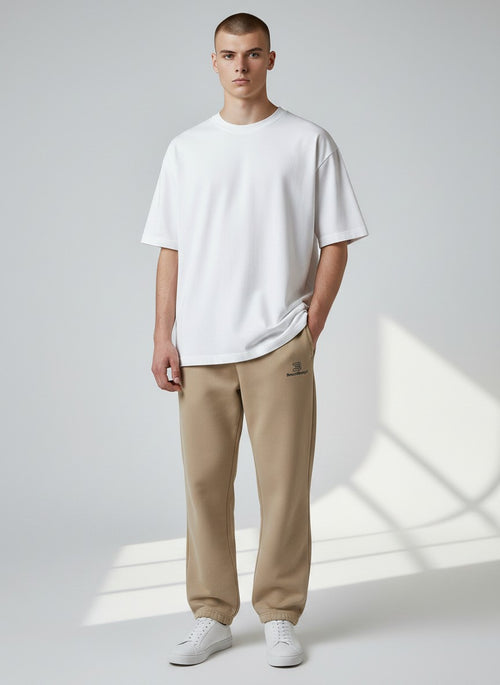
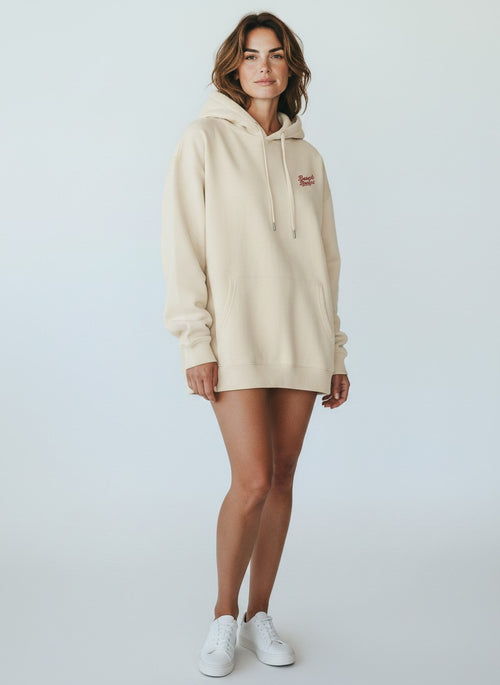
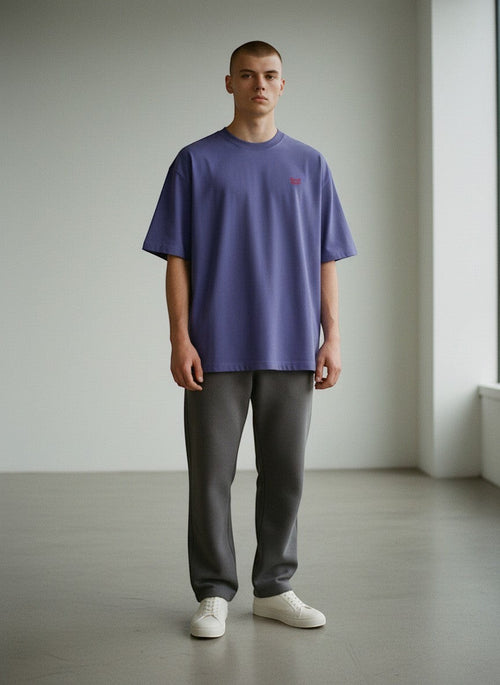
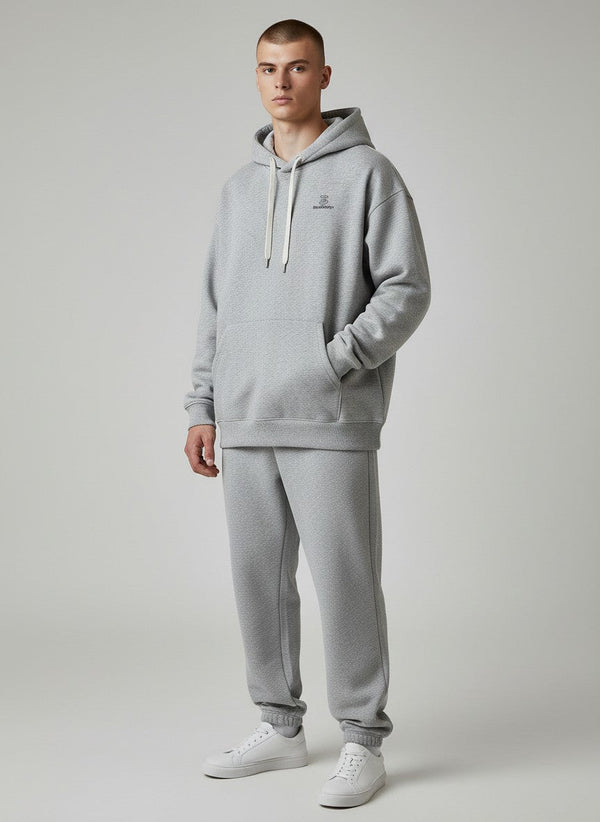
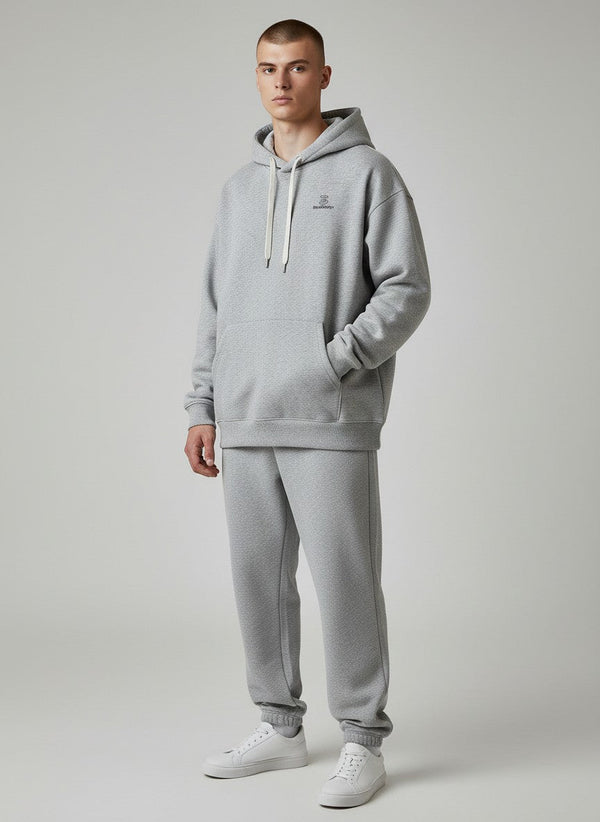
Beachbodyz produces its collections from certified organic cotton and complements them where necessary with recycled materials, instead of relying on new goods from fossil raw materials. This material decision is not a marketing phrase, but the basis of every basic item in our assortment, from oversized T-shirts to hoodies and sweatpants.
Production takes place fairly within the EU, which enables shorter supply chains and verifiable production conditions—an advantage that mass-produced goods from distant manufacturing countries can rarely offer. Shipping is climate-neutral, and many pieces can also be customized, for example through embroidery that uses sustainable embroidery thread instead of standard synthetic threads, as described in the article on sustainable embroidery thread.
For critical shoppers, Beachbodyz recommends exactly what this guide advises: do not believe certificates blindly; instead, ask questions and verify them in official databases. More background on the brand's material strategy can be found in the article on sustainable streetwear, including the question of how recycled materials are specifically integrated into basics without sacrificing longevity.
Why plastic-free clothing is a realistic goal, but should not be a dogma
Perfect fibers are rare, but good choices are plentiful. Anyone searching for the theoretically purest natural fiber with every purchase often loses sight of what really matters: longevity and a manufacturer that takes responsibility instead of just printing labels.
My priority would always be this order: first, repair what you already own; second, check secondhand; and only if both are not options, buy new intentionally, using genuine certificates rather than vague advertising language. Small steps are more effective here than a single "perfect" purchase. A replaced button, a self-repaired tear, or a secondhand find instead of a new item—over the years, these add up to a significantly smaller ecological footprint than any single purchasing decision on its own.
— Ahmed
Sustainable streetwear without compromising on materials
Beachbodyz solves exactly the problem this guide describes: the laborious search for reliably plastic-free clothing. Instead of checking every label individually, you will find consistently GOTS-certified organic cotton, fair EU production, and durable cuts here, without having to research anew for every piece whether the inner lining is synthetic.
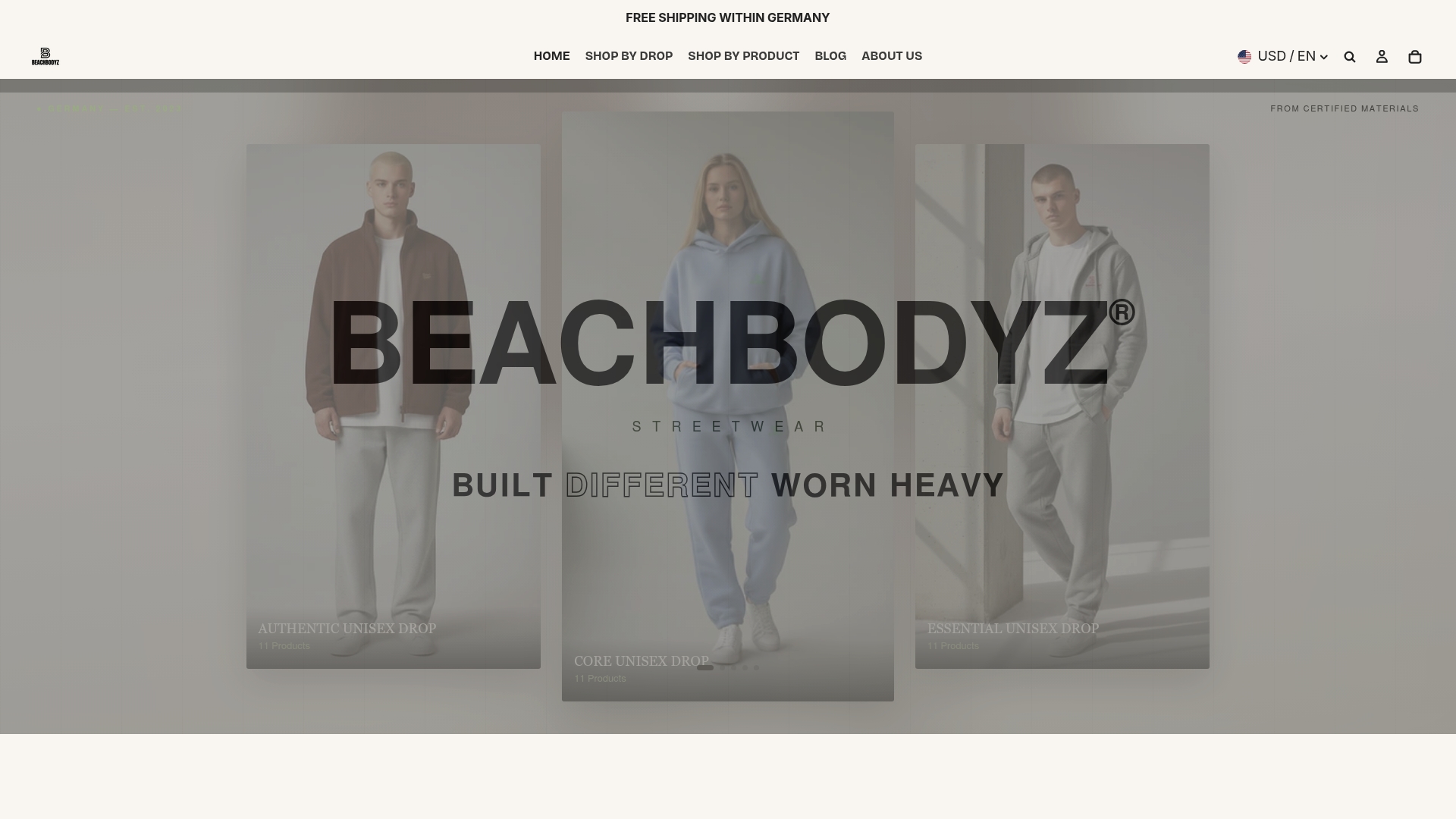
The range extends from oversized T-shirts to hoodies, joggers, and jackets, all designed for everyday use and intended for repair rather than disposal. For those who want a personal touch, many pieces can be embroidered using sustainable thread instead of standard plastic threads. Check out the current collection directly in the Beachbodyz online shop and find your next basic that you will wear for a long time.
Where can you find further reliable information?
If you are uncertain, it is always worth looking directly at the source instead of at the next advertisement.
- The GOTS certificate database helps you to actually verify an advertised seal.
- Fair Wear provides information on working conditions in certified production facilities.
- The German Environment Agency (Umweltbundesamt) provides independent background information on sustainable clothing.
- For the basics of the textile industry explained in a child-friendly way, it is worth looking at this explanation of sustainability in the textile industry.
- The "Grüner Knopf" (Green Button) and "IVN Best" labels publish their own criteria catalogs, which can be read directly on their respective websites in case of doubt.
Sources
- Sustainable clothing: More focus on a long service life – German Environment Agency
- Fair Wear Foundation
- Plastic-free alternatives for outdoor clothing | Bergfreunde Basislager
FAQ
What is the healthiest clothing?
Clothing made from untreated natural fibers such as organic cotton, linen, or wool is considered the most skin-friendly option, as it contains fewer synthetic additives and microplastic sources than synthetic fabrics.
Which brands are known for slow fashion?
Slow fashion brands are characterized by transparent supply chains, durable materials, and fair production conditions rather than rapid collection changes. With its GOTS-certified organic cotton and fair EU production, Beachbodyz belongs to this segment.
Which clothing brands are environmentally friendly?
Environmentally friendly brands are those that disclose their certificates and make them verifiable, for example via the GOTS database, rather than just advertising generally with "sustainability." Look for concrete seals like GOTS, IVN Best, or Grüner Knopf instead of vague statements.
Which well-known brands are not fast fashion?
Brands without a fast-fashion model produce smaller collections, often in the EU instead of low-wage countries, and place value on reparability rather than short usage periods. Beachbodyz consciously relies on limited drops instead of constant replenishment to avoid overproduction.
Is recycled polyester plastic-free?
No, recycled polyester remains plastic and continues to release microplastics when washed. The ecological advantage lies solely in the lower resource consumption during production, not in the material property itself.