In a Nutshell:
- Care labels indicate how to gently wash, dry, and iron clothes. They are important for sustainable use and extend the lifespan of textiles. Properly reading and following the symbols preserves the quality of clothing.
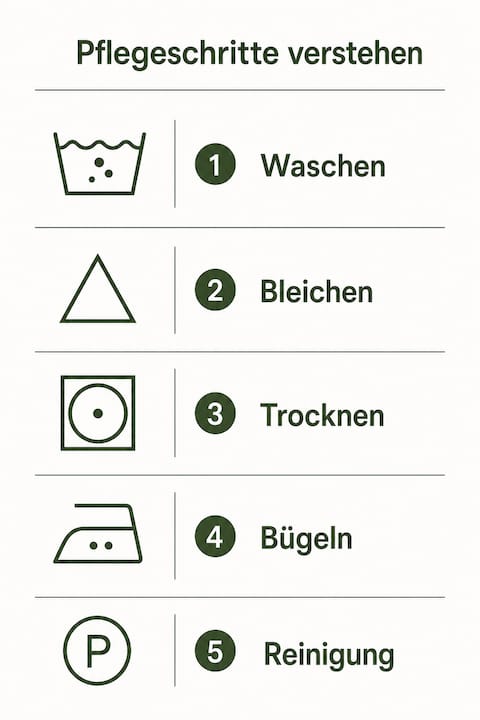
Care labels are standardized symbols on textiles that indicate how a garment can be washed, dried, ironed, and cleaned without risking damage. If you want to understand care labels, every label contains five basic symbols in a fixed order: washing, bleaching, drying, ironing, and professional cleaning. According to EU Regulation No. 1007/2011, fiber composition must be labeled, while care instructions, although not mandatory, must be precise once provided. For sustainable clothing, knowing these symbols is not a luxury but a foundation for conscious consumption.
What do the care label symbols mean?
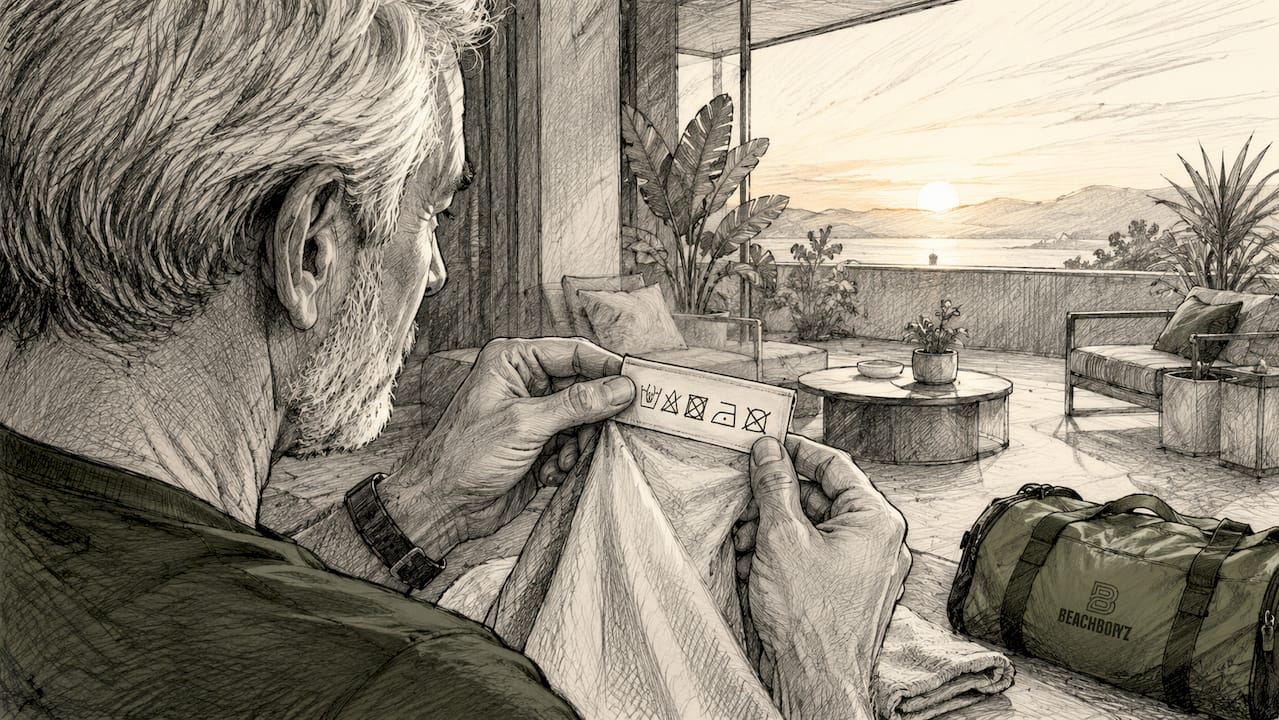
The five basic symbols on textiles always follow the same order. Each symbol represents a care step. Additional signs such as dots, lines, and crosses specify the allowed treatment.
Washing
The wash symbol is a tub with water. A number inside indicates the maximum washing temperature, for example, 30 or 40. A single line under the tub means a gentle cycle, two lines indicate a very gentle cycle. A hand in the tub means hand wash. A cross over the symbol completely prohibits machine washing.
Bleaching
The bleach symbol is a triangle. An empty triangle allows all bleaches. A triangle with two lines inside only allows oxygen bleach. A crossed-out triangle prohibits all bleaching. This symbol is often overlooked but is crucial, especially for colored fabrics.
Drying
The tumble dry symbol is a square with a circle inside. Dots in the circle indicate the temperature level: one dot means low temperature, two dots mean medium temperature. A cross over the symbol prohibits tumble drying. For air drying, there are separate symbols: a square with a horizontal line means dry flat, with a vertical line means hang to dry.
Ironing
The ironing symbol shows an iron. Dots indicate the temperature: one dot means a maximum of 110 °C, two dots for 150 °C, three dots for 200 °C. A cross prohibits ironing. A cross below the iron prohibits steam.
Professional Cleaning
A circle indicates dry cleaning. Letters in the circle specify which solvents are allowed. A "P" stands for perchloroethylene and other solvents, an "F" for hydrocarbons. A crossed-out circle prohibits any professional wet cleaning.
Pro Tip: According to experts, gentler treatment is almost always permissible. A symbol with 40 °C also allows washing at 30 °C. Anyone who understands care instructions as maximum values will protect fibers and extend the lifespan of clothing.
How to read care labels correctly?
Reading care labels follows a fixed logic. The symbols are always arranged from left to right and form a continuous chain. If you consider a symbol in isolation, you risk making mistakes.
The correct order for reading:
- Washing: Check temperature and program. Are there lines under the tub? Then choose a gentle cycle.
- Bleaching: Check the triangle. If there's a cross, do not use bleach, even in detergents with bleach additives.
- Drying: Tumble dryer allowed or prohibited? Dots in the circle determine the temperature. Lines indicate air drying.
- Ironing: Dots on the iron determine the temperature. No steam if there's a cross below it.
- Cleaning: Only relevant for delicate materials like wool, silk, or blends with a high viscose content.
Reading as a continuous chain prevents a correct wash cycle from being undone by incorrect drying. A merino wool sweater survives a 30 °C gentle wash but shrinks to half its size in the dryer.
Pro Tip: For blended fabrics, the most delicate material always serves as the benchmark. A shirt made of 70% cotton and 30% viscose should be treated like pure viscose fabric.
Common mistakes when reading care labels:
- Viewing individual symbols in isolation without checking the combination
- Ironing at too high a temperature because the dots were not counted
- Ignoring dryer instructions and putting clothes in the dryer anyway
- Overlooking spin instructions even though there's a line under the tub
Why do care labels extend the lifespan of clothing?
Care labels are not bureaucratic accessories. They are the most direct way to protect clothing from unnecessary wear and tear. Those who follow the instructions save money and conserve resources.
Lower washing temperatures minimize fiber wear and reduce energy consumption. Modern detergents clean effectively even at 30 °C, so high temperatures are simply unnecessary for most everyday textiles. This means: washing at 30 °C instead of 60 °C protects colors, fibers, and the environment simultaneously.
“Care instructions specify safety limits, not treatment obligations. Gentler care is almost always permissible and often the better choice for fibers and the environment.”
This is especially true for sustainable fabrics like organic cotton or recycled materials. These fabrics are more sensitive to high temperatures and aggressive detergents. Following care instructions maintains the quality of these materials for years.
Concrete measures for a longer clothing lifespan:
- Consistently lower washing temperature to the minimum allowed by the label
- Only use the dryer if the symbol explicitly permits it
- Remove clothes from the machine immediately after washing to avoid wrinkles
- Wash delicate textiles in a laundry bag to reduce mechanical abrasion
- Air clothing between washes instead of washing immediately
How to implement care labels in everyday life?
Knowledge of symbols is of little use if it is not incorporated into the daily washing routine. Implementation is easier than many think.
Check the label before each wash. This sounds laborious, but it only takes seconds. Sorting clothes by wash program saves time and avoids errors. Lights at 40 °C, darks and delicates at 30 °C, wool in the wool program.
When ironing: test on inner seams before applying the iron to the front. Steaming from a distance and an ironing cloth protect delicate fabrics from shiny spots. If you want to play it safe, hang freshly washed clothes smoothly on a hanger. Many wrinkles disappear by themselves this way.
Tips for everyday life:
- Sort clothes by care program, not just by color
- Consistently use wool program and gentle cycle if the label requires it
- Use a laundry bag for delicate textiles
- Always set the iron to the lowest allowed setting and work your way up from there
- For unclear or missing labels: wash cold, gentle spin, dry flat
What to do if the label is missing or illegible? The rule of thumb is: wash cold, no dryer, no bleach. This is the safest treatment for unknown materials. Those familiar with the Beachbodyz Streetwear Care Guide will find material-specific instructions for common fabrics there.
Key Takeaways
Care labels specify maximum values, not obligations. Gentler treatment is almost always permissible and extends the lifespan of any textile.
| Topic | Details |
|---|---|
| Read symbols in sequence | Always consider washing, bleaching, drying, ironing, and cleaning as a chain, never in isolation. |
| Understand maximum values | A 40°C symbol also allows 30°C. Gentler care protects fibers and saves energy. |
| Observe dryer symbols | Dots in the circle determine the temperature. A cross means absolute dryer prohibition. |
| Iron with care | Dots on the iron determine the temperature. Test on inner seams before ironing. |
| Missing labels | For unknown material, wash cold, spin gently, and dry flat. |
Conscious Care as Part of a Sustainable Lifestyle
For years, I hardly paid attention to care labels. The result was predictable: a shrunk wool sweater, shiny spots on a shirt, faded colors after washing too hot. The damage was always avoidable.
What really surprised me: care labels are not a restriction. They are a permission. If you know that 30 °C is allowed, you don't have to wash at 60 °C. If you know that the dryer is forbidden, you simply hang the clothes. This costs no energy and protects the material.
The crucial change in thinking is this: read care labels not as rules, but as room to maneuver. The specified value is the maximum. Anything below that is better. If you want to live sustainably, this is where you start. Not by buying new clothes, but by protecting the ones you already have.
Clothes that last longer need to be replaced less often. This is the most direct contribution to resource conservation that everyone can make immediately. Without effort, without cost.
— Ahmed
Proper Care for Sustainable Beachbodyz Clothing
Beachbodyz produces streetwear from certified organic cotton and recycled materials. These fabrics respond particularly well to gentle care and last significantly longer with proper treatment.
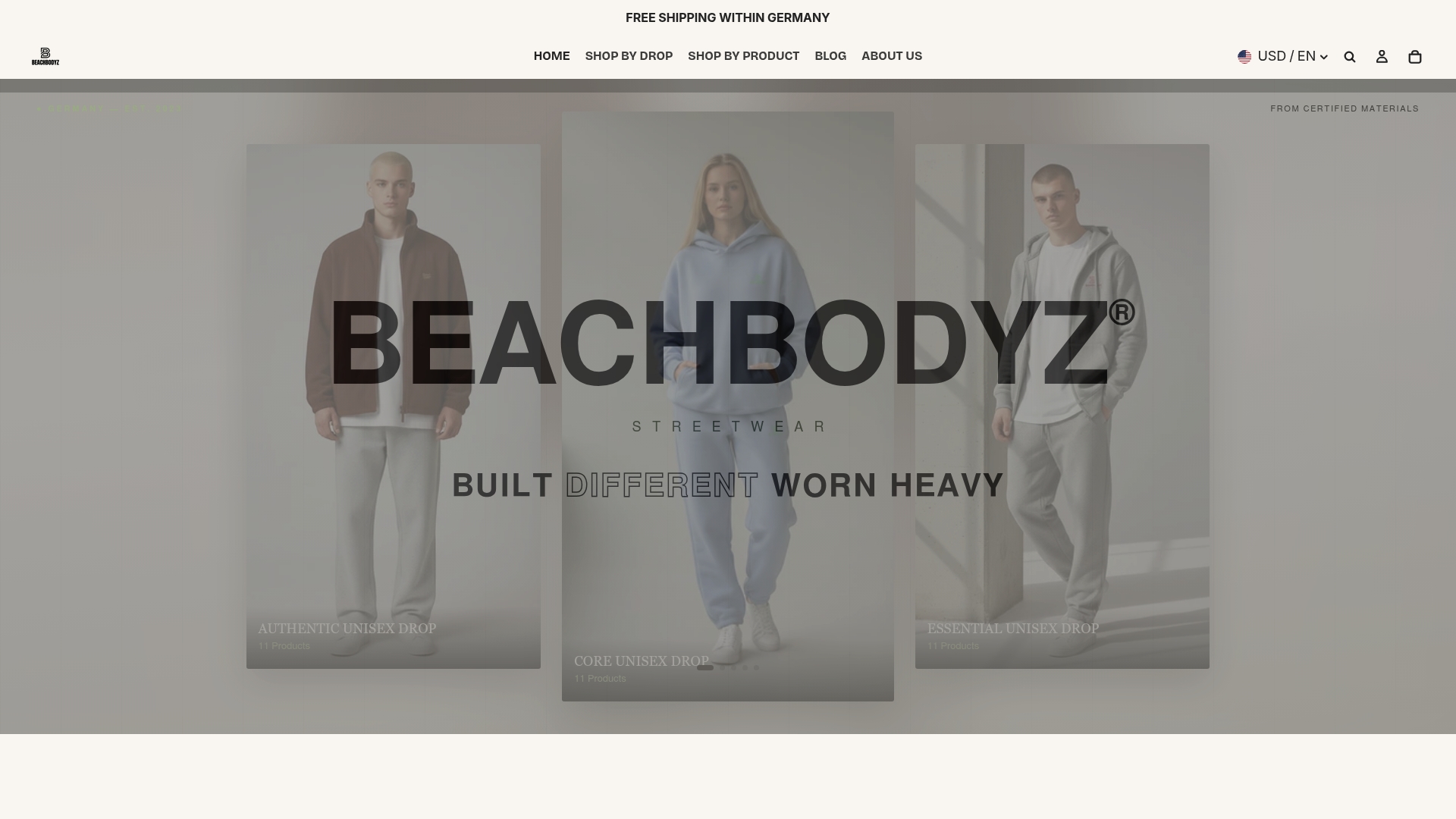
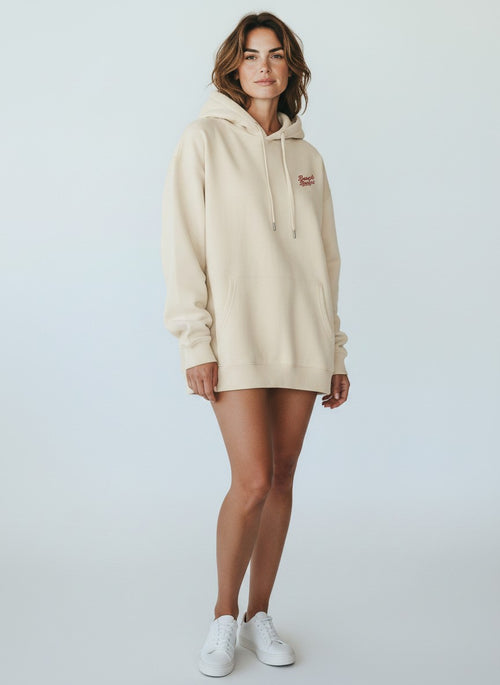
The Essential Oversize Sweatshirt from Beachbodyz is a good example: gentle wash at 30 °C, no dryer, hang to dry. If you follow these three steps, the item will last for years. Beachbodyz provides clear care instructions on each product page so that sustainable clothing is cared for sustainably. Those who value quality and longevity will find clothing in the Beachbodyz store that will bring joy for a long time with the right care knowledge.
FAQ
What are care labels?
Care labels are standardized symbols on textiles that indicate how a garment can be washed, dried, ironed, and cleaned. They specify maximum values, not treatment obligations.
Are care labels legally required in Germany?
Fiber composition must be declared according to EU Regulation No. 1007/2011. Care instructions are not mandatory but must be correct once provided.
What do the dots in the dryer symbol mean?
One dot in the circle of the dryer symbol means low temperature, two dots mean medium temperature. A cross over the symbol completely prohibits tumble drying.
Can I wash at a lower temperature than indicated on the label?
Yes. Care instructions indicate maximum values. Washing a garment at 30 °C, even if 40 °C is allowed, protects the fibers and saves energy.
What to do if the care label is missing?
If the label is missing or illegible: wash cold, gentle spin, no dryer, and no bleach. This is the safest treatment for unknown materials.