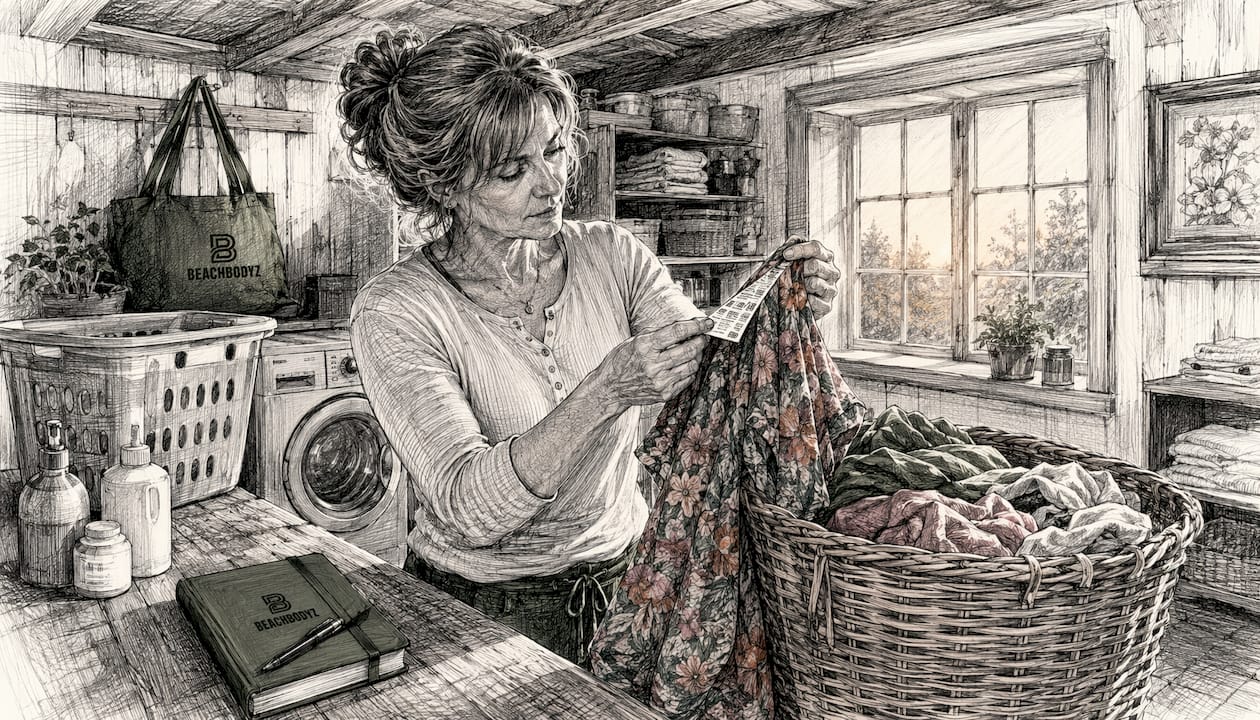
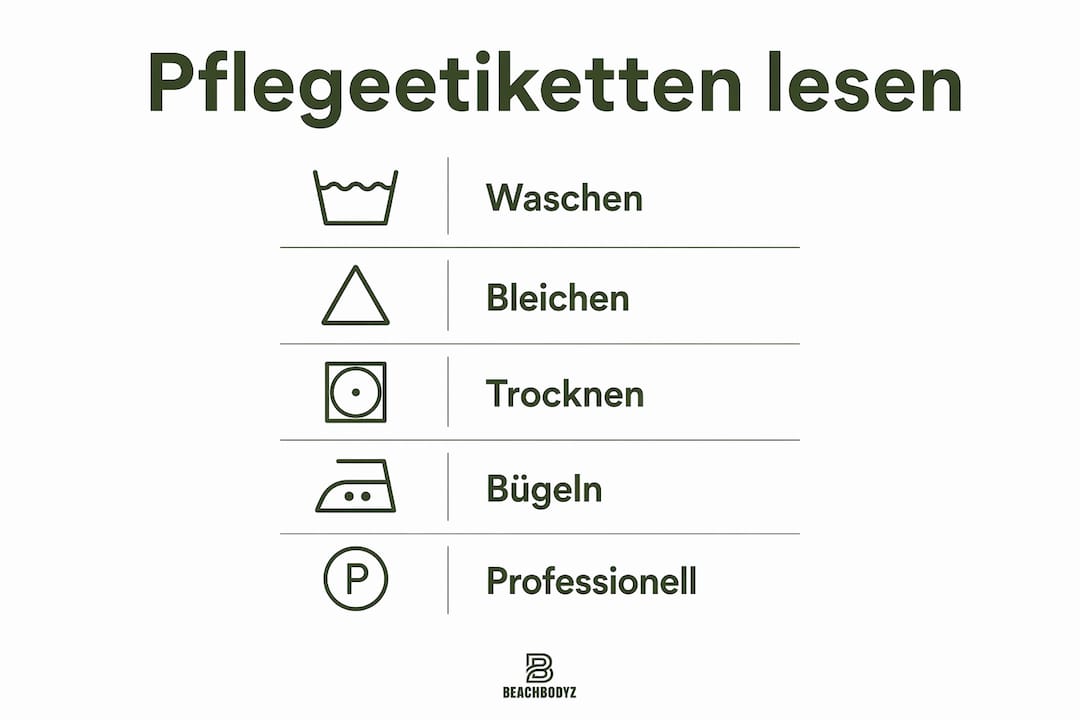
Care labels on clothing follow a uniform standard worldwide. The five symbol groups always appear in this order: washing, bleaching, drying, ironing, professional cleaning. This sequence is set by GINETEX, the international association for textile care labelling. A crossed-out symbol completely prohibits the respective treatment. Additional symbols such as dots indicate temperature levels, and lines below a symbol require gentler treatment.
Quick overview of the five symbol types:
- Wash tub: Machine or hand washing
- Triangle: Bleaching allowed or prohibited
- Square with circle: Tumble dry or air dry
- Iron: Ironing temperature and steam use
- Circle: Professional dry cleaning
1. What do the wash symbols on the care label mean?
The wash tub is the basic symbol for all washing instructions. The number in the tub indicates the maximum washing temperature in degrees Celsius, which must not be exceeded. Lower temperatures are always permitted and protect the fibres.
Lines under the tub indicate the required degree of gentleness:
- No line: Normal programme possible
- One line: Delicate programme, fill drum halfway, reduced spin
- Two lines: Wool wash or delicate programme, fill drum only one-third, greatly reduced agitation
- Hand in tub: Hand wash only up to a maximum of 40 °C
- Crossed-out tub: Do not wash, professional cleaning only
| Symbol | Meaning | Recommended Programme |
|---|---|---|
| Tub with 30 | Max. 30 °C | Delicate wash |
| Tub with 40 | Max. 40 °C | Normal or delicate programme |
| Tub with 60 | Max. 60 °C | Normal programme |
| Tub with 60 | Max. 60 °C | Boil wash |
| Hand in tub | Hand wash only | Max. 40 °C, no rubbing |
| Crossed-out tub | Do not wash | Professional cleaning |
Hand washing does not just mean soaking. Gentle washing without rubbing protects delicate fibres. After washing, carefully shape the garment and dry flat.
2. Bleaching Symbols: What do the care instructions allow for bleaching?
The triangle stands for all bleaching instructions. An empty triangle allows all bleaches, i.e., both chlorine and oxygen. Two diagonal lines in the triangle restrict bleaching to oxygen bleach. Chlorine bleaches are then prohibited.
- Empty triangle: All bleaches allowed
- Triangle with two lines: Oxygen bleach only
- Crossed-out triangle: Do not bleach, also do not use full detergents containing bleach
Ignoring a crossed-out triangle risks colour loss and fibre breakage. Full detergents often contain bleach, so for this symbol, switch to colour or delicate detergent.
3. Drying Symbols: How to dry clothes gently?
The square with a circle indicates machine drying in a tumble dryer. Dots in the circle show the permissible temperature level. A crossed-out symbol completely prohibits machine drying.
- One dot in the circle: Low temperature, initial temperature approx. 60 °C
- Two dots in the circle: Normal temperature, initial temperature approx. 80 °C
- Crossed-out square with circle: Do not tumble dry
- Square with horizontal line: Dry flat
- Square with vertical line: Hang dry
- Square with two diagonal lines top left: Dry in shade, protects colours from fading
Wool and viscose should always be dried flat. Hanging these materials to dry will stretch them out and permanently alter their fit.
4. Ironing Symbols: What temperature is allowed for ironing?
The iron with dots indicates the maximum temperature. The scale is clear: 1 dot equals 110 °C, 2 dots 150 °C, 3 dots 200 °C. A crossed-out iron prohibits all ironing.
- One dot (110 °C): Synthetics, polyester, no steam
- Two dots (150 °C): Wool, blends, steam possible
- Three dots (200 °C): Cotton, linen, steam ironing allowed
- Crossed-out iron: Do not iron, no press, no steam
Prints and coatings are particularly sensitive to heat. When ironing a garment with a print or embroidery, it is best to turn it inside out or place a thin cloth between it and the iron.
Pro Tip: If an iron symbol is crossed out, steam from a distance or hanging the item in the bathroom during a hot shower can help release wrinkles without damaging the material.

5. Symbols for Professional Cleaning: What do the signs mean?
The circle indicates all instructions for professional cleaning. Letters in the circle tell the professional cleaner which solvents are allowed.
- A in circle: Cleaning with all common solvents
- P in circle: Perchloroethylene or hydrocarbons
- F in circle: Hydrocarbons only
- W in circle: Professional wet cleaning
- One line under the circle: Gentle cleaning
- Two lines under the circle: Very gentle cleaning
- Crossed-out circle: Do not dry clean
High-quality garments such as evening dresses, suits, or items with lace and pearls often feature a circle symbol. The letter in the circle is intended for the professional cleaner and does not need to be memorized by the consumer.
6. What to do if care labels are missing or illegible?
If the label is missing or no longer legible, the material composition can serve as a guide. Experts generally recommend low temperatures, delicate wash cycles, and air drying if in doubt.
- Pure cotton usually tolerates 40 °C, sometimes 60 °C
- Wool, silk, and viscose are safer at 30 °C on a delicate programme
- For blended fabrics, the choice depends on the most delicate fibre
- If the dryer symbol is missing, air dry rather than risk it
- Mild delicate detergent and low spin speed are the safest combination
If you can no longer decipher the symbols, opt for a cold delicate wash with low spin and air dry the garment. This way, the fit, colour, and structure will be preserved longer.
7. Sustainability through Proper Care: Wearing textiles longer
Correct textile care significantly extends the lifespan of clothing. The GINETEX standard specifies that care labels indicate the maximum permissible treatment for a textile. Gentler treatment is always allowed and recommended to protect fibres. Washing too hot or spinning too vigorously leads to irreversible damage.
Lines under symbols are often overlooked. Yet, they determine pilling, loss of shape, and premature wear. Paying attention to lines under symbols protects fibres mechanically and significantly extends the wearability of a garment. Sustainable brands like Beachbodyz rely on GOTS-certified materials and durable cuts, where proper care makes all the difference.
Pro Tip: Once you have internalized the care symbols, you can choose the washing programme, drying method, and ironing temperature more confidently. This saves energy, conserves resources, and reduces the ecological footprint of every wash.
For streetwear made from recycled polyester or organic cotton: delicate programmes at 30 °C are sufficient for normal soiling. The Streetwear Care Guide from Beachbodyz provides material-specific instructions for common streetwear fabrics.
Key Takeaways
Care labels indicate the maximum permissible treatment for a textile; gentler treatment is always allowed and extends the lifespan.
| Topic | Details |
|---|---|
| Symbol order | Washing, bleaching, drying, ironing, professional cleaning, always in this sequence. |
| Crossed-out symbols | Completely prohibit the respective treatment, no exceptions. |
| Lines under symbols | One line requires a delicate programme, two lines require very gentle treatment such as a wool wash. |
| Dots as temperature indicator | For ironing: 1 dot = 110 °C, 2 dots = 150 °C, 3 dots = 200 °C. |
| Missing labels | If in doubt, choose 30 °C delicate wash, mild detergent, air drying. |
FAQ
What do the care symbols on clothes mean?
The five basic symbols stand for washing (tub), bleaching (triangle), drying (square with circle), ironing (iron), and professional cleaning (circle). Dots indicate temperature levels, lines require gentler treatment, a cross prohibits the respective method.
Which care labeling applies in Europe?
The care symbols valid in Europe were developed by GINETEX. Their use requires a license from a national GINETEX member organization.
Where can I find the care instructions for my clothes?
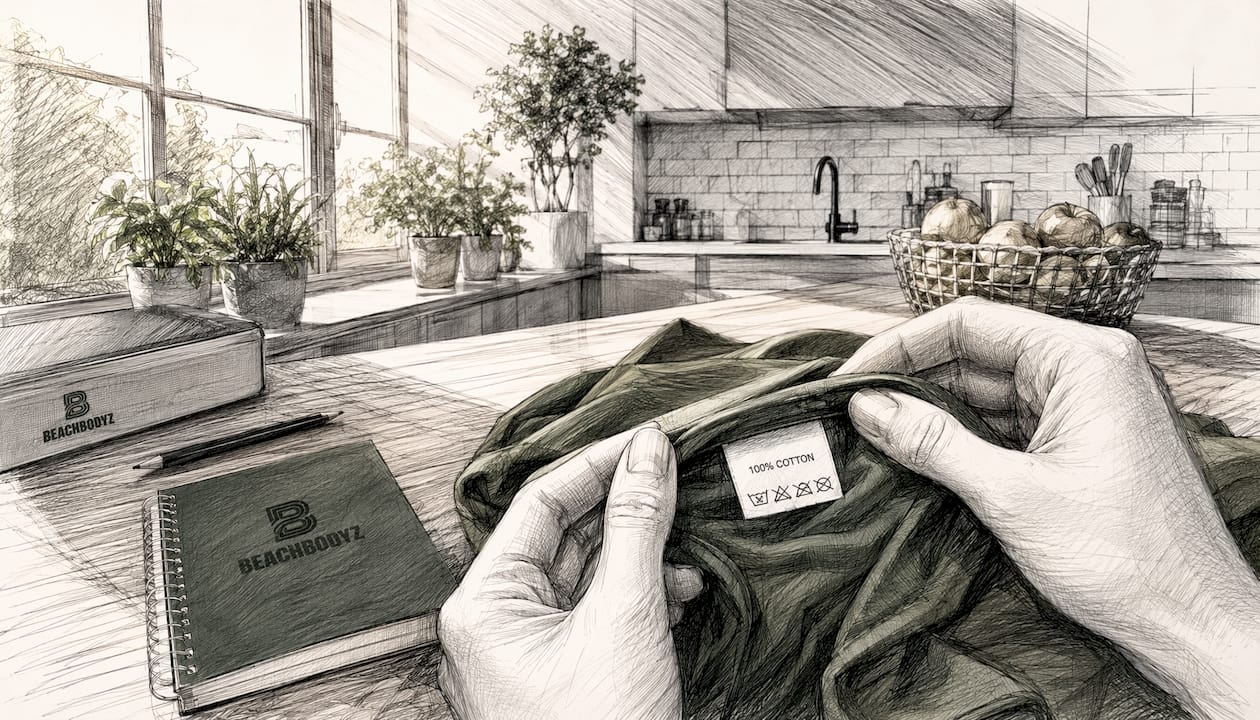
The care label is usually on the inside of the garment, often at the collar, side seam, or waistband. It must remain legible throughout the entire lifespan of the textile.
What do the symbols on clothing labels mean if no numbers are visible?
If a number is missing in the wash tub, 30 or 40 °C on a delicate programme is generally assumed, especially for delicate fibres. In American products, temperatures are sometimes indicated by dots instead of numbers.
Am I allowed to treat clothes more gently than indicated on the label?
Yes. The care label indicates the maximum permissible treatment. A milder treatment is always allowed and recommended to protect fibres and extend the textile's lifespan.