The PETA-Approved Vegan label identifies products that contain no animal-derived materials or animal-derived components in auxiliary substances. This excludes leather, wool, silk, fur, down, animal-based adhesives, and dyes like carmine. Companies must submit a questionnaire, a supplier declaration, and a licensing agreement to PETA. The logo appears on the label, hangtag, or product detail page, making purchasing decisions for vegan fashion buyers immediately easier.
Three key points at a glance:
- The label refers to materials, not production conditions or ecology.
- PETA requires Statements of Assurance (SOAs) from the company and its suppliers.
- The logo may only be used for actually certified products, not for a company's entire range, unless everything is certified.
Table of Contents
- What the PETA-Approved Vegan label covers and who awards it
- Which materials and hidden animal-derived ingredients are excluded?
- How does a collection become PETA-Approved Vegan? Steps, documents, and duration
- How to identify PETA-Approved Vegan products when shopping
- Who uses the label? Distribution and typical use cases
- PETA-Approved Vegan compared to other PETA programs
- Limitations and common misconceptions
- Key takeaways
- The label is useful but not a unique selling point
- Vegan streetwear with clear material standards from Beachbodyz
- FAQ
- Useful resources for Central Europe
What the PETA-Approved Vegan label covers and who awards it
The label is a material-related mark for textiles, accessories, furniture, and home textiles. It confirms that a product is free from animal-derived raw materials. It is awarded by PETA (People for the Ethical Treatment of Animals), one of the largest animal rights organizations worldwide, with program administration through PETA US and PETA Germany.
The PETA-Approved Vegan label is not a state certification. It is an NGO initiative based on contractual self-commitments and spot checks, not on officially mandated material tests.
Important for buyers: The logo can be awarded for individual products, collections, or the entire range. A company can therefore only have part of its offering certified. This means that a manufacturer bearing the label does not necessarily operate vegan in all product areas.
In German, the label is often referred to as "PETA-certified" or "PETA-recognized as vegan." The focus is on fashion, accessories, and interior textiles.
Which materials and hidden animal-derived ingredients are excluded?
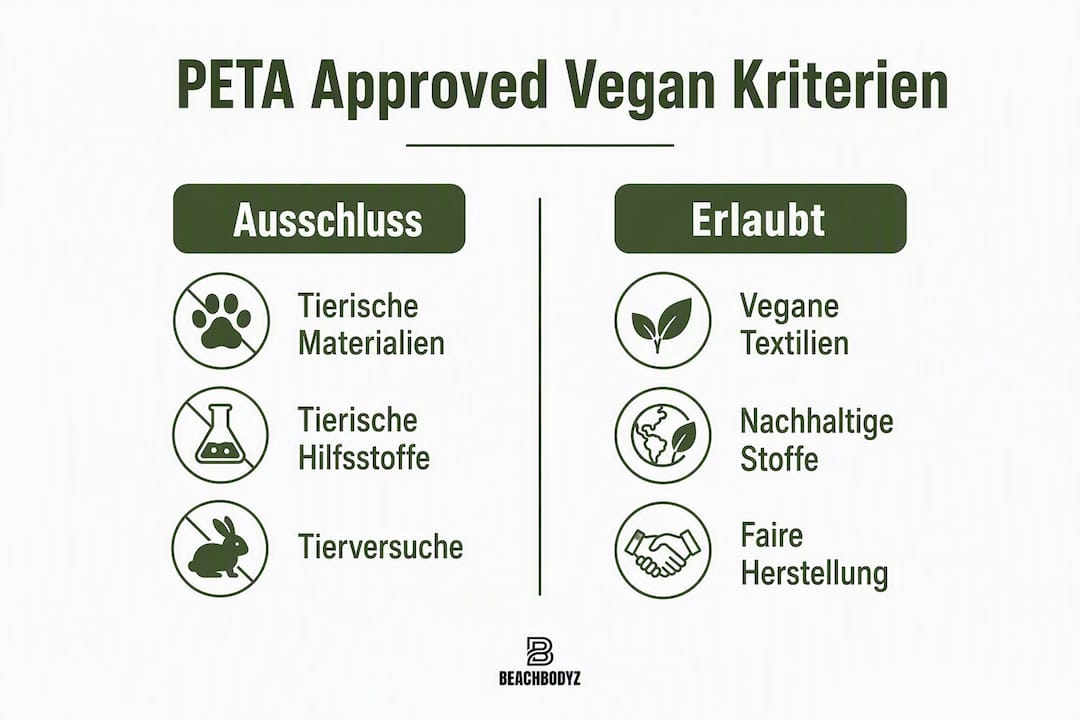
Obvious animal-derived materials excluded by the label:
- Leather (incl. suede, nubuck, patent leather)
- Fur and real fur
- Wool, cashmere, mohair, alpaca
- Silk
- Down and feathers
Less known but equally excluded components:
- Horn and mother-of-pearl buttons
- Carmine (cochineal dye, E 120) in textile dyes
- Shellac as a coating or finishing agent
- Animal-based adhesives (e.g., bone glue in shoe soles)
- Beeswax in impregnations or wax coatings
Labels rarely name these components directly. If you want to be sure, read the complete material list on the product page and ask the retailer if information on buttons, lining, or adhesives is missing. Especially with shoes and bags, animal-based adhesives are a frequently overlooked point.
Pro Tip: Look for the terms "lining" or "sole" on the product page and specifically ask if these components contain animal-based adhesives. Many retailers don't know this immediately themselves, but can inquire with the manufacturer.

How does a collection become PETA-Approved Vegan? Steps, documents, and duration
The process at a glance
- Application and questionnaire — The company fills out a questionnaire that covers all relevant materials and suppliers.
- Statement of Assurance (SOA) — The company and suppliers sign a statement of assurance confirming that no animal-derived components are used.
- Review by PETA — PETA reviews the submitted documents. Laboratory analyses are not a formal requirement, but PETA may request random tests and unexpected material lists.
- License agreement — After successful review, a license agreement is signed.
- Annual fee — The company pays an annual license fee, which is tiered according to annual turnover.
Fee structure (by annual turnover)
The annual license fee is tiered by PETA according to annual turnover and is revenue-dependent. The exact amounts can be found in the official FAQs.
Timeline expectation
If all documents are complete, the process can be completed within a few days. Delays occur if suppliers do not submit their SOAs promptly or if material specifications are incomplete. The more suppliers a company has, the longer the coordination takes.
Verification is primarily based on self-commitments from companies and their suppliers, supplemented by spot checks and the ability to request material lists.
How to identify PETA-Approved Vegan products when shopping
- Logo on label or hangtag: The PETA-Approved Vegan logo appears directly on the product. Authorized companies may use it on labels, hangtags, websites, and social media exclusively for certified items.
- Product detail page in the webshop: Many retailers mention the label in the product description or show the logo in the product image.
- PETA list of certified companies: On petaapprovedvegan.peta.org, buyers can search directly for certified brands. This is the most reliable verification source.
- Check the material list: Even without a logo, it's worth checking the complete material list, especially for information on buttons, lining, soles, and coatings.
- Inquire with the retailer: If information is missing, a direct inquiry to the retailer is useful. A targeted question: "Does this product contain animal-based adhesives or dyes?"
Pro Tip: Take a screenshot of the product page with the label indication before purchasing. In case of returns or complaints, the documentation is helpful if information changes later.

Who uses the label? Distribution and typical use cases
More than 1,000 companies use the PETA-Approved Vegan logo worldwide. This shows that the label is widely accepted and not just used by niche providers.
Typical product categories with the label:
- Vegan shoes and boots (faux leather, textile soles)
- Handbags and backpacks made from synthetic materials
- Bedding and pillows without down
- Home decor textiles (cushions, curtains, carpets)
- Streetwear, jackets, and accessories made from vegan fabrics
In Central Europe, especially providers of vegan shoes and sustainable accessories use the label. Buyers should use the PETA list as the primary verification source, as assortments can change.
A common misconception: A certified company does not necessarily operate exclusively vegan in all business areas. PETA allows the certification of individual collections, which enables companies to transition gradually.
PETA-Approved Vegan compared to other PETA programs
| Criterion | PETA-Approved Vegan | Beauty Without Bunnies |
|---|---|---|
| Coverage | Material composition (textiles, accessories, furniture) | Cruelty-free (cosmetics, personal care products) |
| Exclusion criterion | Animal-derived materials and components | Animal testing on the final product and ingredients |
| Validation method | SOA from companies and suppliers, spot checks | Positive list, company statements |
| Scope of application | Individual products, collections, or assortment | Brand-wide program |
| Relevance for buyers | Ensuring vegan material | Ensuring no animal testing |
PETA operates categorically separate programs: The Vegan label for textiles does not mean that a manufacturer is certified cruelty-free in other product areas. If you want to ensure both, you must check both programs separately.
Limitations and common misconceptions
- Self-commitment as a basis: — Verification relies primarily on SOAs. PETA can initiate spot checks, but does not conduct mandatory laboratory testing of all products.
The label is a reliable material indicator. If you also value ecology or fair production, you should combine it with labels such as GOTS (Global Organic Textile Standard) or Oeko-Tex. You can find more about how GOTS-certified clothing works and what the standard covers in Beachbodyz's own guide.
Key takeaways
The PETA-Approved Vegan label is a material-related mark for textiles that excludes animal-derived components, but makes no statement about ecology or fairness.
| Topic | Details |
|---|---|
| Label Definition | Identifies products without animal-derived materials and animal-derived auxiliary components. |
| Certification Basis | SOA from companies and suppliers; spot checks possible, no mandatory laboratory analysis. |
| Distribution | More than 1,000 companies use the logo worldwide. |
| Limitations | No state control; no guarantee for ecology, fair wages, or CO₂ balance. |
| Beachbodyz | Relies on GOTS-certified organic cotton and recycled polyester, produced fairly in the EU and shipped climate-neutral. |
The label is useful but not a unique selling point
The PETA-Approved Vegan label does something concrete: it excludes animal-derived materials from the supply chain, even where they would be invisible to buyers. Horn buttons, shellac, carmine in textile dyes — these are components that no buyer would recognize without supplier documentation. This is precisely where the value of the label lies.
But it would be a mistake to read the label as a comprehensive sustainability promise. Synthetic fibers can be vegan and at the same time ecologically problematic. Polyester from fossil raw materials causes no animal suffering, but it does cause microplastics. The label says nothing about this.
Anyone who buys vegan fashion and also pays attention to ecology needs several labels at the same time. PETA-Approved Vegan for the material question, GOTS for organic cotton, Oeko-Tex for harmful substance freedom. No single label covers everything. This is not a weakness of the PETA program, but the reality of any certification landscape.
Vegan streetwear with clear material standards from Beachbodyz
Anyone looking for vegan textiles and also valuing ecological production will find both in a single product from Beachbodyz. The streetwear brand from Germany uses GOTS-certified organic cotton and recycled polyester, produced fairly in the EU and shipped climate-neutral.
This specifically means: no animal-derived materials, no synthetic fibers from conventional production, no outsourcing to low-wage countries outside the EU. The Identity Sport jogging pants made from 320 g/m² organic cotton are an example of how GOTS certification and vegan material choice go hand in hand. Those looking for vegan hoodies or sustainable streetwear can find the current range directly in the Beachbodyz shop.
FAQ
What does "PETA-Approved Vegan" mean in English?
The label means that a product contains no animal-derived materials or animal-derived auxiliary components. In English, it is often referred to as "PETA-recognized as vegan" or "PETA-certified vegan."
Is PETA-Approved Vegan the same as cruelty-free?
No. The Vegan label refers to materials (no animal-derived components), while the "Beauty Without Bunnies" program identifies cruelty-free cosmetics. Both programs are categorically separate.
Which products can receive the PETA-Approved Vegan label?
Textiles, accessories, shoes, furniture, and home textiles. The label is not intended for food or cosmetics.
How reliable is the label?
Verification is based on Statements of Assurance from companies and suppliers, supplemented by possible spot checks. It is an NGO initiative, not state control.
Where can I find a list of certified brands?
The official search for certified companies is available at petaapprovedvegan.peta.org.
Useful resources for Central Europe
Reliable Resources for Further Information and Verification:
- PETA‑Approved Vegan: Official Program Page — Application, criteria, and certification process directly from PETA.
- PETA‑Approved Vegan FAQs — Fee schedule, timeline, and verification details.
- PETA Germany: PETA‑Approved Vegan — German-language explanation of the label, scope, and documentation requirements.
- bewusstkaufen.at: PETA Approved — Neutral classification for the Austrian and German-speaking market.
- PETA‑Approved Program Overview — Differentiation of the various PETA programs (Vegan vs. Cruelty-Free).
- GOTS‑Standard — Supplementary label for organic textiles; useful in combination with the Vegan label.
| Source | Useful for |
|---|---|
| petaapprovedvegan.peta.org | Application, criteria, fees |
| PETA Germany | German-language explanation, scope |
| bewusstkaufen.at | Neutral classification for Central Europe |
| PETA‑Approved Program Overview | Differentiation Vegan vs. Cruelty-Free |
| global‑standard.org (GOTS) | Supplementary eco‑standard for textiles |
Product pages with label information should always be cross-referenced with the entry in the PETA list. Information on retailer sites may be outdated.