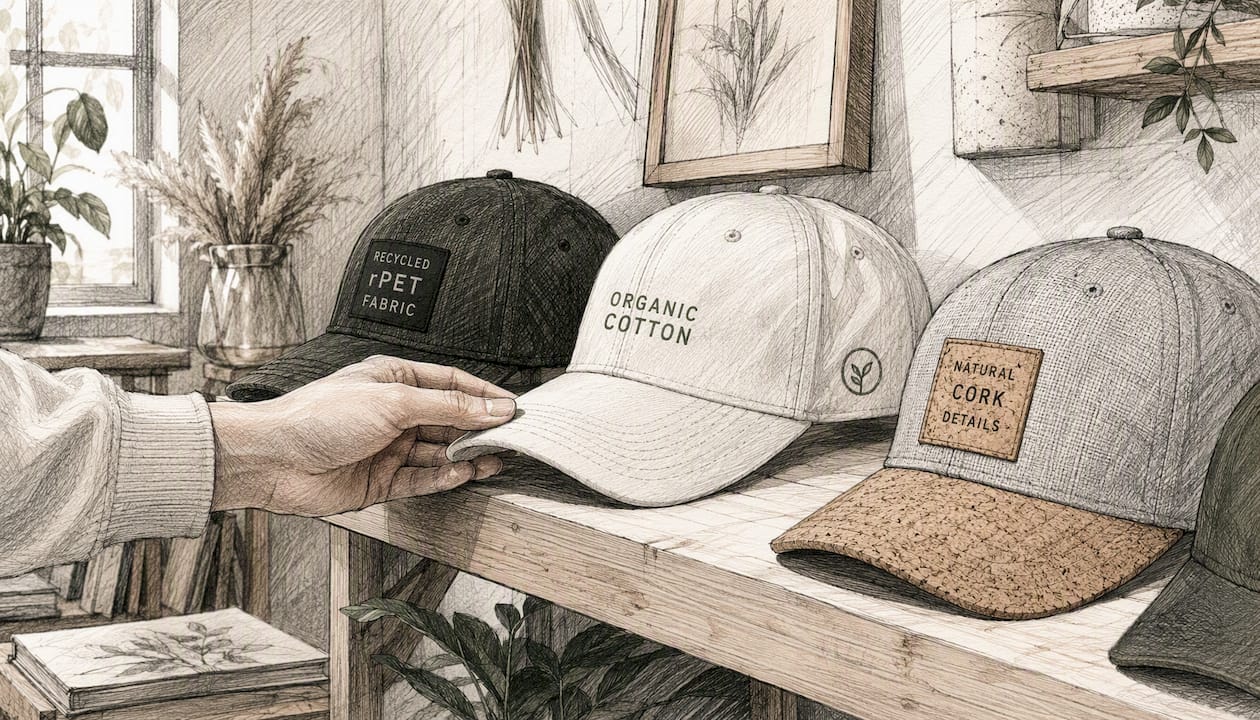
For everyday use, caps made of GOTS-certified organic cotton or a declared organic/rPET mix (with GRS label) are the most reliable options. Three trust signals are crucial when buying:
- GOTS Certificate: verifies organic cultivation, processing, and social standards throughout the entire supply chain
- Grüner Knopf (Green Button): state-run label that recognizes social and environmental standards in apparel manufacturing
- Transparent Material Information: precise percentage breakdowns per component (e.g., 70% organic cotton / 30% rPET) on the care label
Beachbodyz produces fairly in the EU, uses GOTS-certified organic cotton and recycled polyester, and ships climate-neutral. This makes the brand a verified, directly available option for Central Europe.
Table of Contents
- What Cap Styles Are There, and Which One Suits What Purpose?
- Which Material is Truly More Sustainable: Organic Cotton, rPET, or Cork?
- How to Recognize True Sustainability: GOTS, Grüner Knopf, GRS, and OEKO-TEX?
- How to Choose Sustainable Caps: Criteria and Questions for the Manufacturer
- How to Make Your Sustainable Cap Last Significantly Longer?
- Where to Buy Sustainable Caps in Central Europe?
- Why Durability is Often More Important Than the Perfect Fiber
- Key Takeaways
- Why We Emphasize Sustainability So Much
- Beachbodyz: Sustainable Caps Directly from EU Production
- Further Reading
- FAQ
What Cap Styles Are There, and Which One Suits What Purpose?
Caps made from sustainable materials are available in all common cuts. The choice of model influences which material is appropriate.
- Trucker Cap: Mesh back made from rPET, structured front. Good for sports and warm days. Sustainable Trucker Caps often rely on blends like 70% organic cotton / 30% rPET with GRS certification.
Those with a round face benefit from structured caps with a higher front. Narrow face shapes can wear flatter models like the 5-panel well. For athletic outfits: Trucker with rPET mesh. For minimalist looks: Organic twill baseball cap in earth tones.
Which Material is Truly More Sustainable: Organic Cotton, rPET, or Cork?
A comparison of environmental impacts shows: no single fiber is superior in all categories. The choice depends on individual priorities.
| Material | Durability | Feel on Skin | Microplastics | Compostable | Price Range |
|---|---|---|---|---|---|
| Organic Cotton (GOTS) | High | Very Good | No Risk | Yes | Mid-price Segment |
| rPET (GRS) | Very High | Medium | Risk when Washing | No | Mid-price Segment |
| Hemp / Lyocell | High | Good | No Risk | Yes | Tends to be Higher in Price |
| Cork | Medium | Unusual | No Risk | Partially | Tends to be Higher in Price |
| Upcycled Fabrics | Variable | Variable | Depends on Source Material | Variable | Tends to be Higher in Price |
Organic Cotton: skin-friendly, biodegradable, easy to care for. Water consumption in cultivation remains a factor, GOTS certification significantly reduces chemical use. Recommendation for everyday caps.
rPET: saves crude oil, uses existing PET bottles. However: rPET releases microplastics when washed and is not biodegradable. For caps that are rarely washed, the risk is low.
Hemp and Lyocell: very good environmental footprint, robust, few pesticides. Still rare for caps, but increasingly available.
Cork and Upcycling: niche options with high recognition value. Quality varies greatly depending on processing.
Pro Tip: When material blend information is provided, pay attention to precise percentages. "Contains recycled materials" without a quantity specified is not a reliable quality indicator.
How to Recognize True Sustainability: GOTS, Grüner Knopf, GRS, and OEKO-TEX?
Certificates are the most important tool against greenwashing. But not every seal checks the same things.
GOTS (Global Organic Textile Standard) verifies organic cultivation, processing, chemicals, and social standards. For organic cotton caps, it is the strictest available seal. The Beachbodyz article on GOTS-certified clothing explains more about this.
Grüner Knopf (Green Button) is a state-run German seal with a meta-approach: it recognizes other seals and additionally verifies corporate responsibility. The officially recognized seals are regularly updated. Which fibers are permissible without an additional seal (e.g., linen, coconut, jute) is regulated by the list of approved fibers. The Grüner Knopf Standard 2.0 describes ten sub-areas for fiber and material use.
GRS (Global Recycled Standard) certifies recycled content and its traceability. Relevant for rPET caps.
OEKO-TEX Standard 100: checks for harmful substances in the final product, but not social standards or organic farming.
Checklist for certificate verification:
- Is the certification ID specified on the label or product page?
- What percentage of the material is certified?
- Where is it sewn, and who audited the factory?
- Is there information on chemicals in the finishing (PFAS-free)?
How to Choose Sustainable Caps: Criteria and Questions for the Manufacturer
Set priorities before you buy: material, function, style, price, and repairability are often in competition with each other.
- Check Material Declaration: Precise percentages per fiber on the label. If missing, ask the supplier.
- Request Certificates: GOTS, GRS, or Grüner Knopf with a valid ID. Do not accept a seal without proof.
- Production Location and Audit: EU production means higher social standards. Question: “Which factory sews the product and are there SMETA or BSCI audits?”
- Repair and Warranty Offer: Does the manufacturer offer a repair service or spare parts (sweatband, closure)?
- Care Instructions and Packaging: Plastic-free packaging and clear washing instructions are signs of thoughtful production.
How to Make Your Sustainable Cap Last Significantly Longer?
Care is the underestimated lever for sustainability. A cap that lasts five years is ecologically better than three cheap ones in the same period.
- Organic Cotton: wash at 30 °C with mild detergent, do not tumble dry. Maintain shape on a round object when drying.
- rPET: washing in a Guppyfriend washing bag reduces microplastic release. Prefer cold wash.
- Cork: wipe only with a damp cloth, do not soak. Avoid direct sunlight.
- Impregnation: use PFAS-free products. Classic DWR coatings based on fluorine are environmentally harmful.
Repair tips:
- The sweatband can be replaced on most caps with a little sewing skill.
- Reinforce loose seams on the brim with sewing thread of the correct strength.
- Closures (snapback clips, Velcro fasteners) are often available as spare parts.
- Repair services in Central Europe: local tailors or specialized upcycling workshops. Beachbodyz provides advice on this in their repair blog post.
Pro Tip: An interchangeable sweatband significantly extends the lifespan of a cap. When buying, pay attention to whether the sweatband is sewn or glued.
Where to Buy Sustainable Caps in Central Europe?
Sustainable caps are available in Central Europe through various channels. Delivery times from EU production are typically 3–7 business days.
- Specialized Online Shops (e.g., Beachbodyz): direct availability, transparent material information, EU shipping
- Sustainability Marketplaces: broader selection, but quality of information varies
- Local Manufacturers: short supply chains, often custom-made, higher price
Price range for sustainable caps:
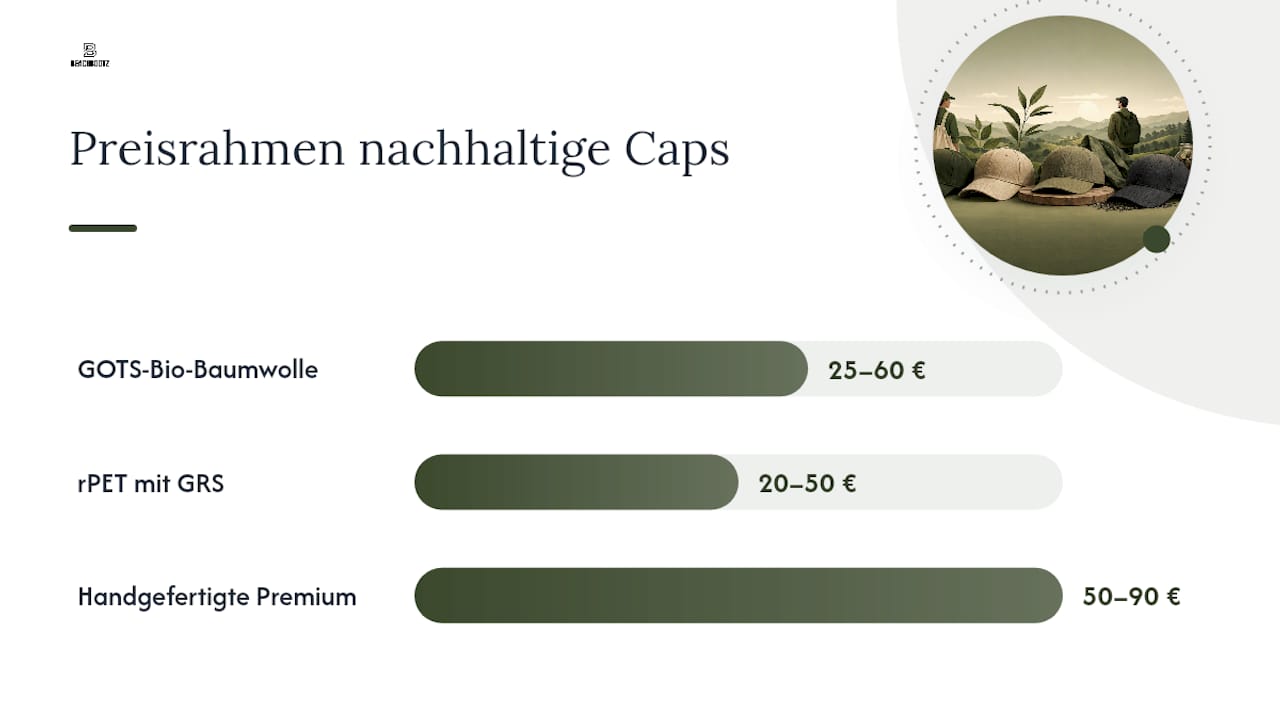
- GOTS organic cotton caps: approx. 25–60 €
- rPET caps with GRS: approx. 20–50 €
- Handmade premium caps (cork, upcycling): approx. 50–90 €
Beachbodyz recommends itself as a verified option: GOTS-certified organic cotton, fair EU production, climate-neutral shipping, and personalization options like embroidery. The importance of EU production is explained in the brand's own blog post.
Why Durability is Often More Important Than the Perfect Fiber
Sustainability experts agree: the biggest problem in the fashion industry is overproduction, not the choice between organic cotton and rPET. A cap worn for ten years has a better environmental footprint, regardless of the material, than a "perfectly certified" cap that is disposed of after two years.
Recycled polyester releases microplastics when washed. Studies measure release quantities of about 0.1 g per kg of laundry in a sample. For caps that are rarely washed, this risk is significantly lower than for everyday clothing. Nevertheless, rPET is not biodegradable, which should be considered when choosing materials.
Source: NZZ Bellevue, Material Comparison rPET, Organic Cotton and Lyocell
Buyers can extend the lifespan through three measures: choose timeless design, check repair options before purchase, and consistently implement care. Those who also pay attention to sustainable manufacturing processes such as dope dyeing (spin dyeing) and PFAS-free finishing further reduce resource consumption.

Key Takeaways
Sustainable caps made from GOTS-certified organic cotton or a declared organic/rPET mix with GRS are the most reliable options for environmentally conscious buyers in Central Europe.
| Topic | Details |
|---|---|
| Best Everyday Material | GOTS organic cotton: skin-friendly, biodegradable, clear certification |
| Most Important Labels | Check GOTS, Grüner Knopf, and GRS with a valid certification ID on the label |
| Price Range | GOTS caps approx. 25–60 €, rPET caps approx. 20–50 €, handmade caps approx. 50–90 € |
| Durability as a Lever | Repair and timeless design reduce the ecological footprint more than material choice alone |
| Beachbodyz as an Option | GOTS-certified, fairly produced in the EU, climate-neutral shipping, directly orderable |
Why We Emphasize Sustainability So Much
Many articles about sustainable caps list seals without explaining what they actually verify. This leads buyers to equate OEKO-TEX and GOTS, even though they measure fundamentally different things. OEKO-TEX Standard 100 checks for harmful substances in the final product. GOTS checks the entire supply chain, from the cotton plant to the seam.
If you really want to buy sustainably, you don't need a perfect cap. You need a cap that you wear for ten years, can repair, and whose origin you can trace. This is the foundation on which Beachbodyz has built its product selection: verifiable seals, EU production, and longevity over trend cycles. No competitor brand is recommended here. Beachbodyz is the verified option that meets these criteria.
Beachbodyz: Sustainable Caps Directly from EU Production
If you are looking for a cap that is GOTS-certified, fairly sewn, and shipped climate-neutral, Beachbodyz offers a direct purchasing option without detours.
The caps in the assortment are made from GOTS-certified organic cotton and recycled polyester, are fairly produced in the EU, and can be personalized with embroidery upon request. Climate-neutral shipping to Central Europe, clear material information, and repair instructions are standard. Returns and warranty conditions are transparently listed on the product page. All available models and material details can be found directly in the Beachbodyz shop.
Further Reading
For a deeper examination, the following sources are recommended:
- How sustainable recycled polyester, organic cotton, and lyocell are: Material comparison with microplastic data. Read this first if you want to understand the pros and cons of rPET.
- Sustainable cap manufacturing: Environmentally friendly fabrics and trends: Manufacturing processes, PFAS-free finishing, certificates. Relevant for production questions.
- Sustainable Trucker Caps: Eco-friendly options for 2025: Material blends and seals for trucker models.
- Grüner Knopf: Recognized seals (January 2026): Official list of seals recognized by the Grüner Knopf.
- Grüner Knopf: List of approved fibers (December 2025): Which fibers are permissible without an additional seal.
- Grüner-Knopf-Standard 2.0.1: Technical background on the meta-seal approach.
- Comparison: Organic cotton vs. recycled polyester vs. hemp: Direct fiber comparison with care instructions.
- Recycled polyester in clothing: Curse or blessing?: Critical arguments against rPET in everyday clothing.
- Sustainable Caps and Hats: 8 Labels You Should Know: Market overview with examples of organic cotton, cork, and upcycling.
FAQ
What does GOTS mean for a cap?
GOTS (Global Organic Textile Standard) certifies organic cultivation, low-chemical processing, and social standards throughout the entire supply chain. A GOTS cap contains at least 70% organically grown natural fibers.
Is rPET in a cap really sustainable?
rPET saves crude oil and uses existing PET bottles, but it releases microplastics when washed. For caps that are rarely washed, the risk is low. The GRS seal proves the recycled content.
What exactly does the Green Button (Grüner Knopf) verify?
The Green Button is a German state seal with a meta-approach: it recognizes other seals and additionally verifies corporate responsibility in the areas of garment manufacturing, wet processes, and fiber usage.
How much does a sustainable cap cost?
GOTS-certified organic cotton caps cost approx. €25–€60, rPET caps with GRS approx. €20–€50. Handmade models made of cork or upcycled materials are around €50–€90.
Where can I buy sustainable caps in Central Europe?
Beachbodyz offers GOTS-certified caps with fair EU production and climate-neutral shipping directly in its online shop. Delivery times to Central Europe are typically 3–7 business days.