In a nutshell:
- "Made in Europe" refers to the final significant production stage, often sewing in Europe, while raw materials originate elsewhere. Truly sustainable action requires GOTS certificates and supply chain transparency, as the label has no binding standards. Beachbodyz produces EU-based streetwear from GOTS-certified organic cotton and recycled polyester with transparent documentation.
"Made in Europe" primarily means that the last substantial manufacturing stage, i.e., cutting and sewing, took place in Europe. Raw materials such as cotton often grow outside Europe. Those looking for true sustainability need additional certificates like GOTS. Beachbodyz is a streetwear brand produced in the EU that uses GOTS-certified organic cotton and recycled polyester.
Table of Contents
- What does "Made in Europe" mean legally and practically?
- Where European production really helps and where it doesn't
- Which certificates and proofs are truly reliable?
- Which materials are suitable for EU fashion?
- How to find genuine "Made in Europe" fashion: Checklist
- Beachbodyz: EU-produced streetwear with GOTS materials
- Key takeaways
- Why Beachbodyz relies on EU production
- Beachbodyz Essential Collection: Order EU streetwear directly
- Further sources
- FAQ
What does "Made in Europe" mean legally and practically?
The label is not a protected quality seal. There is no EU-wide uniform standard that dictates how many production stages must take place in Europe. The decisive factor is the last substantial processing stage: those who sew in Portugal can print "Made in Europe," even if the cotton comes from India, the yarn was spun in Turkey, and the fabric woven in Morocco.
A typical supply chain looks like this:
- Fiber cultivation: Cotton, linen or hemp, often outside Europe (India, USA, Egypt)
- Yarn spinning: often Turkey, Asia or North Africa
- Weaving/Knitting: Portugal, Turkey, Eastern Europe
- Manufacturing (sewing): Portugal, Italy, Poland, Romania
- Shipping/Trade: EU internal market
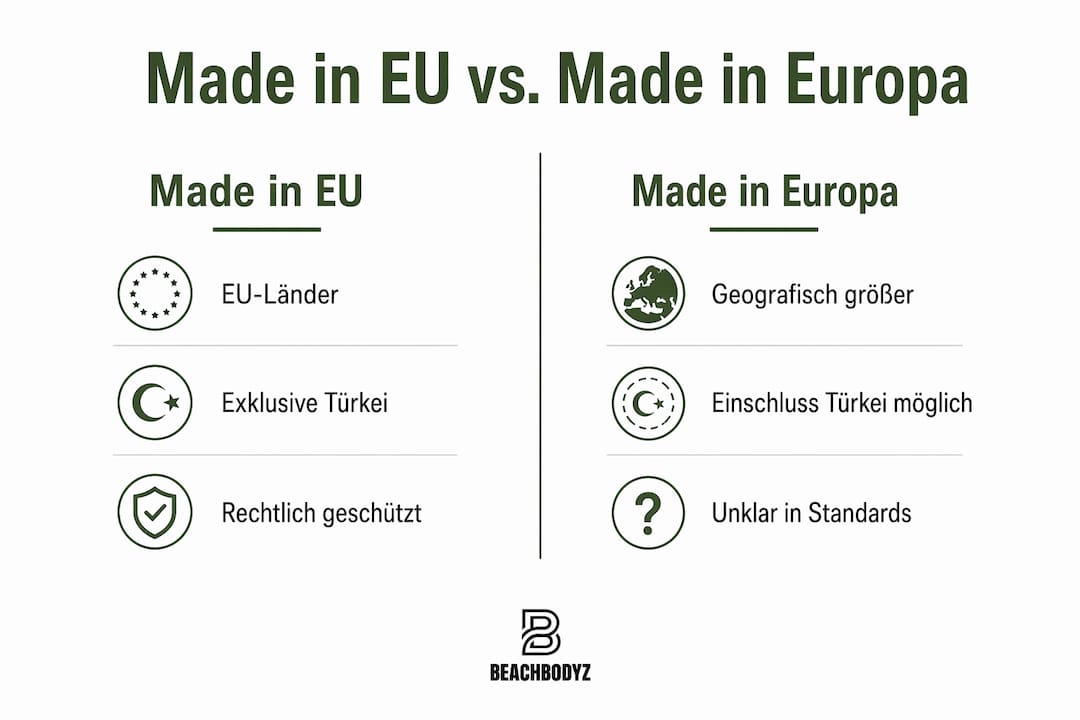
"Made in EU" vs. "Made in Europe": "Made in EU" excludes Turkey, "Made in Europe" can include it. Neither label makes any binding statements about social and environmental standards.
Portugal is considered an important production location for knitwear of medium to high quality. Italy stands for leather and luxury apparel. Poland and Romania often produce for mid-price segments.
Where European production really helps and where it doesn't
Shorter transport routes for the end product, better audit possibilities, and stricter labor laws are real advantages. European factories are easier to inspect on-site. Production flexibility and smaller batch sizes enable demand-oriented manufacturing, which reduces overproduction.

But: Production in Eastern Europe does not guarantee fair wages. Investigative reports show poor conditions in individual factories because national minimum wages vary greatly. And because raw materials usually come from outside, the overall balance is difficult to assess without supply chain transparency.
The German Federal Environmental Foundation (DBU) has published clear figures on this:
"Eco-shoring, i.e., demand-oriented production in Europe combined with automation and digital production planning, can reduce CO₂ emissions by up to 98% compared to fast fashion. Even a 10% share of eco-shoring could save millions of tons of CO₂." — DBU, Sustainable Textile Production in Europe
Local production is therefore a strong lever, but not a free pass. Transparency across the entire supply chain remains crucial.
Which certificates and proofs are truly reliable?
"Sustainable" is not a protected term. That's why independently audited seals help.
| Seal | Fiber Coverage | Processing | Social Criteria | Audit Type |
|---|---|---|---|---|
| GOTS | Organic Fibers | Yes, entire chain | Yes | Annual on-site inspection |
| OEKO-TEX Standard 100 | All Fibers | Absence of harmful substances | No | Lab test + Inspection |
| Fair Wear Foundation | No Specification | Manufacturing | Yes, focus on wages | Factory audits + Complaint system |
GOTS checks organic fibers plus social standards along the entire supply chain. A final product receives the GOTS label only if all participating companies have a valid certificate and have passed the annual inspection. The Fair Wear Foundation focuses on living wages in garment factories. OEKO-TEX Standard 100 confirms the absence of harmful substances but says nothing about working conditions.
Checking authenticity: Certificate numbers can be verified on the official databases of the respective seals. Transaction Certificates (TCs) prove that a specific delivery is GOTS-compliant, not just the company in general.
Pro Tip: GOTS audits cost money, especially for small producers. Those who don't have a certificate can still credibly demonstrate transparency: factory addresses, audit summaries, and supplier lists are often more indicative than a mere statement of origin.
Which materials are suitable for EU fashion?
| Material | Advantages | Disadvantages |
|---|---|---|
| GOTS Organic Cotton | Soft, breathable, socially audited | Water consumption, raw material often imported |
| Recycled Polyester | Resource-saving, durable | Microplastics when washing |
| Linen/Hemp | Low pesticide use, EU cultivation possible | Less comfortable to wear, higher price |
| Lyocell (e.g., Tencel) | Closed water cycle | Check origin of wood fiber |
GOTS organic cotton and recycled polyester are the most common materials in sustainable EU streetwear. The industry-standard price premium for GOTS-certified goods is 20-40% compared to conventional goods. For viscose, a closer look is worthwhile: only viscose from demonstrably responsible processes (e.g., with FSC-certified wood) is ecologically justifiable. The Beachbodyz material guide explains more about sustainable fabrics.
How to find genuine "Made in Europe" fashion: Checklist
- Where exactly is it sewn? Ask for the country and factory name.
- Is a supplier list available? Transparent brands publish factory addresses.
- Are there certificate numbers? Check GOTS numbers on gotslabel.global-standard.org.
- Are audit reports viewable? Request social compliance reports or summaries.
- How is CO₂ balanced? Check Scope 1-3 statements and compensation proofs.
- What materials are used? Request material proofs (GOTS-TC, OEKO-TEX).
- Price expectation: Factor in a GOTS premium of 20-40%. Very cheap "sustainable" EU fashion is a warning sign.
- Delivery times: Small European production runs and limited drops require more lead time.
Recognizing greenwashing: Vague formulations like "environmentally friendly produced" or "sustainable materials" without a certificate number or factory information are not reliable proofs.
Beachbodyz: EU-produced streetwear with GOTS materials
Beachbodyz is a German streetwear brand with production in the EU. The range includes oversized T-shirts, hoodies, sweatshirts, jogging pants, and jackets made from GOTS-certified organic cotton and recycled polyester. Shipping is climate-neutral. Products are suitable for personalization such as embroidery, which enables small runs in Europe, for example, through partners like Textildruck München.
If you want to check the proofs: Product pages list material composition and certification details. The sustainable streetwear overview 2026 explains the supply chain approach. The Essential collection is the direct entry point for EU-made basics.
Key takeaways
"Made in Europe" refers to the final manufacturing stage in Europe but says nothing about raw materials or social standards. GOTS certification and a supplier list are the most reliable verification tools.
| Topic | Details |
|---|---|
| Meaning of the label | "Made in Europe" refers to the last processing stage, not the entire supply chain. |
| Most important verification tool | GOTS certificate number and supplier list are more indicative than the origin statement alone. |
| Typical price premium | GOTS-certified goods typically cost 20-40% more than conventional goods. |
| Recognizing greenwashing | Missing certificate numbers and vague sustainability claims without factory information are warning signs. |
| Beachbodyz as an EU option | Beachbodyz produces streetwear fairly in the EU with GOTS organic cotton and climate-neutral shipping. |
Why Beachbodyz relies on EU production
Fair production in the EU is not a marketing decision, but a basic requirement for what Beachbodyz sells. GOTS-certified organic cotton and recycled polyester are the material basis. Climate-neutral shipping and transparent product information are integral components of the offering. Limited drops instead of mass production keep batch sizes small and overproduction low. This is the concrete difference from fast fashion.
Beachbodyz Essential Collection: Order EU streetwear directly
Beachbodyz offers EU-produced streetwear made from GOTS organic cotton and recycled polyester. Oversized T-shirts, hoodies, and the Core Windbreaker are shipped climate-neutrally and are suitable for personalization. If you don't have time for extensive brand research, you'll find products with verifiable proofs here. The Essential Collection is the direct entry point.
Further sources
- GOTS — The Standard: Official explanation of certification criteria, verifying certificate numbers.
- DBU — Sustainable Textile Production in Europe: Research results on eco-shoring and CO₂ reduction in the textile industry.
- Fashion Changers — Made in Germany: Critical classification of local production, limits of the label.
- Jefferys — Made in Europe: Legal definition and practical meaning of the label.
- Allianz pro Nachhaltigkeit — Made in Europe: Country overview, transparency signals, finding fair clothing.
- Greenya — GOTS Certification: Costs, surcharges, and practical tips for certification.
FAQ
What exactly does "Made in Europe" mean for clothing?
The label refers to the last substantial processing stage, i.e., cutting and sewing, in Europe. Raw materials and earlier production stages can be located outside Europe.
Is "Made in EU" more sustainable than "Made in Europe"?
"Made in EU" excludes non-EU countries like Turkey but also says nothing about social or environmental standards. Crucial factors are certificates like GOTS and supply chain transparency.
How do I recognize genuine GOTS certification?
The certificate number on the product can be verified on the official GOTS database. Transaction certificates prove that a specific delivery is GOTS-compliant.
Why does sustainable EU fashion cost more?
GOTS audits, fair wages, and smaller production runs increase manufacturing costs. The industry-standard premium for GOTS-certified goods is 20-40% compared to conventional goods.
Where can I buy EU-produced streetwear with GOTS materials?
Beachbodyz produces streetwear fairly in the EU from GOTS-certified organic cotton and recycled polyester, with climate-neutral shipping and transparent product information.