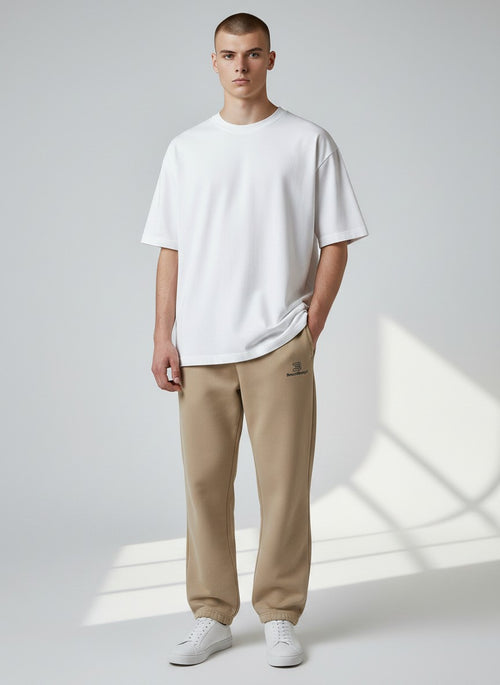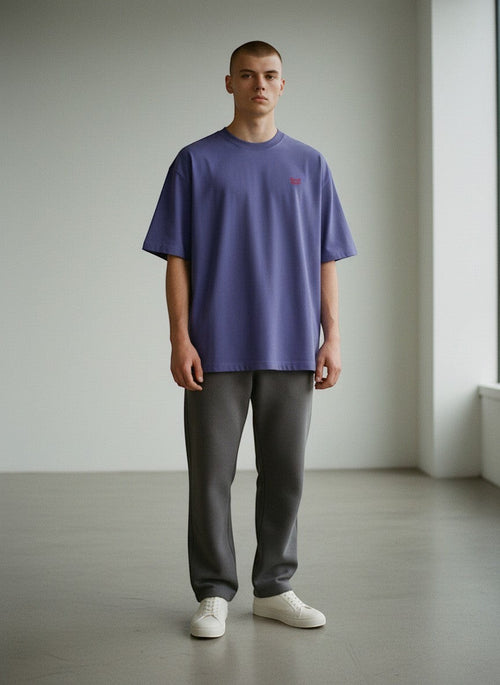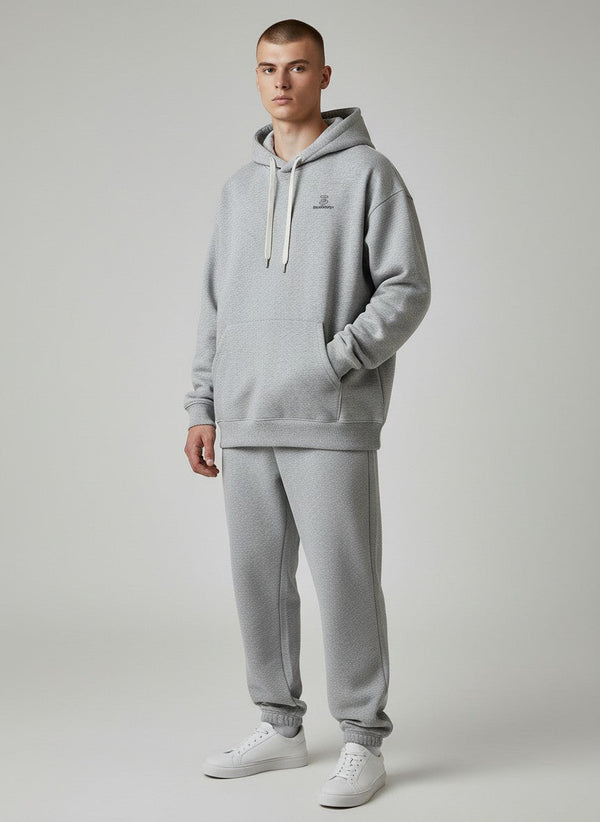
GSM indicates the fabric weight in grams per square meter (g/m²) for hoodies. The higher the value, the heavier, denser, and usually warmer the fabric is. As a rough guide in retail: under about 280 g/m², a hoodie is considered light; about 280 to 320 g/m² is medium-heavy; from about 350 g/m² it is heavy (heavyweight). Which value is right depends on the intended use, season, cut, and fabric construction. The number alone only describes the weight, not the overall quality.
Key Takeaways
- GSM = grams per square meter. The value measures the mass of the fabric, not the mass of the finished hoodie.
- Guidelines: light under approx. 280 g/m², medium approx. 280–320 g/m², heavy from approx. 350 g/m². Very heavy streetwear qualities are 400 g/m² and above.
- Higher GSM means more warmth, more opacity, and usually more durability for the same fabric type. Lower GSM means more breathability.
- Fabric type, yarn, and processing also matter: French Terry and brushed fleece feel different at the same GSM value.
- Heavy hoodies need appropriate care: gentle wash, low spin cycle, dry flat.
Table of Contents
- What GSM means for hoodies
- Common GSM values for hoodies
- How GSM affects warmth, breathability, and durability
- What else matters besides GSM
- How much a hoodie weighs depending on GSM
- GSM and fit: Oversize and heavyweight
- Choosing the right GSM value by intended use
- Reading product specifications correctly
- Caring for heavy hoodies
- Heavyweight hoodies from BeachBodyz
- Frequently Asked Questions
- Sources
What GSM means for hoodies
GSM, g/m² and fabric weight
GSM stands for "grams per square meter", or fabric weight in German. It measures how many grams one square meter of the fabric weighs. The Austrian newspaper Der Standard describes the specification as fabric weight in grams per square meter and explains why streetwear brands state the weight of their hoodies so prominently.
Common notations on labels and in product descriptions:
| Notation | Meaning |
|---|---|
| 350 GSM | 350 grams per square meter |
| 350 g/m² | identical, German unit notation |
| 350 gsm | identical, lowercase |
| Fabric weight 350 | identical, German technical term |
| 10.3 oz | ounces per square yard, US notation |
Important for comparison: GSM always refers to the base fabric of the body. Ribbing, hood lining, drawstrings, and pockets are often made of different qualities and are not included in the specification.
Converting ounces to g/m²
US manufacturers and some international shops state the fabric weight in ounces per square yard (oz/yd²). One ounce per square yard corresponds to around 33.9 g/m². For conversion:
- g/m² → oz/yd²: Value × 0.0295
- oz/yd² → g/m²: Value × 33.9
| g/m² | oz/yd² (rounded) | Classification |
|---|---|---|
| 240 | 7.1 | light |
| 280 | 8.3 | light to medium |
| 320 | 9.4 | medium |
| 350 | 10.3 | heavy |
| 400 | 11.8 | heavy |
| 450 | 13.3 | very heavy |
| 500 | 14.7 | very heavy |
For specifications in ounces, this table helps with a direct comparison with hoodies rated in g/m².
Common GSM values for hoodies
In retail, a rough classification into three to four weight classes has become established. The boundaries are fluid and not standardized. Every brand sets them slightly differently.
| Class | GSM range (approx.) | Character | Typical use |
|---|---|---|---|
| Light | 240–280 g/m² | thin, flexible, airy | summer, indoor, transitional |
| Medium-heavy | 280–320 g/m² | balanced, suitable for everyday wear | year-round, everyday, sports |
| Heavy (Heavyweight) | 350–400 g/m² | dense, shape-retaining, warm | autumn, winter, streetwear |
| Very heavy | from 400 g/m² | massive, stiff, voluminous | statement streetwear, cold days |
Between 320 and 350 g/m² lies a transitional range. Hoodies in this range are described as "medium" or already as "heavy" depending on the brand.
Simple mass-market hoodies usually sit at the lower end of the scale, often in blended fabrics. Premium and streetwear hoodies are often significantly above that. A higher value requires more material per piece, which is reflected in the price. The background for this: why heavyweight clothing is more expensive.

How GSM affects warmth, breathability, and durability
The GSM value affects several properties simultaneously. According to the GSM guide from textile manufacturer Fersan, for the same structure and yarn: higher fabric weight means more warmth, more opacity, and usually more durability; lower fabric weight means more coolness and breathability.
| Property | Low GSM value | High GSM value |
|---|---|---|
| Warmth | low to medium | high |
| Breathability | high | lower |
| Opacity | lower | high |
| Shape retention | flowing, soft | standing, structured |
| Durability | good | usually higher |
| Drying time | short | longer |
| Pack size | small | large |
Warmth
More material per square meter traps more air. This insulates. A 400 g/m² hoodie often replaces a light jacket on cool autumn days. A 260 g/m² hoodie works more as a mid-layer.

Breathability
Thinner fabrics allow more air and moisture through. For training, warm interiors, or summer evenings, a lighter or medium-heavy hoodie is more comfortable. In heavier qualities, cotton content improves moisture absorption.
Durability
Denser fabrics are more resistant to abrasion and retain their shape over many washes. For clothing that is intended to be worn for years, a higher GSM value is an important factor, together with yarn quality and processing.
What else matters besides GSM
The Standard points out that a heavy fabric is not automatically of higher quality: processing and fabric also play a role. The Fersan guide mentions three more factors that only together with the GSM value provide a complete picture: yarn fineness, knit structure, and stitch density.
Fabric type: French Terry, Fleece, Jersey
Hoodies are usually made of sweatshirt fabric. The most important variants:
| Fabric type | Inside | Feel | Typical GSM range (approx.) |
|---|---|---|---|
| French Terry | Loops (terry look) | dry, grippy, airy | 280–350 g/m² |
| Brushed fleece (sweatshirt, brushed) | fluffy brushed | soft, warm | 300–400 g/m² |
| Heavyweight fleece | densely brushed | massive, very warm | from 400 g/m² |
| Jersey | smooth | light, flowing | under 250 g/m² |
Two hoodies with 350 g/m² can therefore feel completely different. French Terry feels drier and is well suited for transitional seasons. Brushed fleece feels warmer and softer. The difference between smooth jersey and sweatshirt fabric is explained in detail in the post Jersey vs. Sweatshirt Fabric.
Material and material blend
- 100% cotton: natural feel, good moisture absorption, voluminous at a high GSM value.
- Organic cotton: cotton from controlled organic farming. Certifications such as GOTS (Global Organic Textile Standard) prove origin and processing.
- Cotton with recycled polyester: more shape-retaining, faster drying, less shrinking.
- Conventional polyester fleece: light, warm, less breathable.
The material blend affects how heavy a fabric feels for the same volume. Cotton is denser and heavier than polyester. A blended fabric can appear slightly lighter in hand at the same GSM value.
Processing
In addition to the fabric, details show the quality of a hoodie:
- Double-layer hood
- Ribbed cuffs and hem with high elastane recovery
- Clean double seams on shoulders and sides
- Reinforced drawstring openings
- Pre-washed or pre-shrunk fabric
Small parts also deserve attention. The post on Hoodie Drawstrings Made of Organic Cotton covers the material, dimensions, and seals of drawstrings.
How much a hoodie weighs depending on GSM
The GSM value describes the fabric, not the finished garment. The total weight results from fabric area × fabric weight plus cuffs, drawstrings, seams, and prints. For a hoodie in size L, a processed fabric area of around 1.75 m² can be calculated. This results in the following example calculation:
| GSM value | Calculation | Approximate weight (Size L) |
|---|---|---|
| 280 g/m² | 280 × 1.75 | approx. 490 g |
| 320 g/m² | 320 × 1.75 | approx. 560 g |
| 350 g/m² | 350 × 1.75 | approx. 610 g |
| 400 g/m² | 400 × 1.75 | approx. 700 g |
| 450 g/m² | 450 × 1.75 | approx. 790 g |
| 500 g/m² | 500 × 1.75 | approx. 875 g |
Deviations arise from:
- Size: Size S needs less, XXL significantly more fabric.
- Cut: Oversize cuts with wide sleeves and dropped shoulders consume more area.
- Hood: A double-layer hood adds noticeably more weight in heavy qualities.
- Pockets and applications: Kangaroo pocket, embroidery, and large-area prints increase the weight.
Anyone who weighs a hoodie in their hand clearly feels the difference between 280 and 400 g/m²: around 200 grams difference for the same size.
GSM and fit: Oversize and heavyweight
In the streetwear area, fabric weight is deliberately part of the design. A heavy fabric does not collapse, but stands. This creates the typical boxy, voluminous silhouette of oversize hoodies.
| Criterion | Lighter fabric | Heavier fabric |
|---|---|---|
| Drape | flowing, hugs the body | structured, holds the shape |
| Oversize silhouette | loose, soft | boxy, angular |
| Shoulder area | drops | remains defined |
| Hood | lies flat | stands, frames the face |
| Layering | good under jackets | rather as an outer layer |
In addition to the weight, the fabric construction determines the drape. A compactly knitted fabric with 420 g/m² looks clearly defined, a softly knitted fabric with the same value significantly looser.
For oversized cuts, a heavy fabric is therefore particularly suitable. The volume looks intentional rather than shapeless. The post Layering with Oversized Hoodies shows combination ideas with jackets, vests, and shirts underneath. The same principle applies to larger sizes: Structured heavyweight fabrics hang cleanly and do not sag. Find out more under Styling Streetwear in Larger Sizes.
Choosing the Right GSM for the Intended Use
| Use | Recommended Range (approx.) | Reason |
|---|---|---|
| Summer evenings, indoors | 240–280 g/m² | airy, lightweight |
| Everyday, year-round | 280–350 g/m² | balanced between warmth and comfort |
| Training, gym (warm-up) | 280–350 g/m² | warms the muscles, stays flexible |
| After training, commute home | 350–400 g/m² | keeps you warm after sweating |
| Autumn and winter | 350–450 g/m² | high insulation, wind-resistant |
| Oversized streetwear | from 350 g/m² | shape-retaining drape, boxy silhouette |
| Layering under jackets | 280–320 g/m² | does not add too much bulk |
| Embroidery and print | from 300 g/m² | stable surface, design distorts less |
Gym and Sports
Before training, a hoodie keeps the muscles warm. After training, it prevents you from cooling down too quickly. For athletes who wear a hoodie in both situations, a medium-weight to heavyweight cotton fabric with a polyester content is a practical choice. Details on style, function, and care in everyday sports: Gym Hoodie Before and After Training.
Personalization
For embroidered or printed hoodies, the GSM plays an additional role. Denser fabrics offer embroidery more support, and stitches pull the fabric together less. Large-scale prints lie flatter on heavy fabrics. Anyone planning their own design will find tips on designs for textile printing, including contrast, line thickness, and placement.
Reading Product Specifications Correctly
Many shops provide GSM values, but not always completely. A short checklist for comparison:
- Check the unit: g/m² or oz/yd²? Multiply ounce values by 33.9.
- Clarify the reference: Does the value apply to the body fabric? Cuffs and hood linings often have their own values.
- Note the fabric type: French Terry, brushed fleece, or jersey. Same GSM, different feel.
- Read the material composition: Cotton content, organic cotton, recycled polyester.
- Note certifications: GOTS for organic cotton, information on the place of production.
- Categorize the cut: Regular, relaxed, or oversized. Heavy fabrics have the most pronounced effect in an oversized cut.
- Look at the care label: Washing temperature and dryer instructions indicate the level of care required.
GSM before or after washing: Some manufacturers state the weight of the raw material, while others state that of the finished, trimmed fabric. Washing and shrinking can slightly change the fabric weight because the fabric becomes denser.
Caring for Heavy Hoodies
Heavy hoodies absorb a lot of water when washed. The wet weight puts stress on seams, cuffs, and the shoulder area. With proper care, shape and feel are preserved for many years.
- Turn inside out. Protects the surface, print, and embroidery.
- Wash cold up to 30 °C. An example from the trade: For a cotton-polyester hoodie, the manufacturer recommends a 30 °C machine wash on a delicate cycle without a dryer, as is common with cotton sweatshirts, according to Ad-hoc-News.
- Delicate cycle, low spin speed. Less mechanical stress, less distortion.
- Do not overload. Heavy hoodies need space in the drum.
- Pull into shape. Wet sweatshirt material stretches lengthwise. Smooth the hood and ribbed cuffs after spinning.
- Dry flat. Lay flat on a drying rack or towel. On a hanger, the wet weight pulls the shoulders out of shape.
- No dryer. Heat and movement promote shrinking and stress prints.
- Iron on the reverse side, if necessary, at a low temperature.
Many of these rules apply to all fluffy, densely knitted fabrics. Similar basic principles, such as gentle washing and flat drying, are described in a guide on how to care for velvet fabrics gently.
Washing hoodies less often is also sensible. Airing out after wearing is often enough. This saves energy and protects the fibers.
Heavyweight Hoodies from BeachBodyz
BeachBodyz is a streetwear brand from Bremen with a focus on heavyweight qualities and oversized cuts. The hoodies are made from GOTS-certified organic cotton and recycled polyester, are produced fairly in the EU, and shipped carbon neutrally. According to the brand, the items are designed for durability and are suitable for personalization such as embroidery.

| Product | Price |
|---|---|
| Hoodies | €66–78 |
| Sweatshirts | €71 |
| Sweatpants | €59 |
| Jackets | €58–68 |
| Oversized T-Shirts | €45 |
The combination of heavy fabric and an oversized cut combines streetwear and gymwear. What goes into the price of sustainable hoodies is explained in the post why sustainable hoodies are more expensive.
Frequently Asked Questions
How much GSM is good for a hoodie?
For an everyday hoodie, 280 to 350 g/m² is considered balanced. Anyone looking for a warm, shape-retaining streetwear hoodie should choose 350 g/m² or more. For summer and indoors, 240 to 280 g/m² is sufficient.
How much does a hoodie weigh?
A hoodie in size L with around 1.75 m² of fabric weighs approximately 490 g (280 g/m²) to 875 g (500 g/m²), depending on the GSM value. Size, cut, hood, and pockets change the total weight. Oversized cuts weigh more due to the larger fabric area.
What is the fabric that hoodies are made of called?
Hoodies are usually made of sweatshirt fabric, either as French Terry with loops on the inside or as brushed fleece with a fluffy inside. Cotton, organic cotton, polyester, or blends of these are used as materials. Lightweight models are also made from jersey.
Is a hoodie with 400 GSM too warm in summer?
On hot days, a 400 g/m² hoodie is too warm for most people. On cool summer evenings, in air-conditioned rooms, or after training, however, it is a good choice. For warmer months, an oversized T-shirt or a lighter sweatshirt fabric is suitable.
Sources
Der Standard: Why do streetwear brands brag about the weight of their hoodies?
Fersan: GSM Guide, choosing the right fabric weight
Ad-hoc-News: Tommy Hilfiger ESSENTIAL HOODY, hooded sweatshirt with logo