The Global Organic Textile Standard (GOTS) requires textiles to consist of at least 70% certified organic fibers and to meet strict environmental and social criteria throughout the entire supply chain. With a high fiber content, the product may be labeled as "organic." The currently valid version is GOTS 7.0, which sets binding requirements for fiber content, due diligence processes, and detailed social and environmental criteria.
Three key points upfront:
- Label levels: "made with x % organic materials" (at least 70% organic fibers) and "organic" (at least 95% organic fibers)
- Chemical rule: Only approved inputs, verified by Material Safety Data Sheet (MSDS), may be used
- ILO Social Criteria: Freedom of association, prohibition of forced and child labor, and non-discrimination are mandatory for all processing stages
Key Takeaways
The Global Organic Textile Standard requires at least 70% certified organic fibers, verified chemical inputs, functional wastewater treatment for wet processing, and adherence to ILO core standards at every supply chain stage.
| Topic | Details |
|---|---|
| Label levels and fiber content | "organic" from ≥ 95%, "made with" from ≥ 70% organic fibers; percentage indication mandatory for the lower level. |
| Chemical rule | Only MSDS-verified, approved inputs allowed; inventory controls and annual inspections ensure compliance. |
| Wastewater requirement | Wet processing facilities need functional wastewater treatment before discharge into surface waters. |
| ILO Social Criteria | Freedom of association, prohibition of forced and child labor, non-discrimination, and wage gap analysis are mandatory. |
| Certification logic | Scope Certificate (SC) for the operation, Transaction Certificate (TC) for each delivery; both must be current. |
Table of Contents
- What do GOTS criteria mean for label levels and fiber content?
- Which fibers, product types, and production stages does GOTS cover?
- How does GOTS regulate chemical additives, prohibitions, and MSDS verification?
- What environmental management obligations apply to processing operations?
- What do the GOTS social criteria specifically require?
- How does GOTS certification work, and what certificates are there?
- What information must appear on the GOTS label?
- When are residue tests performed, and what happens in case of violations?
- How does a Central European brand practically implement GOTS criteria?
- GOTS as a basis for credible sustainability communication
- Sources
- FAQ
What do GOTS criteria mean for label levels and fiber content?
GOTS 7.0 defines two main levels, which are exclusively based on the certified organic fiber content:
| Label Level | Minimum Organic Fiber Content | Permitted Non-Organic Content | Labeling |
|---|---|---|---|
| "organic" | at least 95% | up to 5% | "organic" without percentage |
| "made with x % organic materials" | at least 70% to less than 95% | up to 30% | Percentage mandatory |
Fibers that are still "in conversion" to organic farming can also be used, but must be declared as such. The Verbraucherzentrale NRW confirms: labeling is possible from 70% organic fiber content; only from ≥ 95% may "Organic" appear without a percentage.
Every product bearing the GOTS mark must also state the name of the responsible certification body and the license number. Without this information, the use of the logo is not permitted.
Pro Tip: Simply enter the license number on the GOTS website when purchasing. This allows you to check in seconds whether the certificate is still valid.
Which fibers, product types, and production stages does GOTS cover?
GOTS covers all textile products made from natural fibers. These include:
- Cotton, wool, linen, silk, and other natural fibers in organically certified quality (kbA/kbT)
- Fibers "in conversion" to organic farming, if declared accordingly
- Approved supplementary fibers (e.g., recycled synthetic fibers) up to a defined proportion that does not exceed the label level
Product categories include all types of clothing, home textiles, mattress covers, textile toys, and food contact textiles. Yarns and fabrics at intermediate stages also fall under the standard, provided they are further processed.
Materials such as asbestos, PVC, and other chlorinated plastics in accessories and ingredients are prohibited. For manufacturers, every stage of the supply chain that touches the material, i.e., spinning, weaving, dyeing, and garment manufacturing, must present a valid GOTS certificate. If a stage is missing, the final product loses its GOTS conformity. More on sustainable material options can be found in the Beachbodyz guide to sustainable fabrics.
How does GOTS regulate chemical additives, prohibitions, and MSDS verification?
The basic principle is: no dangerous input, no dangerous output. Only additives that have successfully completed the GOTS approval procedure may be used in certified operations.
Requirements for chemical suppliers and operations:
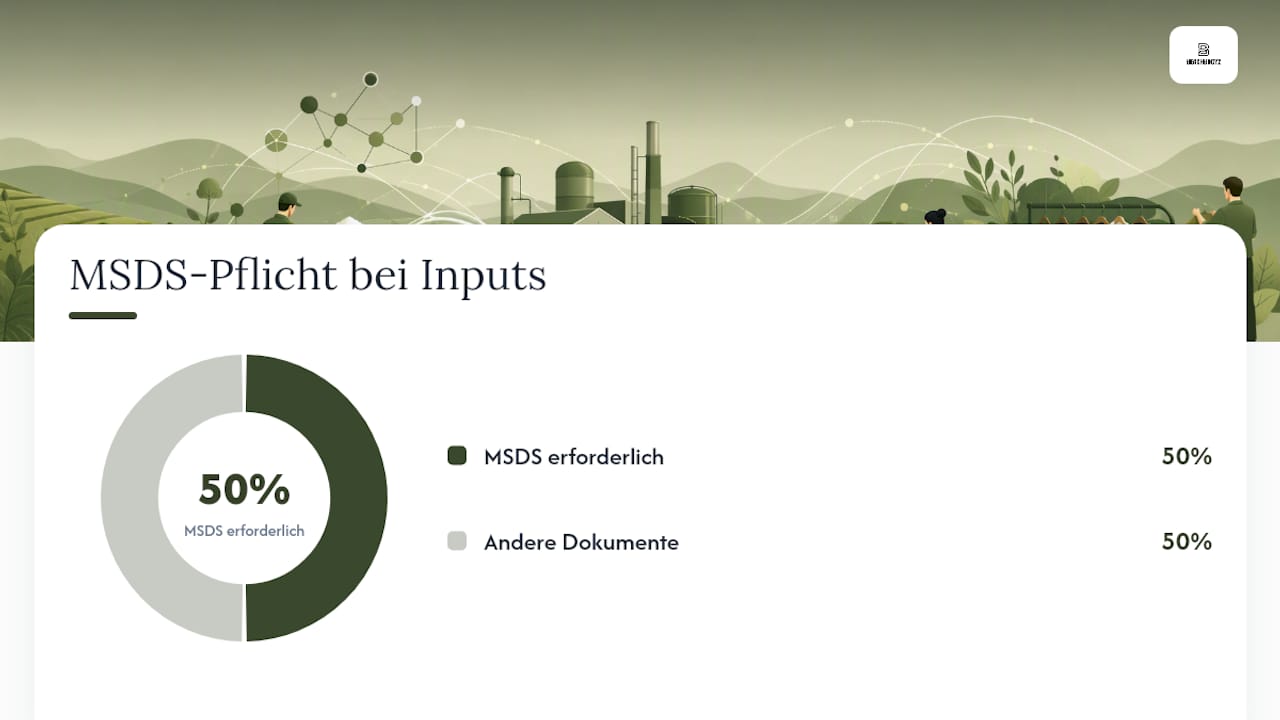
- Submission of a complete Material Safety Data Sheet (MSDS) for each substance used
- If necessary, additional toxicological reports or independent laboratory analyses, which certifiers may request
- Proof of a separate environmental management system at the chemical supplier
- Annual on-site inspections and inventory controls by the certification body
Typical prohibitions concern heavy metals, certain biocides, formaldehyde above defined limit values, and chlorinated plastics in accessories. GOTS Standard PDF Version 6.0 contains the complete technical list of limit values and prohibitions.
| Input Category | Mandatory Document | Control Mechanism |
|---|---|---|
| Dyes and pigments | MSDS, if applicable laboratory analysis | Annual inspection, inventory control |
| Auxiliary agents (softeners, fixing agents) | MSDS | Invoice and delivery note verification |
| Accessories and ingredients | Material declaration, manufacturer's proof | Random sample testing in case of suspicion |
| Packaging materials | Declaration | Document verification |
In case of suspected residues, auditors take samples and send them to accredited laboratories. The GOTS environmental criteria page describes the control principle as an integrated quality system: dangerous substances are excluded at the input stage, not only tested in the final product.
What environmental management obligations apply to processing operations?
Operations that perform wet processing, i.e., dyeing, bleaching, or printing processes, are subject to the strictest environmental requirements of the standard. GOTS requires a written environmental and chemical policy as well as active monitoring of the following parameters:
- Water consumption per production unit with documented readings
- Energy consumption and measures for reduction
- Waste quantities, disposal methods, and recycling rates
- Chemical use with quantity specifications and batch traceability
Wastewater treatment is not optional for wet processing. Operations must either operate their own functional sewage treatment plant or prove that wastewater is treated externally before discharge into surface waters. Records of sludge disposal are also mandatory.
Risk-based monitoring means: operations with high chemical use are inspected more frequently and intensively than those with a lower risk profile. Emission reduction and waste avoidance are not recommendations, but part of the annual audit program.
What do the GOTS social criteria specifically require?
The GOTS social criteria are entirely based on the ILO core standards and apply to all certified processing stages. GOTS 7.0 has significantly tightened the requirements for risk-based due diligence processes in accordance with the UN Guiding Principles on Business and Human Rights.
Specific obligations:
- Freedom of association: Workers have the right to join or form trade unions
- Prohibition of forced labor: No retention of identity documents, no debt bondage
- Prohibition of child labor: Minimum age according to ILO convention; protective measures for young people under 18 years
- Prohibition of discrimination: Equal treatment regardless of gender, origin, or religion
- Wage policy: Compliance with national minimum wages or industry benchmarks; companies must conduct a wage gap analysis and present a plan for closing it
- Working hours: Compliance with legal maximum limits; overtime only voluntary and with surcharge
- Maternity protection and protection of vulnerable groups: Documented measures required
GOTS 7.0 also requires a six-stage due diligence process: risk identification, action planning, implementation, monitoring, communication, and remediation. This process must be integrated into the management system.
Pro Tip: The OECD Guidelines for Multinational Enterprises and the UN Guiding Principles provide concrete templates for risk-based due diligence documentation. Those who adopt this structure meet the GOTS 7.0 requirements and are also well-prepared for the German Supply Chain Due Diligence Act.
Practical tips for fair production in the EU can also be found in the Beachbodyz article on "Made in Europe" fashion.
How does GOTS certification work, and what certificates are there?
Certification is a multi-stage, continuous process. Every supply chain stage must remain certified; if a stage lapses, the final product loses its GOTS conformity.
Step-by-step process:
- Application to an approved certification body
- Submission of all relevant documents: company description, supplier list, chemical list, MSDS
- Initial on-site inspection by an accredited auditor
- Issuance of the Scope Certificate (SC): confirms that an operation is fundamentally GOTS-compliant
- Issuance of Transaction Certificates (TC): confirm specific deliveries between certified operations
- Annual on-site audits and inventory controls; unannounced checks are possible
Important distinction: The SC confirms the certification of an operation. The TC confirms a specific transaction and is the decisive proof for traders and further processors that a specific delivery is GOTS-compliant.
Control methods include:
- Quantity reconciliation (mass balance): Purchased organic fibers must match GOTS goods delivered
- Bookkeeping audits: Invoices, delivery notes, and inventory levels are reconciled
- Random residue tests in case of suspected prohibited substances
- Unannounced checks as an integral part of monitoring; in case of deviations, corrective measures must typically be submitted and verified within short deadlines
The TÜV NORD service description for GOTS certification describes this process as a continuous commitment, not a one-time act.
What information must appear on the GOTS label?
Mandatory information when using the GOTS mark:
- Label level: "organic" or "made with x % organic materials"
- GOTS logo in the prescribed form
- Name of the responsible certification body
- License number of the certified operation
For fibers "in conversion," this note must explicitly appear on the label. Percentages are mandatory for the "made with" level, and not permitted for "organic," as the proportion is by definition ≥ 95%.
Checklist for Consumers:
- Check GOTS logo and license number on the label
- Verify license number on the GOTS website or through the certification body
- Request a Transaction Certificate (TC) from the retailer, which confirms the specific delivery
- Review the manufacturer's Scope Certificate (SC) to confirm the certification level
How Beachbodyz uses GOTS certificates and what documents buyers can request is explained in the article on GOTS-certified clothing.
Pro Tip: A retailer who cannot or will not provide a TC may not have one. The TC is the only proof that a specific delivery is actually GOTS-compliant.
When are residue tests performed, and what happens in case of violations?
GOTS relies on a risk-based testing strategy. Routine residue tests for every product are not foreseen; samples are specifically taken when there is suspicion of the use of prohibited substances or when the risk profile of an operation justifies more intensive monitoring.
Limit values for residues in intermediate and end products are defined in the standard. Trace amounts of unavoidable contamination can be tolerated, provided they do not exceed the specified limit values.
| Test Item | Trigger for Testing | Possible Sanction / Correction Period |
|---|---|---|
| Residues in end products | Suspicion, risk profile, random sample | Certificate withdrawal, corrective actions |
| Chemical use in operation | Annual inspection, inventory control | Correction period, re-audit |
| Wastewater quality | Annual inspection, complaints | Operational shutdown until remedied |
| Documentation gaps | Each inspection | Corrective actions, suspension if necessary |
If prohibited substances are discovered, the following applies:
- Immediate reporting obligation to the certification body
- Documentation of the source and extent of contamination
- Submission of a corrective action plan within the deadline set by the certification body
- Follow-up audit to verify the measures
How does a Central European brand practically implement the GOTS criteria?
A practical example: A sustainably producing streetwear brand in Germany has certified all relevant supply chain stages, from spinning mill to dye house to garment production. The most important operational measures:
- Establishment of a complete input list of all chemicals used with associated MSDS documents
- Installation of external wastewater treatment for the wet processing stage
- Monthly payroll checks to ensure compliance with ILO wage requirements
- Regular supplier audits with documented results
Documents auditors want to see on-site:
- Complete accounting: incoming invoices for organic fibers, delivery notes, inventory lists
- MSDS of all chemicals and auxiliaries used
- Current Transaction Certificates (TC) and Scope Certificates (SC) of all suppliers
- Quantity reconciliation: purchased organic fibers vs. produced and delivered GOTS goods
- Records of water consumption, wastewater treatment, and sludge disposal
- Payroll and timesheets
Common weaknesses in practice are incomplete supplier documentation and missing TCs for individual transactions. Both can be remedied by a central document management system and quarterly supplier evaluations.
Pro-Tip: Before the initial audit, an internal pre-audit based on the official GOTS checklist is recommended. For unannounced inspections: All documents must be readily available at all times, not just for the annual audit.
GOTS as a basis for credible sustainability communication
For a sustainable streetwear brand, GOTS is not an optional quality feature. It is the only standard that comprehensively and verifiably examines and documents environmental and social criteria across the entire supply chain. Brands that communicate sustainability need precisely this verifiability.
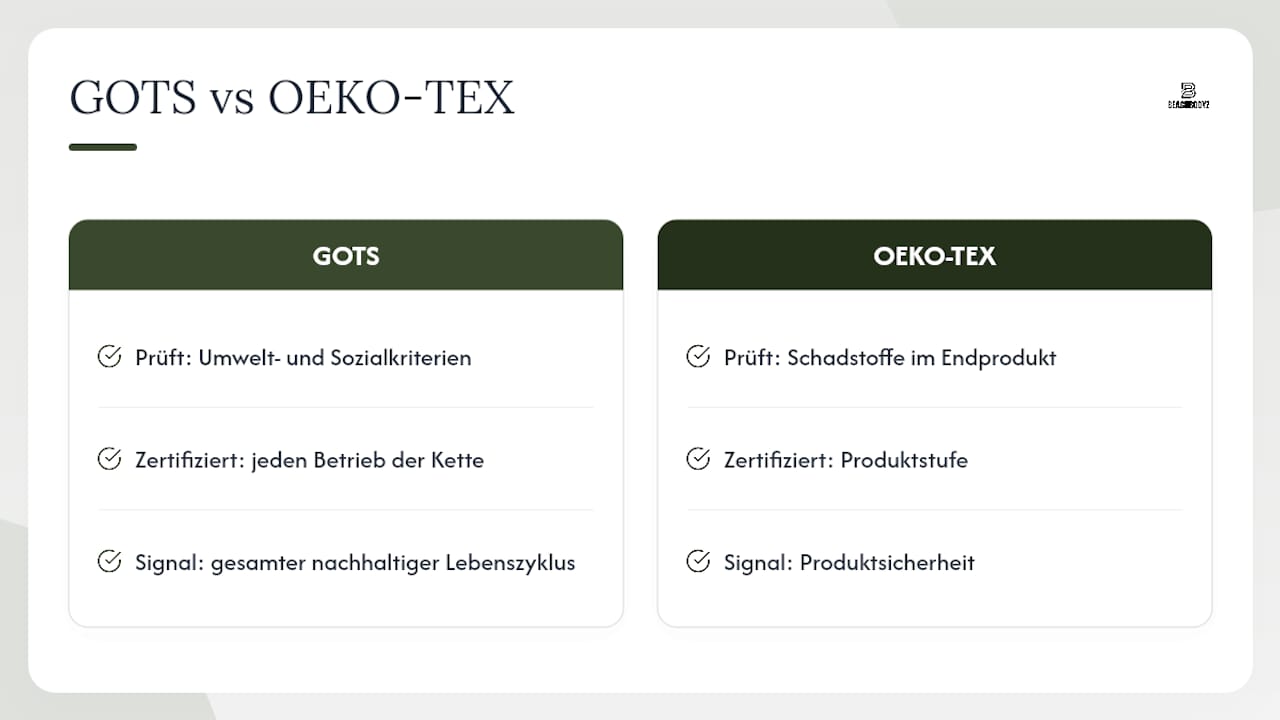
The crucial difference to other textile labels lies in the chain logic. GOTS not only tests the end product for harmful substances but certifies every operation that touches the material. This makes greenwashing structurally more difficult because every claim must be verifiable by a TC. OEKO-TEX signals product safety; GOTS certifies the entire sustainable lifecycle of an organic textile.
For communication with customers: Transaction Certificates may be presented upon request. Those who actively offer this signal transparency. Those who refuse raise legitimate doubts. Beachbodyz relies on precisely this openness and shows how GOTS certificates work in everyday life, for example with the Identity Oversize Hoodie, which is made from GOTS-certified organic cotton.
Pro-Tip: Internal GOTS compliance can be ensured through three routines: quarterly supplier evaluation with certificate verification, annual employee training on documentation requirements, and a well-maintained, readily available audit history. Those who consistently implement these three points are also prepared for unannounced inspections.

Beachbodyz produces sustainable streetwear from GOTS-certified organic cotton and recycled polyester, fairly manufactured in the EU and shipped climate-neutrally. All products are suitable for personalization and available in oversized fits.
Sources
Key reference documents for manufacturers, retailers, and consumers:
- Environmental Criteria - GOTS - Global Organic Textile Standard
- Fair Clothing: What the Seals Mean | Consumer Advice Centre NRW
- TÜV NORD: Service Description GOTS Certification
FAQ
What do the GOTS criteria require from producers?
Producers must use at least 70% certified organic fibers, verify all chemical inputs via MSDS, operate functional wastewater treatment for wet processing, and comply with ILO core standards at every supply chain stage. Annual on-site audits by an approved certification body are mandatory.
What is the GOTS Standard?
GOTS (Global Organic Textile Standard) is an international chain standard that mandatorily regulates ecological and social requirements from fiber cultivation to garment production. The current version is 7.0.
Which is better: GOTS or OEKO-TEX?
The two standards pursue different goals. GOTS is a supply chain standard that tests cultivation, processing, and social criteria; OEKO-TEX primarily tests the end product for harmful substances. They complement each other but are not equally interchangeable.
What does the GOTS certificate promise?
GOTS guarantees that a textile product consists of a defined minimum percentage of certified organic fibers, has been produced under controlled environmental and social conditions throughout the entire supply chain, and that all participating operations can demonstrate valid certificates.
How can a GOTS certificate be verified?
The license number on the label can be verified directly on the GOTS website. Additionally, a Transaction Certificate (TC) can be requested from the retailer, which confirms the specific delivery.