
In short: Certain azo dyes are banned in the EU if they release carcinogenic aromatic amines when broken down. The 30 mg/kg limit in the finished product is crucial. Other azo dyes remain legal, but individual unregulated substances such as 1,4‑phenylenediamine can still cause skin reactions, especially in seasonal goods.
Official controls show a reassuring picture: The statutory limits are almost consistently met. Nevertheless, caution is worthwhile with certain product groups.
- Wash new clothing before wearing it for the first time
- Check labels for instructions such as “wash separately”
- Be particularly vigilant with heavily dyed seasonal goods (fancy dress costumes, cheap wigs)
For a large number of samples examined since 2015, the exceedance rate of banned azo dyes was below one percent, according to studies by CVUA Stuttgart. However, a relevant proportion of the samples tested positive for 1,4‑phenylenediamine, a substance that is not yet on the REACH ban list.
Key Findings
Azo dyes are only banned if they release one of the 22 listed carcinogenic amine compounds at levels exceeding 30 mg/kg when broken down, while other problematic substances such as 1,4‑phenylenediamine remain legally unregulated.
| Topic | Details |
|---|---|
| Legal core point | REACH Annex XVII No. 43 bans certain azo dyes at levels of 30 mg/kg or more in the finished product. |
| Control result | CVUA data show over 99% compliance in around 900 samples tested since 2015. |
| Seasonal goods risk group | 1,4‑phenylenediamine appears repeatedly in fancy dress costumes and wigs. |
| Everyday protection | Washing new clothing and taking “wash separately” labels seriously reduces exposure. |
| Responsible brands | Beachbodyz relies on organic cotton with documented dyeing processes. |
Table of Contents
- What are azo dyes and how do they work in textiles?
- Health risks: Carcinogenicity, sensitization and allergies
- Legal situation explained briefly: REACH, Annex XVII No. 43 and the 30 mg/kg threshold
- Official testing and market surveillance: Findings from CVUA, LAVES and Co.
- Practical consumer tips: Washing, labels and textile certifications
- Seasonal goods and risk groups: Why fancy dress costumes stand out
- How responsible manufacturers minimize risks
- Primary official and specialist sources
- What the numbers really mean
- Sustainable streetwear without compromising on safety
- Sources
- FAQ
What are azo dyes and how do they work in textiles?
Azo dyes owe their name to a chemical group, the so-called azo group (two nitrogen atoms with a double bond). This structure can be produced in almost every shade, manufactured cheaply and fixed stably. This is why azo dyes still dominate the global textile market today. According to the Colour Index, there is a very large number of textile dyes, including numerous azo dyes.
Not all azo dyes are constructed the same way. They are divided into:
- Soluble dyes, which bind chemically to the fiber (common in cotton)
- Disperse dyes, which are incorporated into synthetic fibers such as polyester
- Azo pigments, which are insoluble and are usually used for printing
It becomes relevant when certain azo dyes are reductively cleaved in the body or under environmental influence. This produces aromatic amines, some of which are carcinogenic. Sweat, skin moisture and the skin microbiome can promote this cleavage process, which is why direct skin contact plays a central role in the legal assessment.
Health risks: Carcinogenicity, sensitization and allergies
Under REACH, 22 aromatic amines are listed that can occur as cleavage products in certain azo dyes and are classified as carcinogenic. This list forms the basis for the statutory ban. It is important to distinguish between two types of risk that are often confused.
On the one hand, there are the 22 regulated pAAs (problematic aromatic amines), whose release in textiles is legally prohibited. On the other hand, substances such as 1,4‑phenylenediamine exist, which although they act as skin sensitizers and can cause allergies, are currently not on this REACH list. It is precisely this gap that causes confusion in practice, because a product can be legally compliant and still cause a skin reaction.
Absorption through the skin depends heavily on the molecular size and fat solubility of a dye, as explained in detail in the specialist article on printing on polyester. Disperse dyes are usually small and lipophilic, making them easier to penetrate the skin than reactively bound dyes on cotton. Sweating additionally increases this absorption, and the individual skin microbiome can also influence how a dye is metabolized.

Pro tip: Those prone to contact allergies should be particularly attentive to tight-fitting, dark-dyed synthetic clothing. Disperse dyes in polyester are considered one of the more common causes of textile contact allergies.
Legal situation explained briefly: REACH, Annex XVII No. 43 and the 30 mg/kg threshold
The central legal basis is provided by the REACH Regulation (EC) No. 1907/2006, more precisely Annex XVII Number 43. It states that azo dyes that can release one or more of the 22 listed aromatic amines through reductive cleavage are banned in textile and leather products that come into direct and prolonged contact with the skin.
Crucial here is the practical detection limit in the finished product, which according to LAVES Lower Saxony represents a clearly defined threshold that is easily measurable analytically. Affected products include:
- Clothing items in direct skin contact (T‑shirts, underwear, socks)
- Shoes and leather accessories
- Bed linen, towels and similar home textiles
For importers and retailers, the ban means a clear duty of care. Those who import textiles from non-EU countries must ensure that the azo dyes used meet the limits, regardless of where they were produced. Violations can lead to recalls and sales bans, which market surveillance also regularly enforces in practice.
Official testing and market surveillance: Findings from CVUA, LAVES and Co.
German market surveillance operates through spot checks by the Chemical and Veterinary Inspection Offices (CVUA) as well as state institutions such as LAVES. The results are mostly positive.
- Most tested samples meet the limits for banned azo dyes
- Recurring findings concern 1,4‑phenylenediamine in fancy dress items in particular
- Individual wigs and costume parts showed values significantly above the permissible threshold in some cases
Even though the REACH system aims for a high level of protection, a large part of practical risk avoidance lies in the careful selection of tested dyes by manufacturers as well as in supplier controls.
Authorities therefore recommend regular batch testing to manufacturers, especially for short-lived seasonal goods, where time pressure in production often shortens quality controls.
Practical consumer tips: Washing, labels and textile certifications
A few simple habits significantly reduce the risk, even if they do not offer one hundred percent protection.
- Wash before wearing for the first time. This removes loose dye residues and equipment chemicals from the surface, but does not eliminate chemically firmly bound substances.
- Read labels carefully. According to Gesund, the instruction “wash separately” is a signal that a dye is prone to color transfer and is therefore released more easily.
- Scrutinize certain product groups more critically. Heavily dyed black seasonal items, cheap costume wigs and very cheap imported goods are flagged unusually often in controls.
- Pay attention to certifications and manufacturer information. Certificates such as GOTS or Oeko‑Tex require a documented selection of tested fabrics and create more transparency than uncertified cheap goods.
Pro tip: If you are unsure whether a care label actually reveals anything about dye risks, you will find a practical translation guide for the common symbols in our guide to reading care labels.
Seasonal goods and risk groups: Why fancy dress costumes stand out
Seasonal items such as fancy dress costumes or cheap Halloween wigs are produced under enormous time pressure and with short production cycles. This is exactly what according to market surveillance reports increases the risk of limit exceedances, because quality controls in the supply chain are often shortened.
- Parents should pay particular attention to material information and country-of-origin labeling on children's costumes
- People with known contact allergies should briefly test heavily dyed wigs or costume parts on their skin before wearing them
- Anyone with a reasonable suspicion of a contaminated product can contact the retailer or directly the responsible market surveillance authority of the respective federal state
How responsible manufacturers minimize risks
A large part of risk avoidance does not take place in the control laboratory, but earlier in the supply chain: in the selection of tested dyes, in supplier audits and in random batch testing. Beachbodyz starts exactly at this point and processes organic cotton as well as recycled polyester, with documented origin of the materials used and dyeing processes.
Consumers who want to identify responsible manufacturers can pay attention to the following points:
- Publicly accessible certifications instead of mere self-promotion
- Clear information on origin and country of production
- Transparency regarding material composition, not just the final product
| Criterion | What it shows |
|---|---|
| GOTS certification | Independently tested organic fibers and limits for chemicals |
| Country of production EU | Shorter control routes, more regulatory supervision |
| Material transparency | Traceability of fabric and dyeing process |
Primary official and specialist sources
For those who want to delve deeper: The REACH Regulation clarifies the legal situation, the CVUA report provides testing data, and the UBA explains the chemistry behind it.
What the numbers really mean
The most common misconception is that azo dyes are generally dangerous. This is not true. The data shows rather the opposite: A functioning regulatory system plus effective spot checks keep carcinogenic cases at a very low level. The real problem lies elsewhere, namely in the gap between what is legally prohibited and what can actually cause skin reactions.
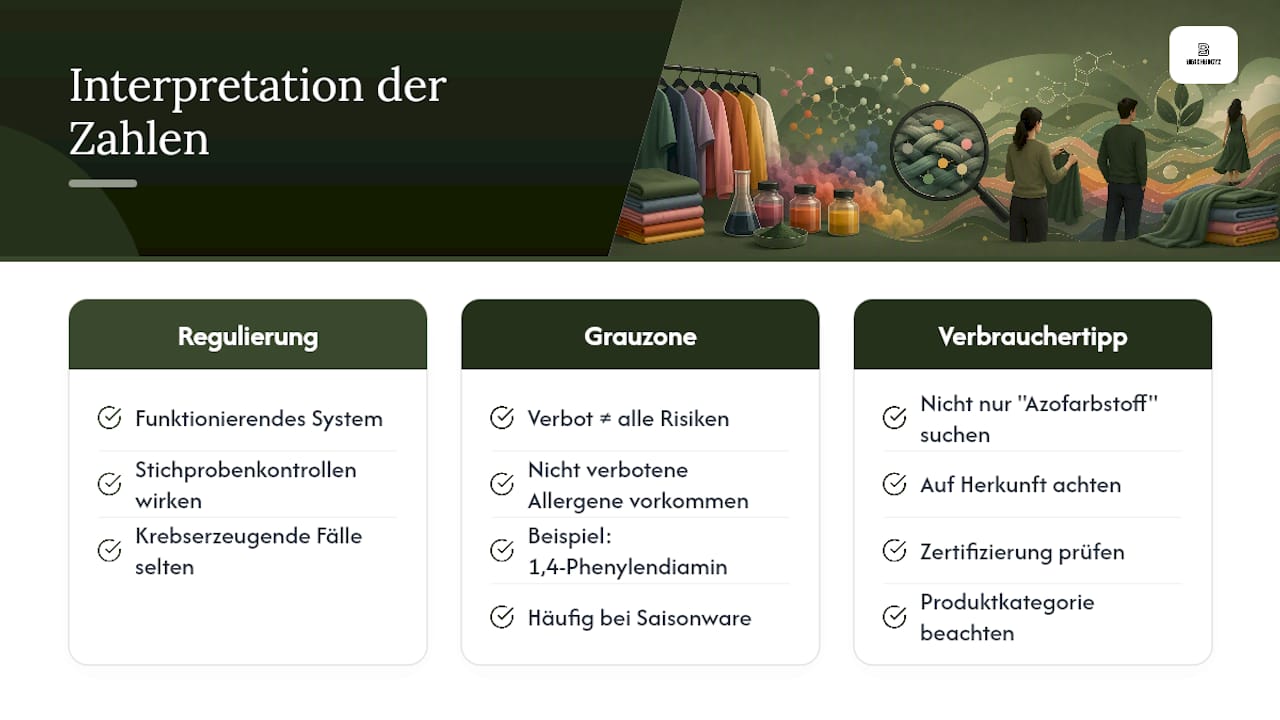
1,4‑phenylenediamine is the best example of this. It is not on the REACH ban list and yet repeatedly appears in control reports, especially in seasonal goods with short production cycles. Anyone who focuses exclusively on “legal versus illegal” overlooks this gray area.
My assessment: Consumers should look less for the word “azo dye” on the label, which is rarely there anyway, and more at origin, certification and product category. A fancy dress accessory from an anonymous supply chain deserves more skepticism than a certified everyday T‑shirt.
— Ahmed
Sustainable streetwear without compromising on safety
Beachbodyz not only avoids risky chemicals but also provides a documented alternative to the anonymous fast-fashion supply chain: organic cotton, recycled polyester and fair production within the EU.

Anyone who looks closer at this article before buying a piece of clothing will find oversized T‑shirts, hoodies and sweatpants at Beachbodyz whose material origin remains traceable instead of disappearing in an intransparent supply chain. The option for individual embroidery additionally makes the collections a durable choice instead of a seasonal purchase. Look at the current online shop and find a piece that combines style and tested materials.
This article contains general information and does not replace advice from a qualified doctor. Contact a qualified medical professional about your personal situation before taking action based on this content.
Sources
FAQ
Can you wash toxins out of clothing?
Washing removes loose residues on the surface and reduces exposure, but does not completely eliminate chemically firmly bound dyes.
Are azo dyes allowed in Germany?
Yes, most azo dyes are allowed. Only those that release one of the 22 carcinogenic aromatic amines listed under REACH at levels exceeding the 30 mg/kg limit when broken down are banned.
Does clothing from major fashion chains contain toxic substances?
Official spot checks generally show high compliance with legal limits for well-known brands, with individual irregularities usually occurring in seasonal items rather than regular collection items.
Which fabrics should you generally avoid in clothing?
Caution is advised with heavily dyed, inexpensive seasonal items such as carnival costumes or cheap wigs, as 1,4-phenylenediamine is detected there more often than average. Certified materials such as organic cotton offer greater transparency here.
Why should you generally avoid certain azo dyes?
Because a small proportion of azo dyes can release carcinogenic amines when broken down, and other currently unregulated substances can cause skin allergies, especially with sensitive skin and frequent skin contact.